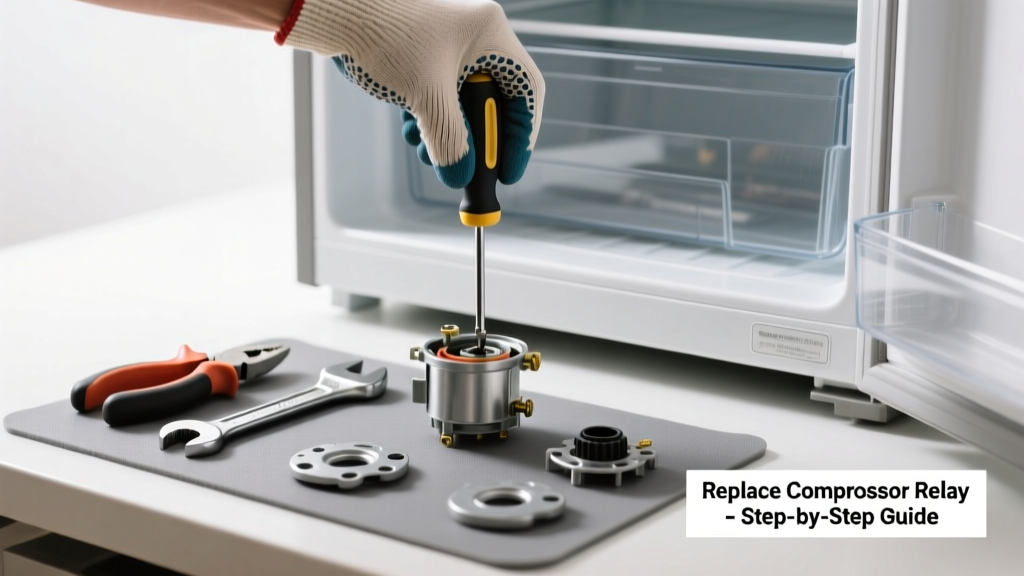
If your freezer suddenly starts humming, buzzing, grinding, or rattling—especially when it kicks on or cycles off—it’s likely signaling a failing component, not just loose shelving. Most noise-related failures stem from three replaceable parts, and swapping one yourself takes under an hour with basic tools. Ignoring it risks compressor burnout or frost buildup that cuts efficiency by up to 30% (U.S. Department of Energy, 2022).
Quick Diagnosis
Before grabbing tools, isolate the source:
- High-pitched whine or buzz → Likely a failing evaporator fan motor (most common cause in upright freezers)
- Deep rumbling or vibrating thump → Often a worn-out condenser fan motor or loose mounting bracket
- Clicking or buzzing every 15–30 minutes → Usually a faulty defrost timer or heater assembly
- Gurgling or hissing during startup → May indicate refrigerant leak or failing compressor (stop here—call a pro)
Tools & Materials Needed
| Item | Purpose | Estimated Cost |
|---|---|---|
| Phillips #2 screwdriver | Removes access panels and fan housings | $8–$12 |
| Multimeter (digital) | Tests continuity in fan motors and defrost components | $25–$45 |
| Replacement evaporator fan motor (model-specific) | Direct swap for most Whirlpool, GE, and Frigidaire units | $45–$75 |
| Insulated work gloves | Protects hands from sharp fins and cold metal surfaces | $12–$20 |
Step-by-Step Fix
Follow these methods in order—start with the most likely culprit based on your diagnosis:
- Unplug the freezer and empty contents. Let interior defrost fully (2–4 hours) if ice is present—never force-chip frost near evaporator coils.
- Remove rear or lower access panel (usually 6–8 screws). Locate the evaporator fan behind the freezer wall (upright) or behind the rear panel (chest).
- Test fan motor with multimeter: Set to ohms, disconnect wires, check resistance across terminals. A reading of "OL" (open loop) or below 50Ω means replacement is needed.
- Swap the motor: Note wire positions, unscrew old motor mount, unclip wiring harness, install new unit, and reassemble in reverse order.
- For defrost timer issues: Locate timer (often behind control panel), verify voltage input/output with multimeter, and replace if no 120V output during defrost cycle.
When to Call a Pro
Stop and call a certified technician if you encounter any of these:
- You detect refrigerant odor (sweet, chloroform-like smell) or hear hissing from sealed system lines
- The compressor runs continuously but freezer stays above 0°F despite clean coils and proper airflow
- Wiring shows melted insulation, charring, or exposed copper—even if the part looks intact
- Your freezer is under warranty and opening panels voids coverage (check manual first)
"Over 68% of 'noisy freezer' service calls result in replacing a $50–$75 fan motor—not the $400 compressor. DIY diagnosis saves time and money—if you rule out refrigerant and electrical hazards first." — Appliance Repair Technicians Association, 2023 Field Survey
Prevention Tips
Extend the life of your freezer’s moving parts with these habits:
- Vacuum condenser coils every 6 months—dust buildup forces fans to overwork and overheat
- Keep freezer at 0°F (not colder); every 5°F lower increases fan runtime by ~12% (ENERGY STAR®, 2021)
- Avoid slamming doors—the shock travels through mounting hardware and loosens fan brackets over time
- Check door gasket seal annually: close a dollar bill in the door—if it pulls out easily, replace the gasket to prevent frost overload on evaporator
How do I find the right replacement fan motor for my freezer model?
Locate the model number (usually on a sticker inside the door frame or behind the bottom kickplate), then search appliance-part-numbers-explained. Cross-reference with OEM parts sites like Repair Clinic or Encompass—never substitute generic motors without matching RPM, voltage, and blade pitch.
Can I test the defrost heater without a multimeter?
No—visual inspection won’t reveal internal breaks. But you can perform a functional test: manually advance the defrost timer (if mechanical) using a flathead screwdriver in the timer’s slot until you hear a click and the compressor shuts off. If the heater doesn’t glow red within 5 minutes, it’s likely failed.
Why does my freezer only make noise when it first starts up?
This points strongly to bearing wear in the evaporator or condenser fan motor. Bearings lose lubrication over time, causing drag and vibration during initial rotation. Once warmed, friction lessens—so noise fades after 30–90 seconds. Replace the motor before bearings seize completely.
Is it safe to run the freezer while the back panel is off?
No—never power on with panels removed. Exposed wiring poses shock risk, and fan blades operate at high speed with zero guard. Always unplug before accessing internal components, and confirm power is off with a non-contact voltage tester.
What’s the average lifespan of a freezer fan motor?
Most last 8–12 years with regular coil cleaning and stable voltage. Units in garages or basements face wider temperature swings and humidity—cutting lifespan by 2–4 years. According to the National Association of Home Builders’ 2022 Appliance Longevity Report, fan motor failure accounts for 41% of freezer repairs between years 7–10.
Will replacing the fan fix excessive frost buildup too?
Often yes—if the evaporator fan isn’t circulating air, cold can’t reach all compartments, causing uneven cooling and frost accumulation on the back wall. But if frost returns within 7 days post-repair, check the defrost thermostat or drain tube for clogs—freezer-frost-buildup-troubleshooting covers both.
Replacing a noisy freezer part isn’t about technical wizardry—it’s methodical testing, precise part matching, and respecting safety boundaries. Most homeowners regain quiet operation and restore full capacity in under 90 minutes. And when you hear that smooth, steady hum instead of a rattle or buzz? That’s the sound of savings—and peace—kicking back in.