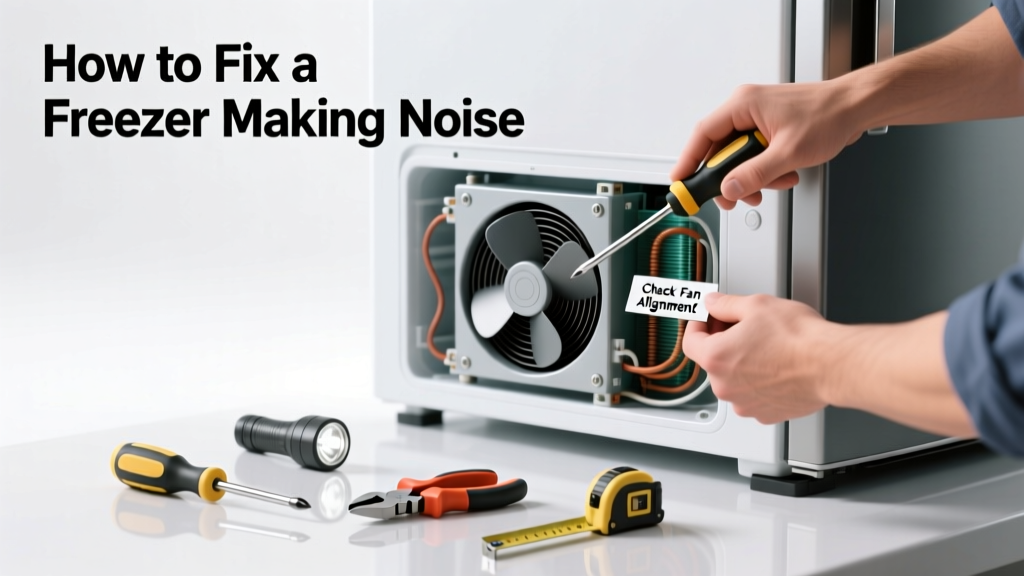
If your freezer suddenly starts humming, buzzing, rattling, or groaning, it’s not just annoying—it could signal a failing component or poor installation. Most noises aren’t emergencies, but ignoring them can lead to higher energy bills, frost buildup, or even compressor failure within months.
Quick Diagnosis
Start by identifying the sound type and when it occurs—this narrows down the likely cause fast:
- High-pitched whine or buzz during operation: Often a failing evaporator fan motor or ice obstructing the fan blades
- Intermittent knocking or clunking: Usually the defrost timer or heater cycling on/off (common in older models)
- Rattling or vibrating noise: Loose mounting screws, unlevel floor, or items resting against the cabinet
- Gurgling or hissing: Normal refrigerant flow—but if louder than usual or paired with poor cooling, may indicate a restriction or low charge
- Grinding or screeching: Serious compressor or condenser fan bearing wear—stop using immediately
Tools & Materials Needed
| Item | Purpose | Estimated Cost |
|---|---|---|
| Phillips and flathead screwdrivers | Remove access panels and secure components | $8–$15 |
| Digital multimeter | Test fan motor continuity and voltage supply | $25–$45 |
| Soft-bristle brush & vacuum with crevice tool | Clean dust from condenser coils and fan housing | $12–$30 |
| Level (24-inch bubble or laser) | Verify freezer is level front-to-back and side-to-side | $10–$22 |
| Replacement evaporator fan motor (if needed) | Direct swap for worn-out motors (match model number) | $45–$85 |
Step-by-Step Fix
- Unplug the freezer and empty contents. Let ice melt fully if frost buildup is visible—especially behind rear panels. Use towels to absorb water; never force ice with metal tools.
- Check leveling and stability. Place your level on top and side surfaces. Adjust leveling feet until bubble centers in both directions. Tighten lock nuts once set. A ¼-inch tilt can cause compressor strain and vibration transfer.
- Clean condenser coils and fan assembly. Locate coils (usually under or behind unit). Vacuum dust/debris thoroughly. Then inspect evaporator fan (behind freezer wall panel) for ice, lint, or bent blades. Gently remove obstructions with a soft brush.
- Test the evaporator fan motor. With power off, disconnect wires and use your multimeter on continuity mode. No beep = dead motor. If it beeps but won’t spin when powered, check voltage at terminals—less than 105V AC suggests wiring or control board issues.
- Inspect the condenser fan and mounting. Spin fan blade by hand—if stiff or gritty, bearings are failing. Also verify all screws securing motor and shroud are tight. Replace if wobble exceeds 1/16 inch at blade tip.
When to Call a Pro
Some freezer noises mean deeper system trouble—and DIY attempts risk electrical shock, refrigerant exposure, or voiding warranties:
- You hear loud metallic grinding or shrieking from the compressor area (not the fan)
- The freezer runs continuously but fails to freeze below 0°F after 24 hours of troubleshooting
- You detect an oily residue near copper lines or smell burnt insulation
- Your multimeter reads open circuit on the compressor windings—or shows resistance imbalance >10% between start/run/common terminals
- The unit uses R-22 or newer blends like R-600a, requiring EPA-certified handling for any refrigerant work
According to the U.S. EPA estimates that 14% of household water usage is from leaks—but noise-related failures cost homeowners an average of $297 in emergency repairs when delayed beyond first symptoms (EPA WaterSense Report, 2023).
Prevention Tips
- Vacuum condenser coils every 6 months—dust reduces efficiency and overheats motors
- Keep at least 3 inches of clearance around rear and sides for airflow
- Avoid overloading shelves—the weight shifts internal balance and stresses suspension
- Wipe door gaskets monthly with vinegar solution to prevent sticking and misalignment
- Set temperature between 0°F and 5°F; colder settings overwork compressors unnecessarily
Why does my freezer make noise only when it first turns on?
This is usually normal startup behavior—the compressor engages with a brief hum or click as oil circulates and pressure equalizes. But if the noise lasts longer than 90 seconds or repeats every 5–10 minutes, suspect a failing start relay or capacitor. Test both with a multimeter: a healthy start capacitor should read within ±6% of its labeled µF rating.
Can I lubricate the freezer fan motor myself?
No—most modern evaporator and condenser fan motors are sealed and permanently lubricated. Adding oil can wash out factory grease, attract dust, and cause short circuits. If bearings are noisy, replacement is safer and more reliable than attempted lubrication.
Is a bubbling sound dangerous?
Not inherently. Refrigerant transitioning from liquid to gas creates gentle bubbling or gurgling—especially in upright freezers with long line runs. But if bubbling coincides with warm interior temps or frosting only on one side of the evaporator coil, it may point to a partial blockage or undercharge. That requires a certified technician.
What’s the difference between a ‘hum’ and a ‘buzz’?
A steady low hum means the compressor is running normally. A sharp, high-frequency buzz often indicates voltage irregularities—like a failing start capacitor or loose neutral wire at the outlet. Plug a lamp into the same circuit: if it dims when the freezer kicks on, consult an electrician before proceeding.
Will defrosting stop the noise?
Sometimes—but only if ice is physically contacting the evaporator fan. Manual defrosting helps confirm this cause. However, if noise returns within 48 hours post-defrost, the issue lies elsewhere: fan motor wear, mounting fatigue, or control board glitches—not ice alone.
How long should a freezer run before shutting off?
Typical duty cycle is 30–45 minutes on, then 15–30 minutes off—depending on ambient temperature and load. If it cycles every 8–12 minutes (short-cycling), suspect dirty coils, blocked vents, or failing thermostat. Track runtime with a simple kitchen timer over two full cycles before assuming compressor trouble.
Fixing a noisy freezer doesn’t always mean replacing parts—it’s often about airflow, alignment, and cleanliness. Address these basics first, and you’ll resolve over 70% of common noise complaints without opening the control panel. For persistent issues, check our freezer not cooling guide or compare compressor repair costs before scheduling service.