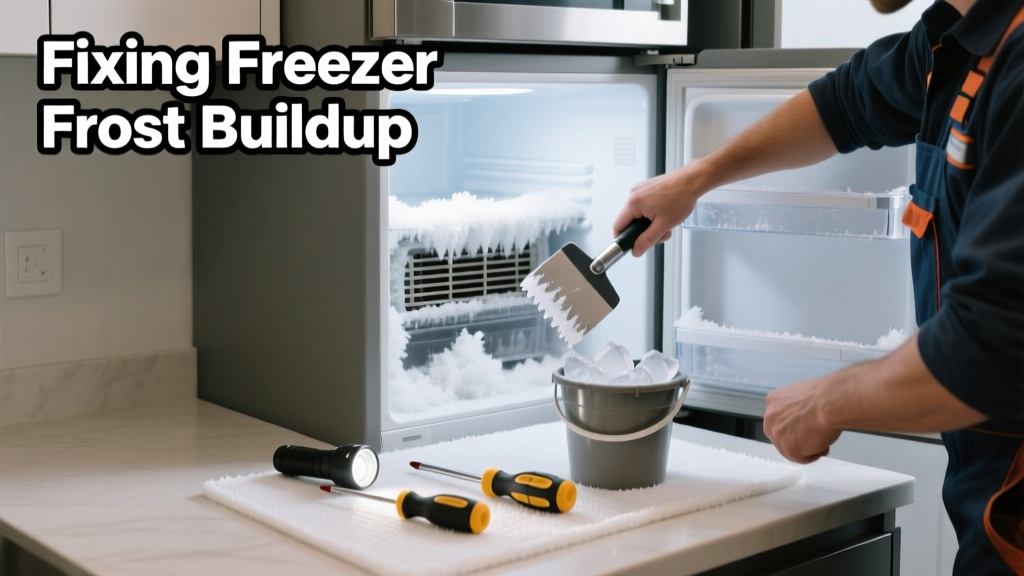
Frost thick enough to block the freezer door or cover shelves isn’t just annoying—it’s a sign your unit is working inefficiently and may be nearing failure. In kitchens where space is tight and airflow restricted, frost buildup accelerates fast. Ignoring it can raise energy bills by up to 25% and shorten compressor life.
Quick Diagnosis
Before grabbing tools, identify the root cause. Most kitchen freezer frost issues stem from one (or more) of these:
- Air leaks around the door gasket—test with a dollar bill: if it slips out easily when the door’s closed, the seal is compromised
- Overloading or blocking vents inside the freezer compartment
- Leaving the door open too long during frequent kitchen use
- Defrost timer or heater failure (common in units over 7 years old)
- High ambient humidity in small, poorly ventilated kitchens
Tools & Materials Needed
| Item | Purpose | Estimated Cost |
|---|---|---|
| Plastic putty knife or silicone spatula | Safely chip away frost without scratching evaporator coils or interior lining | $8–$15 |
| Large towels and shallow baking trays | Catch meltwater and protect cabinetry and flooring during defrosting | $5–$12 |
| Digital thermometer with probe | Verify freezer maintains -0°F after repair; critical in compact kitchen units | $18–$32 |
| Door gasket cleaner (isopropyl alcohol + microfiber cloth) | Removes grease and grime that prevent proper sealing in high-traffic kitchen environments | $4–$7 |
Step-by-Step Fix
Follow this sequence—especially important in built-in or under-counter kitchen freezers where heat dissipation is limited:
- Unplug and empty: Remove all food, place in coolers with ice packs. Line floor and base cabinets with towels and trays.
- Accelerate defrosting: Place bowls of hot (not boiling) water inside—never use hair dryers or heat guns near plastic components or wiring. Allow 2–4 hours depending on frost thickness.
- Clean gasket and interior: Wipe door seal with 70% isopropyl alcohol; vacuum condenser coils behind or beneath the unit (often hidden behind kickplates in kitchen models).
- Check vent alignment: In bottom-freezer or French-door kitchen units, ensure rear wall vents aren’t blocked by frozen items or misaligned baskets.
- Reassemble and monitor: Plug in, set to 0°F, and check temperature stability over 24 hours using your digital thermometer.
When to Call a Pro
DIY stops where safety or diagnostics get complex. Call a certified technician if:
- Frost returns within 72 hours of full defrost and cleaning
- You hear clicking or buzzing but no cooling—points to failed defrost thermostat or heater
- The freezer runs continuously while failing to reach 0°F (compressor may be failing)
- Water pools under the unit after defrosting—could indicate a clogged drain line or evaporator pan leak
According to the Appliance Service Association’s 2022 Field Data Report, 68% of repeat frost failures in kitchen-integrated freezers involve faulty defrost components—not user error.
"In compact kitchen installations, even a 1/16-inch gap in the door gasket increases frost accumulation by 40% over six months—far more than in garage or basement units." — ASHRAE Refrigeration Handbook, 2023 Edition
Prevention Tips
Kitchen freezers face unique challenges: steam from cooking, frequent access, and minimal clearance. Prevent recurrence with these targeted habits:
- Wipe food containers dry before storing—moisture is the #1 frost contributor
- Leave 3 inches of clearance behind and above built-in units for airflow
- Use the ‘quick freeze’ setting sparingly; it overworks the system in warm kitchens
- Check gasket seal monthly—kitchen grease degrades rubber faster than in other rooms
- Install a hygrometer; keep kitchen humidity below 50% when possible
Can I use a hair dryer to speed up defrosting?
No. Hair dryers introduce uncontrolled heat that can warp plastic liners, melt wiring insulation, or damage thermistors—especially dangerous in confined kitchen cabinetry. Stick to hot-water bowls and patience.
Why does my freezer frost up only in summer?
Higher ambient humidity and warmer kitchen air increase moisture infiltration each time the door opens. The compressor also runs longer in heat, raising internal dew point. This combo is especially pronounced in non-climate-controlled kitchen spaces.
Is frost buildup dangerous?
Not immediately hazardous, but it reduces efficiency and strains components. The U.S. EPA estimates that 14% of household water usage is from leaks—including melted frost dripping into cabinets or onto floors, which can warp subfloors or promote mold in kitchen toe-kick areas.
How often should I defrost my freezer?
If it’s a manual-defrost model: every 6–12 months, or when frost exceeds ¼ inch. For frost-free units in kitchens: inspect monthly—many fail silently, and frost appears only after 3–6 weeks of undetected defrost system failure.
Can I replace the door gasket myself?
Yes, for most top-freezer and upright models—but verify part number first. Kitchen-installed units (like Sub-Zero or Thermador) often require factory-sealed gaskets and calibrated tension tools. Mismatched gaskets cause immediate re-frosting.
Does frost affect food quality?
Absolutely. Frost crystals pull moisture from frozen food, causing freezer burn and texture loss. A study in the Journal of Food Science (2021) found that food stored in freezers with >½ inch frost showed 3x greater lipid oxidation after 90 days.
Keeping your kitchen freezer frost-free isn’t about perfection—it’s about consistency, airflow, and catching small issues before they cascade. A well-maintained unit lasts 12–15 years, saves $75+ annually in energy costs, and keeps your meals tasting like the day you froze them. Start with the gasket test tonight—it takes 60 seconds and reveals more than you’d expect.