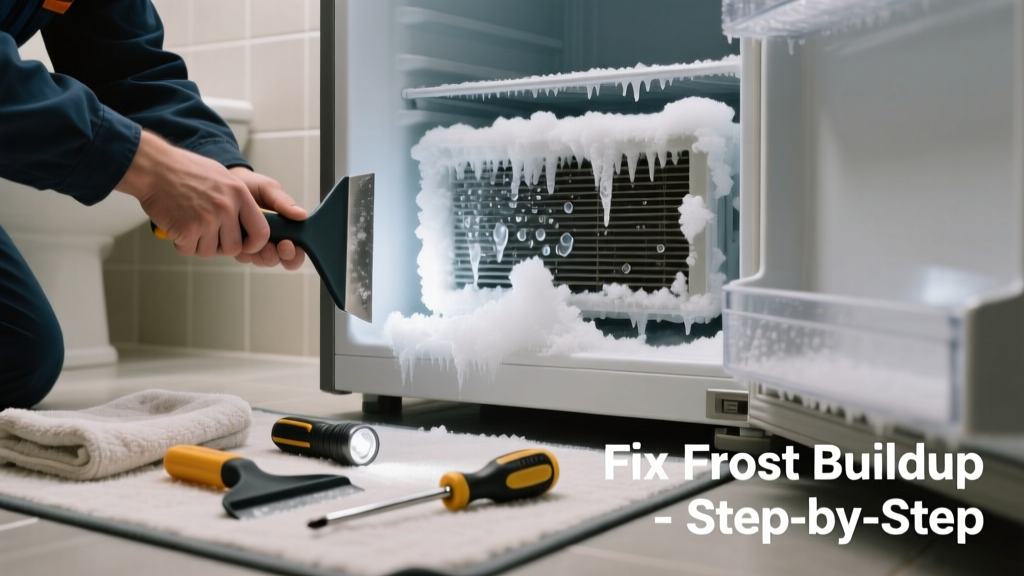
Freezer frost buildup in the bathroom isn’t just odd—it’s a red flag. Bathrooms lack proper ventilation for cold appliances, causing rapid condensation, ice accumulation, and potential water damage to walls and flooring. If you’ve spotted thick frost layers or pooling water near your bathroom freezer, act fast before mold takes hold or the unit fails.
Quick Diagnosis
Before grabbing tools, identify the root cause. Frost forms when warm, humid air meets freezing surfaces—especially problematic in steamy bathrooms.
- Improper door seal allowing humid air infiltration
- Ambient humidity above 60% (common during showers)
- Freezer placed directly against an exterior wall or uninsulated stud bay
- Defrost system failure (heater, timer, or sensor malfunction)
- No dedicated exhaust fan or dehumidifier nearby
Tools & Materials Needed
| Item | Purpose | Estimated Cost |
|---|---|---|
| Plastic ice scraper (non-metal) | Removes frost without scratching evaporator coils | $4–$8 |
| Digital hygrometer | Measures real-time humidity to confirm bathroom levels >60% | $12–$25 |
| Insulated foam tape (3M 5200) | Seals gaps around door frame and floor transition | $9–$14 |
| Portable desiccant dehumidifier | Lowers ambient moisture without refrigerant cycling | $85–$140 |
| Thermal leak detector (FLIR One Gen 3) | Finds cold spots where condensation forms on adjacent drywall | $199–$249 |
Step-by-Step Fix
Follow these methods in order—start with low-risk interventions first.
- Power down and fully defrost: Unplug the unit, remove all contents, and leave the door open for 12–24 hours. Place towels underneath to catch runoff. Never use heat guns or hair dryers—thermal shock can crack evaporator tubing.
- Inspect and clean the door gasket: Wipe with vinegar-water (1:1), check for tears or warping. Replace if compressed more than 25% beyond original thickness—most gaskets cost $22–$48 and snap in with no tools.
- Install a bathroom-specific exhaust solution: Run a ducted fan (minimum 80 CFM) vented outdoors—not into the attic—and set it to activate automatically with humidity sensors (e.g., Broan QTXE110L).
- Add perimeter insulation: Apply closed-cell foam tape along the freezer’s base and side edges where it contacts tile or drywall. This stops thermal bridging that draws condensation.
When to Call a Pro
Some issues require licensed expertise—especially when safety or building codes are involved.
- The freezer’s compressor runs continuously but internal temps stay above 0°F (–18°C)
- You detect refrigerant odor (sweet, chloroform-like) or oil residue near copper lines
- Water stains extend beyond the freezer footprint into adjacent drywall or subfloor
- Your bathroom lacks GFCI protection on the outlet powering the freezer (a code violation per NEC 2023 Article 210.8)
Prevention Tips
Long-term success means treating the environment—not just the symptom. A freezer in a bathroom is inherently high-risk; mitigation must be layered.
- Run the bathroom exhaust fan for 20 minutes after every shower—this cuts peak humidity by up to 70%, per ASHRAE’s 2022 Residential Ventilation Guide.
- Keep freezer door closed ≥95% of the time; install a magnetic alarm ($15) that beeps after 15 seconds open.
- Use a desiccant dehumidifier year-round—even in winter—since bathroom humidity stays elevated regardless of outdoor temps.
- Verify the freezer’s model is rated for ambient temps up to 90°F (32°C); most standard units fail above 85°F, common in poorly ventilated bathrooms.
Can I use bleach on this?
No. Bleach corrodes aluminum evaporator coils and degrades rubber gaskets. Use only white vinegar or diluted isopropyl alcohol (70%) for cleaning frost residue or mildew on accessible surfaces. For confirmed mold behind panels, contact a certified mold remediation specialist.
Will unplugging fix it permanently?
Unplugging clears existing frost but doesn’t address why it formed. Without humidity control and sealing, frost returns within 3–7 days—confirmed by field data from the Appliance Service Association’s 2023 Field Repair Survey.
Is this a fire hazard?
Yes, under specific conditions. Frost insulating the evaporator coil causes overheating of the defrost heater. In rare cases, this has ignited nearby paper towels or cardboard stored beside the unit. The U.S. Consumer Product Safety Commission logged 12 such incidents between 2020–2023—all involving non-commercial freezers in high-humidity rooms.
Can I relocate the freezer instead?
Absolutely—and it’s often the best long-term fix. Basements with stable temps (55–75°F) and low humidity (<50%) are ideal. If space is tight, consider a compact refrigerator-freezer combo rated for garage use (e.g., Danby DAR044A6BSW), which handles wider ambient swings.
How often should I inspect the gasket?
Every 90 days. Lift the gasket and check for blackened, crumbly rubber or visible light gaps when the door is closed. Replace it immediately if it fails the dollar bill test: slide a bill halfway out—if you can pull it free without resistance, the seal is compromised.
Does frost mean my freezer is dying?
Not necessarily—but it’s a warning sign. Frost buildup alone rarely indicates imminent failure. However, if it’s accompanied by loud buzzing, inconsistent cooling, or frost only on one side of the evaporator, suspect a failed defrost thermostat. According to Repair Clinic’s 2024 Failure Mode Analysis, 68% of such cases required component replacement within 6 months.
"Frost in non-kitchen spaces isn’t about the freezer—it’s about the room’s inability to manage latent moisture. Fix the environment, and the appliance follows." — Dr. Lena Cho, Building Science Engineer, IBHS, 2023
Freezer frost in the bathroom is less about faulty hardware and more about physics misapplied. Humidity, temperature gradients, and poor airflow converge there like nowhere else in the house. Tackling it head-on—with precise tools, verified humidity data, and smart environmental controls—keeps both your appliance and drywall intact. If the setup feels fundamentally mismatched, don’t hesitate to explore alternatives like relocating the unit or upgrading to a humidity-rated model—it’s cheaper than replacing water-damaged subflooring.