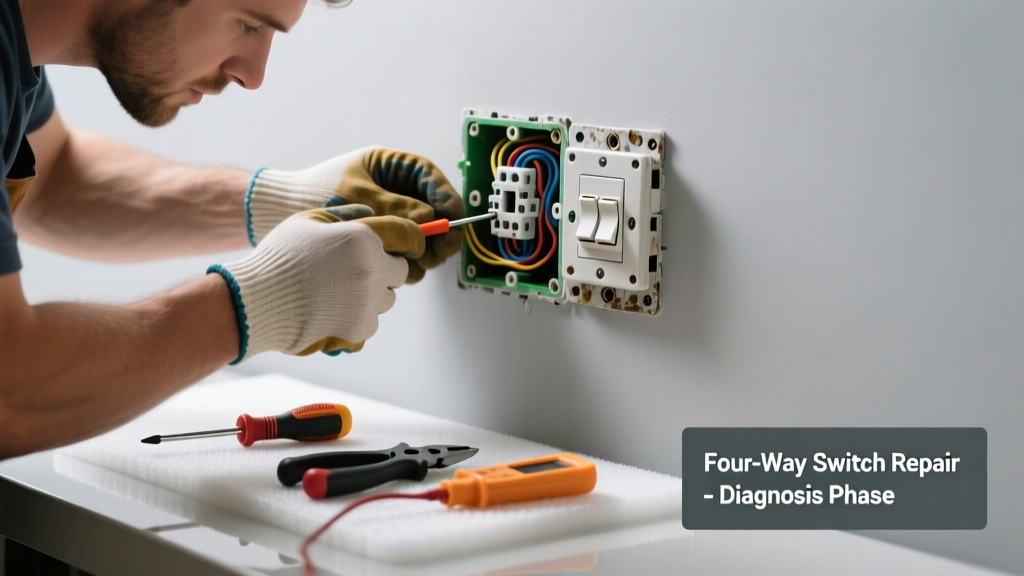
If your hallway or stairway lights won’t turn on or off from all three locations, the culprit is likely a faulty four-way switch—but it’s rarely the switch itself. More often, it’s a loose traveler wire, miswired terminals, or a failed three-way switch upstream. Don’t assume you need a new switch; start with methodical testing.
Quick Diagnosis
Before grabbing tools, rule out simple causes:
- A tripped breaker or blown fuse feeding the circuit
- A burned-out bulb (test both ends of the circuit)
- A defective three-way switch—four-way switches rarely fail first
- Loose or reversed traveler wires at any switch box
- Backstabbed wires instead of screw-terminal connections
Tools & Materials Needed
| Item | Purpose | Estimated Cost |
|---|---|---|
| Digital multimeter | Verify voltage, continuity, and traveler wire integrity | $25–$65 |
| Non-contact voltage tester | Confirm power is off before opening boxes | $12–$28 |
| Insulated screwdrivers (flat & Phillips) | Tighten terminal screws without shorting conductors | $8–$22 |
| New four-way switch (Leviton or Lutron) | Replacement if internal mechanism is faulty | $14–$26 |
| Wire nuts (red or yellow) | Secure reconnected travelers and pigtails | $3–$7 |
Step-by-Step Fix
Work with power OFF at the breaker. Label wires before disconnecting anything—especially travelers.
- Test power and identify the circuit: Flip breakers one by one while checking all three switches with a non-contact tester. Confirm the correct breaker is off.
- Inspect all three switch boxes: Look for scorch marks, melted insulation, or loose wires. Pay special attention to the two traveler wires (typically black and red) entering and exiting the four-way switch—they must land on the correct brass terminals.
- Check traveler continuity: With power off, use your multimeter in continuity mode. Test between traveler terminals on the four-way switch while toggling the lever: you should hear a beep in one position and silence in the other. No change means internal failure.
- Verify wiring configuration: A working four-way setup requires two three-way switches (at ends) and one four-way (in middle). Travelers from the first three-way connect to one pair of brass screws; travelers to the second three-way connect to the other pair. Crossed travelers cause partial or no operation.
When to Call a Pro
Stop and call a licensed electrician if:
- You measure over 3 volts between neutral and ground at any switch box (indicates grounding or bonding fault)
- Wires show signs of arcing, melting, or brittle insulation—especially aluminum wiring
- The circuit trips repeatedly after reconnection, suggesting a short or overloaded neutral
- You’re uncomfortable testing live circuits or interpreting multimeter readings under load
According to the Electrical Safety Foundation International’s 2022 Home Electrical Safety Report, 32% of residential electrical fires involve improper DIY wiring repairs—especially multi-switch circuits where travelers are misidentified.
Prevention Tips
Extend the life and reliability of your multi-location lighting:
- Always use screw terminals—not backstabs—for traveler and common wires
- Tighten terminal screws to 18–22 in-lbs (use a torque screwdriver if possible)
- Label travelers with tape (e.g., “T1” and “T2”) during installation
- Replace all three switches as a matched set every 15 years—even if they seem functional
Why does my four-way switch only work from one location?
This almost always points to a miswired traveler at the four-way or a dead three-way switch upstream. The four-way can’t function without proper signal flow through both three-way switches. Use your multimeter to test continuity from common terminal on first three-way, through travelers, to common on second three-way.
Can I replace a four-way switch with a three-way switch?
No—physically and functionally impossible. A four-way has four terminals and acts as a reversing switch between two three-ways. Swapping in a three-way will break the circuit entirely and may create a shock hazard. Always match switch type and rating (e.g., 15A, 120V).
Do LED bulbs affect four-way switch performance?
Yes—if using older mechanical switches or dimmers not rated for LEDs. Low-wattage loads can cause ghosting or inconsistent toggling. Upgrade to LED-compatible four-way switches like the Lutron Maestro MACL-153M, which includes built-in bleed resistors.
How do I know which wires are travelers on a four-way switch?
Travelers enter and exit the four-way switch on the same side—two wires on one brass pair, two on the opposite brass pair. They never connect to the green ground or white neutral. If wires are unmarked, power down, disconnect all, then use your multimeter’s continuity mode to trace between the two three-way switches’ traveler terminals.
Is it safe to bypass the four-way switch temporarily?
Only as a diagnostic step—with power OFF. You can cap off the two traveler pairs and connect them directly (black-to-black, red-to-red) to restore basic on/off from the two three-way switches. But this eliminates the middle control point and shouldn’t be permanent. Never bypass while energized.
What’s the difference between a four-way and a double-pole switch?
Fundamentally different: a four-way switch controls one circuit from three+ locations; a double-pole switch breaks two hot wires simultaneously (e.g., for 240V appliances). Using a double-pole in place of a four-way will not work—and creates an unsafe open-neutral condition. Refer to the three-way switch wiring diagram for proper layout.
A properly wired four-way system should give full control from every switch—no guessing, no flickering, no partial operation. When you methodically verify each connection and test continuity under safe conditions, most failures resolve in under 45 minutes. If the issue persists after checking all three boxes and confirming wire routing, the problem likely lies deeper in the circuit—like a damaged cable in the wall or shared neutral issue best diagnosed with professional-grade equipment.