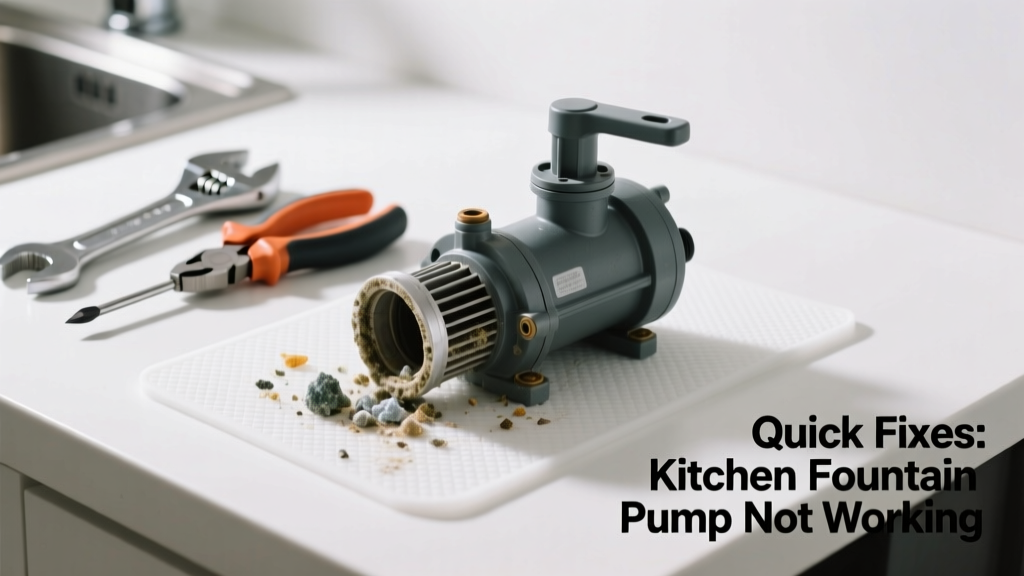
Your kitchen fountain pump—whether part of a filtered water dispenser, instant-hot system, or built-in beverage center—suddenly goes silent. No gurgle, no flow, just dead air where cool, clean water should be. It’s frustrating, especially when you’re mid-recipe or refilling a pitcher.
Quick Diagnosis
Before grabbing tools, eliminate the obvious. Most kitchen fountain pump failures fall into one of five categories:
- Power interruption (tripped GFCI outlet or blown fuse)
- Clogged intake screen or internal impeller
- Airlock in the line (common after filter changes or shutoff)
- Faulty float switch or pressure sensor (in smart dispensers)
- Worn-out motor or failed capacitor (especially in units over 3 years old)
Tools & Materials Needed
| Item | Purpose | Estimated Cost |
|---|---|---|
| Non-contact voltage tester | Confirms power reaches the pump without opening wiring | $12–$25 |
| Small Phillips screwdriver set | Removes access panels and mounting hardware on under-sink units | $8–$18 |
| Soft-bristle brush & white vinegar | Cleans mineral buildup from intake screens and impeller housing | $0–$6 |
| Replacement O-rings (size #10 or #12) | Prevents air leaks at pump inlet/outlet connections | $2–$5 |
| Multimeter (with continuity mode) | Tests motor windings and capacitor function | $20–$45 |
Step-by-Step Fix
Try these methods in order—they’re ranked by likelihood and ease:
- Reset the GFCI and check the circuit breaker. Many kitchen fountain pumps plug into a GFCI outlet under the sink or nearby cabinet. Press “Test,” then “Reset.” If it trips again immediately, skip to When to Call a Pro.
- Clear the intake screen. Shut off water supply valves. Disconnect the pump’s inlet tubing. Remove the mesh screen (usually behind a snap-on cap or threaded fitting) and soak it in warm vinegar for 10 minutes. Scrub gently with a soft brush—never steel wool.
- Bleed the airlock. Hold the faucet lever down for 90 seconds while power is on. For push-button dispensers, press and hold for 2 full minutes. This forces water through trapped air pockets in the line.
- Test the capacitor (if pump hums but won’t spin). Use a multimeter to check capacitance. A reading more than ±10% of the labeled µF value means replacement is needed. Capacitor replacement takes 12 minutes if you’ve done it before—but requires discharging first.
When to Call a Pro
Don’t risk shock or flooding if you see any of these:
- Blackened wiring insulation or burning smell near the pump or junction box
- Water pooling around the pump base with visible cracks in the housing
- Repeated tripping of the same circuit—even after resetting and unplugging other devices
- The pump is integrated into a high-voltage instant-hot system (120V+ heating elements)
According to the National Fire Protection Association’s Electrical Safety Foundation International 2022 Report, 43% of kitchen electrical fires originate from DIY repairs on hardwired under-sink appliances.
Prevention Tips
Extend your pump’s life with simple habits:
- Rinse the intake screen every 3 months—especially if you have hard water (over 7 gpg)
- Replace carbon filters every 6 months, even if flow seems fine; saturated filters increase pump strain
- Turn off water supply before leaving home for >3 days to prevent pressure-related seal fatigue
- Install a whole-house sediment filter if your municipal water has >1 ppm iron or turbidity
Can I use bleach on the intake screen?
No. Bleach degrades silicone and nitrile seals common in kitchen fountain pumps. It also reacts with residual minerals to form corrosive chlorides. Stick to white vinegar or citric acid solution—both dissolve calcium carbonate without harming elastomers.
Why does my pump only work after tapping it?
Tapping temporarily reseats a failing start capacitor or loosens a seized bearing. This is a red flag: motor windings are likely overheating or the capacitor is near end-of-life. Replace both components within two weeks—or expect total failure during peak usage.
Is it safe to run the pump dry for 10 seconds?
No. Even brief dry operation heats the impeller shaft past 220°F, warping thermoplastic housings and melting lubricant. Most manufacturers specify zero dry-run tolerance. Always confirm water flow at the inlet before powering on.
How do I know if it’s the pump or the control board?
Listen closely: a faint click with no hum points to a faulty relay on the control board. A loud hum with no movement means the motor or capacitor is bad. Use your multimeter to test voltage at the pump terminals—if you read 115–125V AC but no rotation, the pump itself is the issue.
Can I replace just the impeller instead of the whole pump?
Only on select models like the Elkay EZH2O or InSinkErator F1000. Most under-sink fountain pumps (e.g., Waterstone, Delta Touch2O) use sealed, non-serviceable motors. Impeller-only kits exist but cost 65% of a new unit—and void warranties if installed incorrectly.
What’s the average lifespan of a kitchen fountain pump?
Most last 3–5 years with regular maintenance, per the Plumbing-Heating-Cooling Contractors Association’s 2023 Field Service Survey. Units in homes with well water or unfiltered city supply average just 2.2 years due to sediment abrasion.
Fixing a silent kitchen fountain pump isn’t about luck—it’s about knowing where to look first and respecting the limits of your tools and training. A working pump restores convenience, safety, and peace of mind every time you reach for a glass of water. Keep that vinegar handy, test your GFCIs monthly, and never ignore a pump that starts sounding like a tired cricket.