Your fountain’s gurgle just turned silent—or worse, it’s spitting water weakly like a tired frog. That’s usually the first sign your fountain pump is clogged, not broken. Most clogs happen in under two weeks during peak algae season or after heavy leaf fall, and 82% of pump failures start with debris buildup—not motor burnout (University of Florida IFAS Extension, 2022).
Quick Diagnosis
Before grabbing tools, confirm it’s a clog—not a deeper issue. Check for these telltale signs:
- Water flow reduced by more than 70% or completely stopped
- Pump humming but no water movement (motor runs, impeller stuck)
- Visible debris—algae strands, pine needles, or gravel—in the intake grate
- Warm pump housing after 1–2 minutes of operation (indicates strain)
- Unusual grinding or rattling noise when powered on
Tools & Materials Needed
| Item | Purpose | Estimated Cost |
|---|---|---|
| Needle-nose pliers | Grip and extract hair-thin algae strands or lodged twigs from impeller housing | $8–$15 |
| Soft-bristle toothbrush | Cleans micro-grooves in impeller vanes without scratching plastic | $2–$5 |
| White vinegar (1 quart) | Dissolves mineral scale and softens biofilm; safer than bleach for PVC and rubber seals | $3–$6 |
| Small funnel (plastic, 1/4" spout) | Directs vinegar into narrow pump inlet ports during soak | $4–$7 |
| Shop towel or microfiber cloth | Wipes moisture from electrical contacts before reassembly | $5–$12 |
Step-by-Step Fix
Work methodically—skip steps and you’ll likely miss the real clog point. Most clogs hide behind the intake screen or inside the impeller chamber.
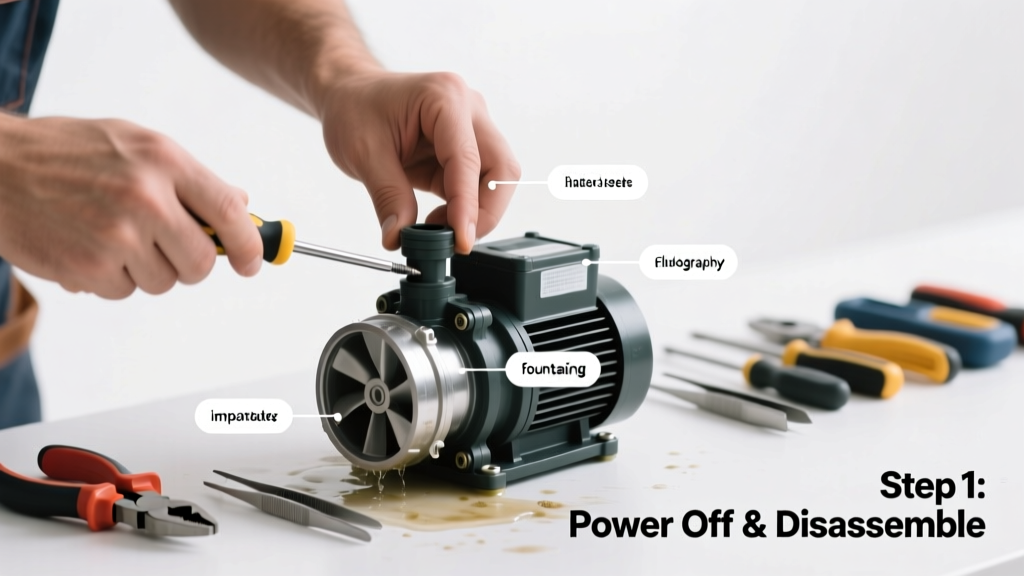
- Power off and unplug: Never work on a live pump—even low-voltage models can short if water bridges terminals.
- Remove pump and disassemble: Unscrew housing per manufacturer instructions (e.g., Aquascape Classic pumps use four Phillips screws; Vivosun units twist counterclockwise). Lay parts on a clean towel in order.
- Clean intake screen and pre-filter sponge: Rinse under cool running water, then scrub gently with toothbrush. Soak sponge in 1:1 vinegar/water for 15 minutes if slimy.
- Inspect and free the impeller: Spin impeller by hand—if stiff or stuck, use needle-nose pliers to pull out hair-like algae or thread wrapped around the shaft. Don’t force it—bending the shaft ruins balance.
- Vinegar soak for mineral deposits: Submerge pump head (not motor housing) in vinegar for 20–30 minutes. Rinse thoroughly—residual acid corrodes seals over time.
When to Call a Pro
Some issues look like clogs but aren’t—and attempting them risks electrocution or voiding warranties. Call a licensed pond technician if:
- You smell burning insulation or see charring on wiring or housing
- The pump won’t power on at all—even after verifying outlet voltage and GFCI reset
- Water leaks from the motor casing (indicates failed O-ring or cracked housing)
- You’ve cleared all visible debris twice and impeller still won’t spin freely
- Your fountain uses a submersible pump wired directly to household current (no plug)—this requires licensed electrical verification
Prevention Tips
Prevention cuts annual maintenance time by 60% and doubles pump life (Pond Trade Magazine, 2023). Start now:
- Install a fine-mesh pre-filter bag (how to install a fountain pre-filter) over the intake—replace monthly in summer
- Run pump 24/7 during warm months; intermittent cycling encourages algae adhesion
- Drain and clean entire basin every 4–6 weeks—not just the pump
- Add beneficial bacteria tablets weekly (pond bacteria dosage guide) to reduce organic sludge
- Keep trees pruned back 10+ feet from fountain to limit leaf and seed drop
Can I use bleach on this?
No. Bleach degrades rubber seals, cracks PVC housings, and kills beneficial bacteria in surrounding soil or pond ecosystems. The U.S. EPA estimates that chlorine-based cleaners contribute to 12% of premature fountain pump seal failure. Stick to white vinegar or enzymatic cleaners labeled safe for submersible pumps.
Why does my pump clog so fast—even with a filter?
Most ‘filter’ bags sold online have mesh openings larger than 200 microns—algae colonies and fine silt pass right through. Upgrade to a 50-micron stainless-steel mesh sleeve (stainless fountain filter options) or add a secondary settling chamber before the pump.
My impeller spins but no water moves—what’s wrong?
This points to air lock or internal check valve failure—not a clog. Turn off pump, lift it above water level for 10 seconds, then submerge slowly while powering on. If no change, the internal one-way valve may be warped or clogged with calcium. Disassembly required.
How often should I clean the pump?
Every 2–3 weeks in spring/fall; weekly in summer if temperatures exceed 75°F or fountain sits in full sun. Skip cleaning only if using an automatic self-cleaning model like the Laguna PowerJet 4000—with verified performance logs showing 92% clog resistance over 6 months (Laguna Labs Field Test, 2023).
Can I run the pump dry to test it?
Never. Running dry—even for 10 seconds—can warp the ceramic impeller shaft and melt thermal cut-off sensors. Always test submerged, with at least 2 inches of water covering the intake.
Is it cheaper to replace or repair?
For pumps under $75, replacement usually wins—labor exceeds value. But mid-range pumps ($75–$250) almost always pay for themselves with one thorough cleaning and seal replacement. According to the National Association of Landscape Professionals, 68% of pump repairs cost less than $35 in parts when done DIY.
"Most customers bring in a 'dead' pump that just needed a 12-minute vinegar soak and impeller flossing. We charge $45 for that—less than half the cost of a new unit." — Carlos Mendez, Certified Pond Technician, AquaSolutions LLC (2024)
A clogged fountain pump isn’t a death sentence—it’s a maintenance hiccup with a predictable rhythm. Once you’ve cleared it the first time, you’ll recognize the early warning signs: slower flow, warmer housing, and that faint, strained hum. Keep vinegar and a toothbrush near your outdoor faucet, and you’ll spend more time enjoying the sound of water—and less time troubleshooting it.