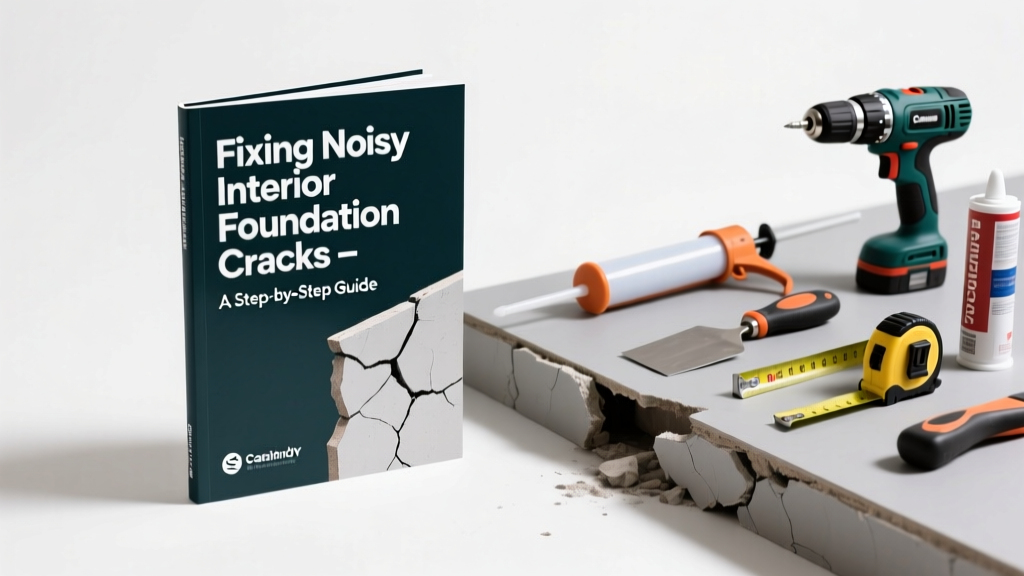
If your basement wall or concrete floor crack suddenly starts groaning, popping, or vibrating when temperature shifts or after heavy rain, don’t dismiss it as ‘just settling.’ These noises often signal active movement—not just cosmetic damage—and ignoring them can lead to moisture intrusion, mold, or worsening structural stress.
Quick Diagnosis
Unusual noises from interior foundation cracks usually stem from one or more of these causes:
- Thermal expansion/contraction of concrete or adjacent framing during seasonal temperature swings
- Hydrostatic pressure pushing against the foundation wall, causing micro-shifts in the crack interface
- Settling or differential movement between the foundation and interior finishes (e.g., drywall pulling away, floor joists shifting)
- Crack widening due to ongoing soil saturation or poor drainage—especially after prolonged rain or snowmelt
- Metal reinforcement bars (rebar) rubbing or corroding inside the concrete matrix
Tools & Materials Needed
| Item | Purpose | Estimated Cost |
|---|---|---|
| Angle grinder with diamond blade | Cuts clean V-groove along crack for proper sealant adhesion | $85–$140 |
| Epoxy injection kit (low-viscosity, ASTM C881 Type II) | Fills crack deeply and bonds concrete internally; stops water and movement | $65–$120 |
| Backer rod (closed-cell polyethylene, 3/8" or 1/2") | Provides depth control and backing for flexible sealant; prevents 3-sided adhesion failure | $12–$25 |
| High-performance polyurethane sealant (ASTM C920 Class 25) | Accommodates up to 25% joint movement without cracking—critical for active cracks | $22–$48 per tube |
| Laser level & crack width gauge | Measures movement over time; detects widening >0.02"—a red flag for structural concern | $45–$95 |
Step-by-Step Fix
Follow this sequence only if the crack is non-structural, less than 1/8" wide, stable for 90+ days, and shows no signs of stair-step pattern or horizontal displacement:
- Clean and prep: Use a wire brush and shop vacuum to remove dust, efflorescence, and loose debris. Wipe with isopropyl alcohol—never water—to ensure dry, contaminant-free surfaces.
- V-groove the crack: With an angle grinder, cut a uniform 60° V-groove at least 1/4" deep and wide enough to accept backer rod. This creates mechanical keying for sealant.
- Install backer rod: Press closed-cell backer rod into the groove until flush with the surface—do not compress more than 25%. It should sit 1/8" below finished surface.
- Apply sealant: Load polyurethane sealant into a caulk gun and tool into the groove using a rounded margin trowel. Smooth gently—don’t overwork—to avoid air pockets.
- Monitor for 30 days: Mark crack ends with permanent marker and measure weekly with calipers. If width increases >0.01" in any week, stop and consult a structural engineer.
When to Call a Pro
Stop DIY immediately and contact a licensed structural engineer or foundation specialist if you observe any of these:
- Horizontal cracks wider than 1/4" anywhere on a basement wall (often indicates lateral soil pressure)
- Stair-step cracking in concrete block or brick walls
- Crack widening more than 0.02" in a single month (per U.S. Army Corps of Engineers’ 2022 Foundation Monitoring Guidelines)
- Doors or windows binding, floors sloping noticeably, or new gaps appearing around trim
- Noise coinciding with visible moisture, white chalky efflorescence, or musty odors
"Over 68% of foundation-related insurance claims involve cracks that were initially dismissed as 'just noise' by homeowners." — Insurance Institute for Business & Home Safety, 2023 Residential Structural Risk Report
Prevention Tips
Long-term stability depends on controlling the forces acting on your foundation:
- Redirect roof runoff at least 5 feet from the foundation using extended downspout extensions and splash blocks
- Maintain consistent soil moisture year-round—avoid letting clay soils dry out completely in summer or saturate in spring (ideal moisture content: 12–18%)
- Install a perimeter French drain with sump pump if your yard slopes toward the house or you have persistent hydrostatic pressure
- Seal exterior foundation walls with damproofing compound before backfilling—if accessible during renovation
- Inspect interior cracks quarterly with a crack width gauge and log measurements in a simple spreadsheet
Can I use hydraulic cement to fill a noisy crack?
No. Hydraulic cement sets too rigidly and lacks flexibility. When the foundation moves—even minutely—it will fracture again, often with louder popping sounds. It also doesn’t bond well to damp or dusty concrete unless perfectly prepped, which is nearly impossible on interior vertical surfaces.
Why does the noise get louder at night?
Ambient noise drops, yes—but more critically, nighttime cooling causes concrete to contract slightly, tightening the crack interface and increasing friction between uneven surfaces. This friction release generates audible pops, especially in older foundations with coarse aggregate or embedded rebar.
Will injecting epoxy stop the noise permanently?
Epoxy injection stabilizes the crack structurally and eliminates water infiltration, but it won’t silence thermal or settlement-related noise if movement continues elsewhere (e.g., floor joists bearing on cracked footings). It’s effective only when the crack itself is the source—not a symptom.
Is this dangerous if the noise happens only once a year?
Intermittent noise isn’t automatically safe. According to the American Society of Civil Engineers’ 2021 Foundation Assessment Protocol, even annual movement events exceeding 0.015" indicate progressive instability—especially when paired with visible displacement. Track timing, duration, and conditions meticulously.
Can I paint over the repaired crack?
Yes—but only after the polyurethane sealant has fully cured (72 hours minimum) and only with a breathable masonry primer and elastomeric paint. Avoid vinyl-based or acrylic paints, which trap moisture and cause blistering or delamination behind the sealant line.
What’s the difference between a hairline crack and a structural one?
Hairline cracks (<0.004") are typically shrinkage-related and silent. Structural cracks show directional patterns (horizontal = pressure, vertical = settlement, diagonal = shear), widen over time, and often align with load paths—like above windows or under beams. Noise alone doesn’t define severity, but combined with width, location, and progression, it’s a strong indicator.
Foundation cracks that talk are rarely just chit-chat—they’re warnings written in concrete and sound. Addressing them early with the right materials and monitoring keeps your home safe, dry, and quiet. For deeper issues like bowed walls or sinking slabs, always pair your observations with professional evaluation—especially before listing your home or filing an insurance claim. And remember: a dry basement starts with proper grading, not just patching cracks. If you’ve recently added heavy landscaping or changed your irrigation, review your perimeter drainage system—it may be the real culprit behind the noise.