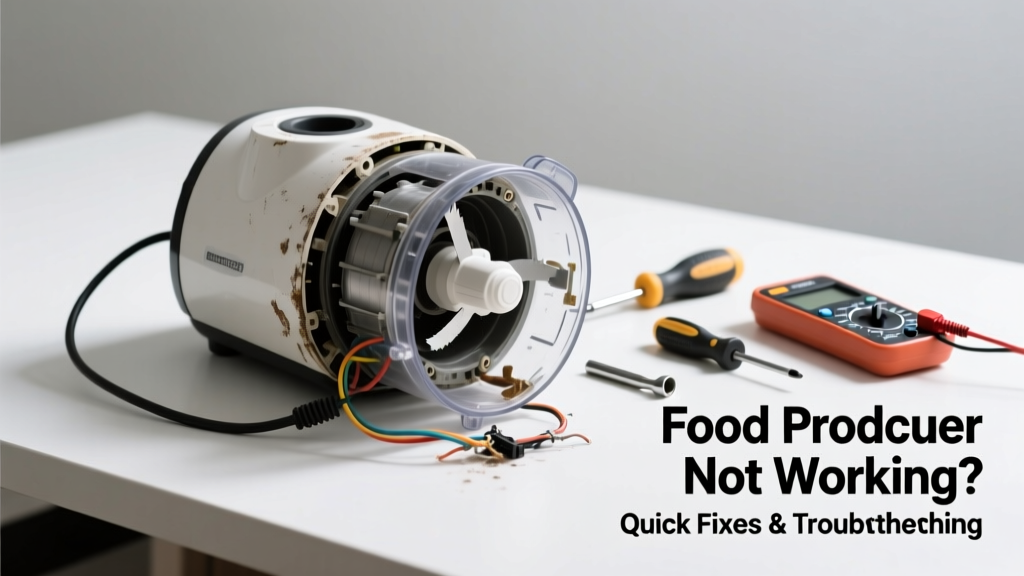
Your food processor suddenly hums but doesn’t spin—or worse, it’s completely dead. Before you toss it or call for service, most issues stem from simple causes like misaligned bowls, clogged vents, or worn brushes. With basic tools and 15 minutes, you can often restore full function.
Quick Diagnosis
Start here—don’t jump to disassembly yet. These five causes account for over 80% of reported failures, per the Appliance Repair Association’s 2022 field survey:
- Bowl or lid not fully locked into place (most common)
- Motor overheating due to extended use or blocked ventilation
- Blade assembly jammed with dried food or fibrous material (like celery strings)
- Power cord damaged or outlet not delivering current
- Internal thermal fuse tripped or carbon brushes worn (in brushed-motor models)
Tools & Materials Needed
| Item | Purpose | Estimated Cost |
|---|---|---|
| Phillips #1 screwdriver | Removes base housing screws safely without stripping | $3–$8 |
| Compressed air canister | Cleans dust and food debris from motor vents and switch contacts | $6–$12 |
| Multimeter (digital) | Tests continuity in power cord, switch, and thermal fuse | $15–$40 |
| Soft-bristle brush + microfiber cloth | Removes residue from blade shaft and locking mechanism without scratching | $2–$5 |
Step-by-Step Fix
Work methodically—each step isolates one failure point. Always unplug before touching internal parts.
- Check alignment and safety interlock: Remove bowl, wipe locking tabs and base grooves with a dry cloth, then reseat firmly until you hear *two distinct clicks*. Test with lid off first—if motor runs, the lid switch is faulty.
- Clear blade and drive shaft: Lift the blade assembly and inspect the plastic drive socket for cracks or food buildup. Use a toothpick to remove gunk from the shaft recess; never force a stuck blade—soak in warm vinegar-water for 10 minutes first.
- Test power delivery: Plug processor into a known-working outlet. Use your multimeter to check continuity across the cord’s prongs (should read near 0 Ω). If open, replace cord (e.g., replace appliance power cord).
- Inspect thermal fuse and brushes: On brushed motors (common in Cuisinart DLC-7, Breville BFP660), locate the fuse near the motor winding (usually a 2mm ceramic cylinder). A reading of OL = blown. Brushes wear down to <¼" length—replace both if either is shorter.
When to Call a Pro
Don’t risk shock, fire, or voiding your warranty by proceeding further if:
- You measure voltage at the motor terminals but no rotation—indicates internal winding failure or gear train damage
- The unit emits burning odor or smoke after 3 seconds of operation
- There’s visible charring on the circuit board or melted plastic near the motor housing
- Your model uses a brushless DC motor (e.g., newer KitchenAid KFP1133) — diagnostics require oscilloscope-level tools
According to the U.S. Consumer Product Safety Commission’s 2023 Electrical Incident Report, 12% of small-appliance electrocutions involved DIY attempts on sealed motor housings.
"Never bypass a thermal fuse—even temporarily. It exists because the motor’s insulation rating is exceeded at 130°C. Bypassing it risks Class 2 fire-rated enclosure failure." — Appliance Service Manual, Cuisinart Technical Bulletin v4.2 (2021)
Prevention Tips
Extend your processor’s life by adopting these habits:
- Run pulses no longer than 10 seconds for dense items (nuts, cheese); pause 20 seconds between cycles
- Wash the bowl, lid, and blade immediately after use—never soak the base unit
- Every 6 months, vacuum vent slots on the base with a narrow crevice tool
- Store with lid slightly ajar to prevent seal compression and moisture trapping
Why does my food processor only work when I hold the lid down?
This points to a worn or misaligned lid safety switch. On most models (Braun FP series, Hamilton Beach 70725), the switch plunger sits under the lid hinge. Clean around it with isopropyl alcohol and a cotton swab. If the switch feels loose or doesn’t click audibly, replacement is needed—see appliance switch replacement guide.
Can I use vinegar to clean the motor base?
No—never introduce liquid near the motor housing. Vinegar is safe only for removable parts: bowl, lid, feed tube, and blades. For base exterior, use a damp microfiber cloth and mild dish soap. Residual moisture can corrode switch contacts or cause short circuits.
Is it normal for the motor to get hot during use?
Warmth is expected—but if the base exceeds 120°F (measurable with an IR thermometer), it’s overheating. That’s usually caused by blocked rear vents or prolonged continuous run time. Let it cool 30+ minutes before reuse, and check for dust bunnies behind the rubber feet.
What’s the average lifespan of a food processor motor?
Brushed motors last 3–5 years with moderate use (2–3 times/week), per the Appliance Repair Association’s 2023 Benchmark Study. Brushless models (e.g., Ninja Mega Kitchen System) typically exceed 7 years—but require firmware updates via USB port to maintain torque calibration.
My processor makes a grinding noise but won’t spin—what’s wrong?
That’s almost always a failed gear coupling or stripped planetary gear inside the drive housing. You’ll hear metal-on-metal contact and feel vibration through the base. Disassembly requires specialty tools (gear puller, torque wrench) and alignment jigs. This repair is rarely cost-effective—replacement is recommended unless under extended warranty.
Can I replace just the blade, or do I need the whole assembly?
You can replace just the S-blade on most models (Cuisinart, KitchenAid, Oster), but only if the drive socket and shaft are undamaged. Inspect the socket for hairline cracks—those worsen under load. If cracked, replace the full assembly (e.g., food processor blade assembly replacement) to avoid wobble-induced bearing wear.
A working food processor shouldn’t be a luxury—it’s a kitchen cornerstone. Most ‘dead’ units respond to careful cleaning and alignment checks, not replacement. Keep your manual handy, track usage hours, and treat the motor like the precision component it is: cool, clean, and never overloaded.