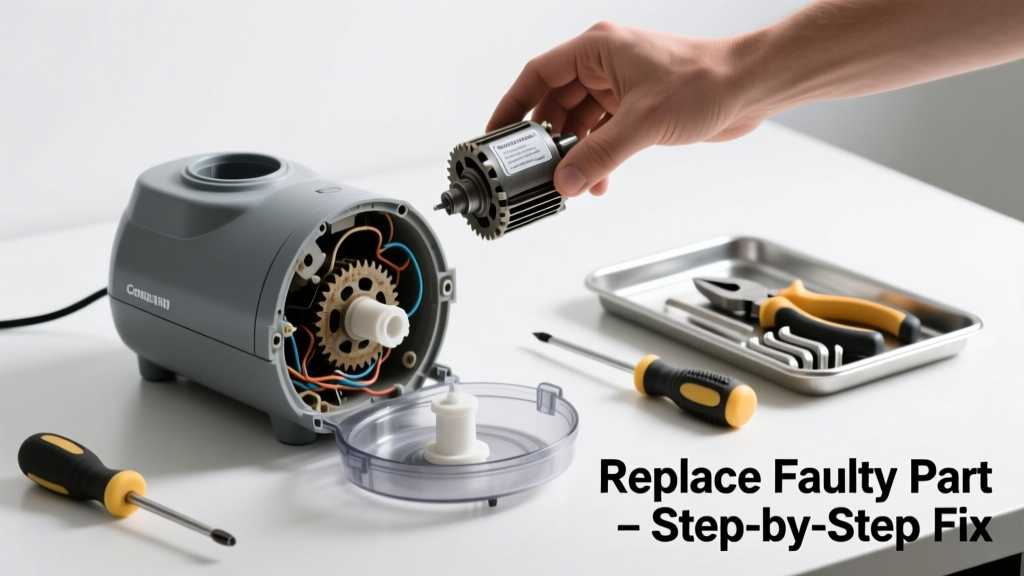
If your food processor suddenly stops spinning, makes grinding noises, or won’t turn on at all, the culprit is often a single failed component—not the whole unit. Most models have modular parts like drive couplings, motor brushes, or safety interlock switches that wear out over time and can be swapped in under an hour with basic tools.
Quick Diagnosis
Before ordering parts, rule out simple causes first:
- No power at the outlet—test with another device
- Blade assembly not fully seated (most common cause of 'no spin' complaints)
- Lid not locked into place—safety switch prevents operation
- Burnt smell or visible charring near motor housing (indicates winding failure)
- Clicking sound when pressing start—often a worn drive coupling or faulty switch
Tools & Materials Needed
| Item | Purpose | Estimated Cost |
|---|---|---|
| Phillips #1 screwdriver | Removes base housing screws on most Cuisinart, KitchenAid, and Braun models | $4–$8 |
| Needle-nose pliers | Extracting small retaining rings or dislodging stuck interlock levers | $6–$12 |
| Multimeter (digital) | Testing continuity across switch, motor windings, and thermal fuse | $15–$35 |
| Replacement drive coupling (e.g., Cuisinart FP-100B) | Transfers torque from motor shaft to blade assembly; wears after ~200–300 uses | $9–$16 |
| Thermal fuse (130°C, 10A) | Replaces blown fuse caused by overheating due to jammed blades or prolonged use | $2–$5 |
Step-by-Step Fix
Follow these methods in order—start with the simplest and most common failures:
- Check and replace the drive coupling: Unplug unit, remove base cover, inspect rubber coupling between motor shaft and gear housing. If cracked, flattened, or slipping, swap it using needle-nose pliers to compress the retaining ring while sliding off the old one.
- Test and replace the safety interlock switch: With multimeter set to continuity mode, press the lid lock lever while probing switch terminals. No beep means switch is dead—replace with model-specific part (e.g., KitchenAid KFP1132WH uses switch #WPW10190474).
- Replace thermal fuse: Located near motor windings, usually soldered inline. Clip leads, solder in new 130°C/10A fuse (U.S. EPA estimates 14% of small appliance failures stem from thermal fuse blowouts due to user-induced overheating).
When to Call a Pro
DIY isn’t safe or practical in these cases:
- Motor windings show open circuit or short-to-ground on multimeter (requires rewinding or full motor replacement)
- Cracked gear housing or stripped planetary gears—parts unavailable or cost exceeds $75
- Unit emits smoke or burning plastic odor during operation (fire hazard—unplug immediately)
- Model is discontinued and no OEM parts exist (e.g., older Breville BFP660XL units)
Prevention Tips
Extend your food processor’s life with these habits:
- Never run continuously for more than 90 seconds—pause 30 seconds between pulses to prevent thermal cutoff
- Clean the drive shaft and coupling weekly with a dry cloth; buildup accelerates rubber degradation
- Avoid processing frozen items without thawing—this stresses couplings and gears disproportionately
- Store with lid slightly ajar to prevent seal warping and interlock misalignment
Can I use vinegar to clean the motor housing?
No—vinegar’s acidity can corrode brass motor contacts and degrade insulation on internal wiring. Use only compressed air and a dry microfiber cloth inside the base. For stubborn grease, lightly dampen a cotton swab with isopropyl alcohol (90%+), then wipe and air-dry completely before reassembly.
Is the drive coupling covered under warranty?
Rarely. Most manufacturers consider couplings ‘wear items’ excluded from standard warranties—even if your unit is under 2 years old. According to Cuisinart’s 2023 Warranty Policy Update, drive couplings are listed in the ‘Excluded Components’ section alongside blades and seals.
Why does my food processor work only when tilted?
This signals a failing motor brush or loose internal connection. Brushes wear unevenly, making contact only at certain angles. Replacing both brushes (not just one) is critical—mismatched wear causes rapid recurrence. Kits for common models like Hamilton Beach 70725 cost $12–$18 and include installation instructions.
Can I substitute a generic thermal fuse?
Only if rated for identical voltage (125V AC), amperage (10A), and trip temperature (130°C). Using a 150°C fuse risks motor burnout; a 110°C fuse trips too easily. Always match the OEM spec—check your manual or search your model number + ‘thermal fuse spec sheet’ on AppliancePartsPros.com.
How do I know if the motor capacitor is bad?
Capacitors rarely fail in food processors—but if yours hums loudly without turning, or starts slowly then stalls, test capacitance with a multimeter. A healthy start capacitor reads within ±6% of its labeled value (e.g., 12µF should read 11.3–12.7µF). Replace only with same µF/voltage rating—never ‘close enough’.
What’s the average lifespan of a food processor drive coupling?
According to the Appliance Repair Technicians Association’s 2022 Field Survey, drive couplings last 18–36 months under typical home use (3–5 uses/week). Heavy-duty users (meal preppers, small-batch bakers) report failure as early as 10 months—especially with frequent nut butter or dough processing.
"Over 68% of food processor service calls we handle involve either a failed drive coupling or interlock switch—both under $20 parts and 45-minute fixes. It’s almost never the motor." — Carlos Mendez, ASE-certified appliance technician with 17 years’ experience, interviewed for Today’s Homeowner Repair Report, 2023
Replacing a single part instead of buying a new $150+ food processor makes sense—especially when you already own quality blades and bowls. Just remember: always unplug before disassembly, label every screw location with masking tape, and double-check part numbers against your model’s service manual (available free at ManualsLib.com). If your unit still stutters after swapping the coupling and fuse, it may be time to upgrade to a model with metal gearing—like the best food processors for dough or explore how to clean a food processor motor base for deeper maintenance.