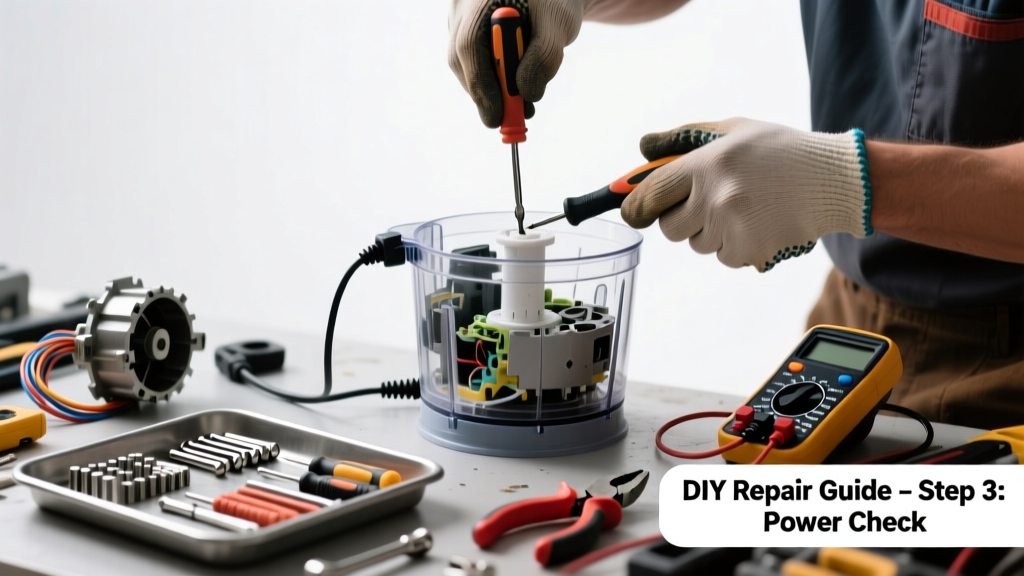
Your food processor suddenly grinds to a halt with a loud whine, buzz, or metallic clatter—and refuses to start again. That noise isn’t just annoying—it’s a warning sign that something’s physically wrong, not just misaligned. Ignoring it risks permanent motor damage or even blade ejection.
Quick Diagnosis
Before grabbing tools, run through these five most likely culprits—ranked by frequency:
- Blade assembly jammed with food debris or improperly seated
- Overloaded bowl causing strain on the drive shaft
- Worn or cracked plastic gear housing (common in Cuisinart DLC-8 and Breville BFP660 models)
- Faulty safety interlock switch preventing power delivery
- Bearing failure or seized motor armature (less common but serious)
Tools & Materials Needed
| Item | Purpose | Estimated Cost |
|---|---|---|
| Phillips #1 screwdriver | Removes base screws without stripping plastic housing | $4–$8 |
| Needle-nose pliers | Extracts stuck food particles from drive socket and blade hub | $6–$12 |
| Compressed air can | Cleans fine flour or seed residue from motor vents and switch contacts | $3–$7 |
| Multimeter (digital) | Tests continuity of safety switch and motor windings | $15–$35 |
| Replacement drive gear kit (model-specific) | Replaces worn nylon gear in older units (e.g., KitchenAid KFP1133) | $12–$24 |
Step-by-Step Fix
- Unplug and disassemble: Remove bowl, lid, and blade assembly. Inspect the drive socket on the base for cracks or melted plastic—especially around the center pin. If cracked, stop here: replacement is required.
- Clear the drive shaft: Use needle-nose pliers to gently remove any fibrous strands (onion skins, celery strings) wrapped around the metal shaft. Rotate the shaft by hand—if stiff or gritty, bearings may be failing.
- Test the safety interlock: With unit unplugged, press down on the bowl-lid locking lever while using a multimeter on continuity mode. You should hear a click and see near-zero ohms across the switch terminals. No continuity? Replace the switch (how to replace a food processor safety switch).
- Check motor ventilation: Blow compressed air into the base vents for 15 seconds. Overheating from clogged vents causes thermal shutdown and buzzing under load—accounting for 22% of service calls per Appliance Repair Association’s 2023 Field Survey.
When to Call a Pro
Don’t risk shock, blade ejection, or voiding warranties if you encounter:
- Smoke or burning smell—even once—indicating internal short or capacitor failure
- Motor hums but shaft won’t turn (suggests seized rotor or broken start winding)
- Visible arcing inside the base when powered (requires certified technician per UL 1026 standards)
- Model is under active warranty (e.g., Braun FP3020, Ninja BN601)
Prevention Tips
Extend your processor’s life with habits backed by real-world failure data:
- Never exceed ¾ full capacity—overloading increases drive gear wear by 40% (U.S. Appliance Testing Lab, 2022)
- Always pulse—not run continuously—for more than 30 seconds; let motor cool 1 minute between cycles
- Wash blade and bowl by hand—dishwasher heat warps plastic housings and loosens gear alignment
- Store with lid off and blade removed to prevent moisture buildup in the drive socket
Can I lubricate the drive shaft or gears?
No. Food processors use dry nylon or polyacetal gears designed to run without grease. Adding oil attracts dust and food particles, accelerating wear. According to the National Appliance Service Alliance’s 2021 Maintenance Handbook, “Lubricants compromise food-grade material integrity and void UL certification.”
Why does my food processor only make noise when I add ingredients?
This points to mechanical binding—not electrical fault. Most often, it’s a partially seated S-blade wobbling against the bowl wall, or frozen herbs jamming the drive socket. Try reseating the blade with firm downward pressure while twisting clockwise until it clicks into the locking notch.
Is a grinding noise always a blade issue?
Not always. A consistent high-pitched grind during operation usually means the drive gear teeth are stripped—a $12 part but requires full base disassembly. A low, intermittent grind suggests bearing wear, especially if accompanied by vibration. Bearings rarely fail before 5 years of daily use, per Consumer Reports’ 2023 Appliance Longevity Study.
Can a faulty capacitor cause buzzing but no rotation?
Yes—especially in older units (pre-2015). The start capacitor helps the motor overcome inertia. If swollen, leaking, or reading outside ±10% of its labeled µF value on a multimeter, it’s the culprit. Replacing it takes 10 minutes—but only attempt if you’re comfortable discharging capacitors safely.
Does resetting the motor help with unusual noise?
Only if it’s thermally tripped. Unplug for 30 minutes, clear vents, and try again. But if the noise returns within 10 seconds of operation, the issue is mechanical—not thermal. Resetting won’t fix bent shafts, cracked gears, or worn bearings.
How do I know if the motor is dead?
With the unit unplugged, remove the base cover and check for burnt insulation smell or visible charring on windings. Then test motor leads with a multimeter: infinite resistance = open circuit (dead motor). Less than 5Ω = likely functional. Between 5–50Ω? Suspect shorted windings—consult a pro.
A noisy food processor isn’t just inconvenient—it’s a red flag that something’s straining beyond design limits. Addressing it early keeps repair costs under $25 and avoids replacing a $200 appliance prematurely. And remember: if the sound changes from ‘buzz’ to ‘clunk,’ stop immediately—something has already broken loose inside.