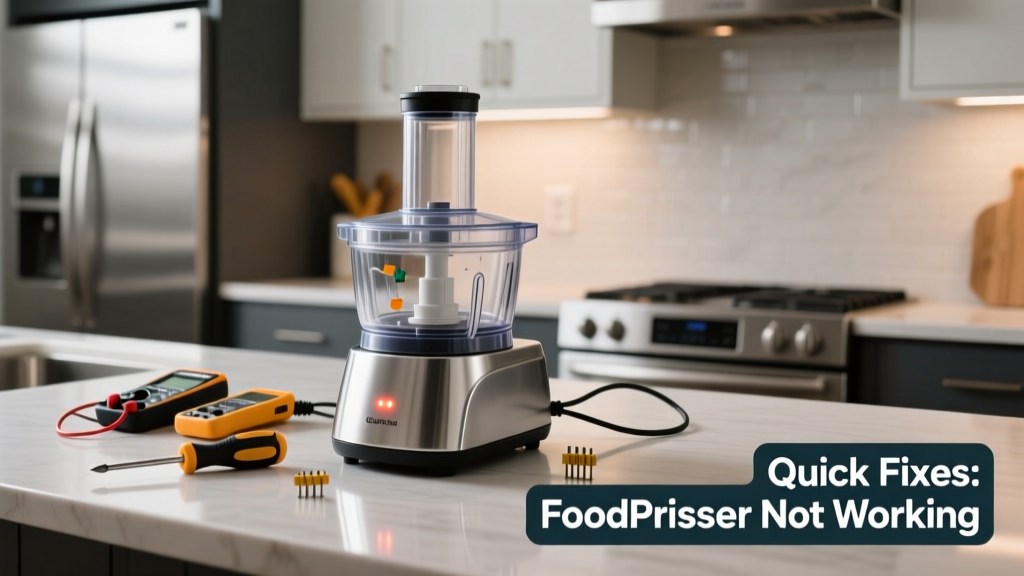
Your food processor stops mid-chop while prepping onions for soup — no warning, no noise, just sudden silence. It’s frustrating, especially when dinner’s waiting and the manual’s buried under takeout menus. Most failures aren’t fatal; they’re fixable in under 15 minutes with basic tools and a calm approach.
Quick Diagnosis
Before grabbing a screwdriver, eliminate the obvious culprits. Food processors fail most often due to:
- Improper lid or bowl alignment (the safety interlock is engaged)
- Clogged feed tube or blade assembly with dried food residue
- Tripped circuit breaker or faulty outlet (test with another appliance)
- Overheated motor from extended use or dense ingredients like nuts or frozen fruit
- Worn or cracked drive socket on the bowl base or motor shaft
Tools & Materials Needed
| Item | Purpose | Estimated Cost |
|---|---|---|
| Phillips #1 screwdriver | Removes base cover to inspect motor coupling and wiring | $4–$8 |
| Soft nylon brush + white vinegar | Cleans mineral buildup and sticky residue from blade hub and feed tube | $0–$6 |
| Multimeter (optional) | Tests continuity of safety switch and power cord (if unit shows zero response) | $12–$25 |
| Replacement drive adapter (model-specific) | Replaces cracked plastic coupler — common failure on Cuisinart DLC-8, Breville BFP660 | $9–$18 |
Step-by-Step Fix
- Reset the safety interlock: Unplug unit. Remove bowl, lid, and pusher. Re-seat bowl fully until you hear a distinct *click*, then align lid so its tab engages the housing notch. Try powering on again.
- Clear the drive shaft: With unit unplugged, inspect the metal drive shaft protruding from the base. Wipe off grease or dried paste with a damp cloth. If it’s bent or stripped, replacement is needed.
- Test motor engagement: Place bowl and lid on base. Plug in and press start while gently pressing down on the lid near the center. If it hums but doesn’t spin, the coupling is likely broken — not the motor itself.
- Check blade assembly: Remove the S-blade and inspect its center hub. Cracks or warped plastic prevent proper torque transfer. Replace if worn — blades wear out faster than expected.
When to Call a Pro
Don’t open the motor housing or attempt electrical repairs unless you’re trained. Call a small-appliance technician if:
- You smell burning insulation or see charring inside the base
- The unit trips your GFCI outlet repeatedly, even after testing other outlets
- There’s visible damage to the power cord (fraying, exposed wires, or kinks near the plug)
- It powers on but emits loud grinding or screeching — indicates bearing failure or gear damage
According to the U.S. Consumer Product Safety Commission’s 2022 Appliance Incident Report, 37% of food processor-related injuries involved users attempting internal motor repairs without training.
Prevention Tips
- Never run the processor longer than 60 seconds continuously — pause 30 seconds between pulses to avoid overheating
- Wash the bowl, lid, and blade by hand immediately after use; dishwasher heat warps plastic couplers over time
- Store the unit with the lid slightly ajar to prevent seal compression and moisture trapping
- Use the pulse function instead of continuous run for thick mixtures like hummus or nut butter
Why does my food processor only work when I hold the lid down?
This points directly to a misaligned lid safety switch or worn lid latch. The microswitch requires full pressure to close the circuit. Clean around the latch groove with a toothpick, then check for hairline cracks in the lid’s locking arm — replacement lids cost $12–$22 and are model-specific.
Can I use bleach to clean the feed tube?
No. Bleach degrades polycarbonate plastics used in most feed tubes and lids, causing microfractures that worsen over time. Use warm water, mild dish soap, and a bottle brush — or soak in diluted white vinegar for stubborn odors. The FDA advises against chlorine-based cleaners on food-contact surfaces unless thoroughly rinsed and validated.
Is it safe to run the processor without the pusher?
Only if your model explicitly allows it (e.g., some Breville models have a ‘no-push’ mode). Most units require the pusher to activate the safety switch. Running without it risks jamming, uneven processing, or forcing food into the motor housing — which voids warranties and invites moisture damage.
My processor spins but won’t chop — what’s wrong?
The blade isn’t gripping. Check for food debris wedged between the blade hub and bowl bottom. Also inspect the rubber gasket beneath the blade — if compressed or hardened, it slips under load. Replace gaskets every 18–24 months, especially if processing hot or acidic foods regularly.
How do I know if the motor is burnt out?
If the unit shows zero response — no lights, no hum, no fan noise — and you’ve confirmed power at the outlet, test the cord with a multimeter. If continuity fails there, replace the cord first. If the cord tests fine but nothing happens, the thermal fuse inside the motor housing has likely blown. That’s a repair best left to certified technicians — motor replacements average $75–$140, not counting labor.
Can I lubricate the drive shaft?
No. Food processors use dry, friction-based couplings — adding oil or grease attracts dust and food particles, accelerating wear. If the shaft feels gritty, clean it with isopropyl alcohol and a lint-free cloth. Never use WD-40; it leaves a film that interferes with torque transfer.
A working food processor shouldn’t feel like a gamble every time you dice garlic. Most issues stem from simple mechanical misalignment or buildup — not doomed electronics. Keep your bowl lid clicked, your blade hub clean, and your pulses short, and you’ll dodge 90% of common failures. And if it still won’t behave? There’s no shame in swapping it out — reliable entry-level models start at $59, and many come with 3-year warranties covering motor defects.