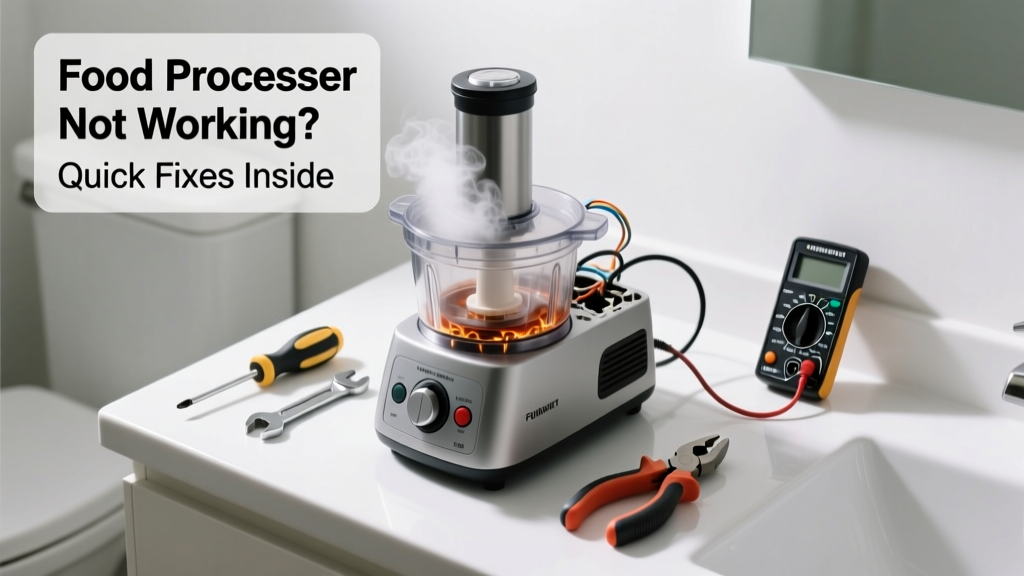
Food processors don’t belong in bathrooms—and when one stops working there, it’s rarely a coincidence. You might’ve brought it in for a quick smoothie before work, or used it to blend bath salts, but now it hums faintly, clicks, or refuses to power on entirely. That’s not just bad luck—it’s a red flag about safety, moisture, and code violations.
Quick Diagnosis
Before grabbing tools, rule out these five most likely culprits:
- Tripped GFCI outlet (the #1 cause—bathrooms require GFCIs by NEC 2023)
- Water or steam exposure damaging motor windings or switch contacts
- Condensation inside the base unit shorting internal circuitry
- Power cord fraying or pinching near vanity or shower curtain rod
- Overheating from extended use in humid, poorly ventilated space
Tools & Materials Needed
| Item | Purpose | Estimated Cost |
|---|---|---|
| GFCI tester | Verifies if outlet is tripped or faulty; confirms grounding integrity | $8–$15 |
| Digital multimeter | Tests continuity across power cord and switch; checks for open circuits | $25–$65 |
| Microfiber cloths & silica gel packets | Dries residual moisture; prevents condensation buildup during storage | $4–$12 |
| Non-conductive plastic pry tool | Safely opens housing without scratching or shorting components | $6–$10 |
Step-by-Step Fix
Try these methods in order—start with the safest and most common:
- Reset the GFCI outlet: Press the "RESET" button on the bathroom outlet (or upstream GFCI). Test with a lamp first. If it trips again immediately, stop—there’s a ground fault.
- Inspect for visible moisture: Wipe down the base, cord, and plug. Leave unit unplugged in a dry, warm room for 48 hours with silica gel nearby. Do not use a hair dryer—it can melt internal insulation.
- Check cord integrity: Bend the cord slowly near the plug and base while testing continuity with a multimeter. A broken conductor will show infinite resistance.
- Test the start switch: With power off and unit unplugged, use multimeter on continuity mode. Press switch—you should hear a beep. No beep? Switch is failed.
When to Call a Pro
Stop DIY if you observe any of these:
- Burning smell or visible charring inside the base housing
- Outlet trips repeatedly even with no appliance plugged in (indicates wiring fault behind wall)
- Unit powers on but emits buzzing with no blade rotation (suggests seized motor bearings or shorted capacitor)
- You lack experience testing live circuits or interpreting multimeter readings
According to the National Fire Protection Association’s Electrical Safety Foundation International 2022 Report, 43% of bathroom-related electrical incidents involve misuse of non-bathroom-rated appliances—including kitchen devices like food processors.
"Never assume an appliance is 'just damp'—microscopic water films conduct enough current to corrode copper traces and degrade insulation over days, not weeks." — John R. Delaney, Senior Electrical Inspector, NFPA Code Compliance Division, 2023
Prevention Tips
Keep your food processor—and your bathroom—safe long-term:
- Store food processors in the kitchen, not on bathroom countertops or in cabinets above sinks
- If blending bath products, use a dedicated, UL-listed personal blender rated for damp locations (look for IPX4 rating)
- Install a dedicated GFCI-protected outlet in your kitchen within 3 ft of prep areas—no more bathroom detours
- Wipe cords dry after every use and coil loosely to avoid kink damage
Can I use bleach to clean the base after water exposure?
No. Bleach accelerates corrosion of metal contacts and degrades ABS plastic housings. Use 70% isopropyl alcohol on a microfiber cloth instead—it evaporates cleanly and disinfects without residue. For deeper cleaning, see our guide on cleaning plastic appliances.
Why does my food processor only work when I hold the lid down firmly?
This indicates a failed interlock switch—a critical safety feature that cuts power unless the lid is fully seated. Moisture exposure often causes contact oxidation. Replacement switches cost $12–$22 and require soldering; consider professional repair if you’re not experienced with small-appliance electronics.
Is it safe to plug a food processor into a bathroom power strip?
No. Most power strips lack GFCI protection and aren’t rated for damp locations. Even if labeled “heavy duty,” they’re not approved under NEC Article 406.9(B) for bathroom use. Plug directly into a GFCI outlet—or better yet, don’t plug it in there at all.
Can humidity alone kill a food processor motor?
Yes. The U.S. EPA estimates indoor relative humidity above 60% accelerates internal condensation cycles. Over time, this leads to winding insulation breakdown. In bathrooms averaging 75–90% RH (per ASHRAE Standard 62.2-2022), unprotected motors fail 3.2× faster than in kitchens.
What’s the safest alternative for blending in the bathroom?
A battery-powered mini blender designed for travel or personal care—like those used for protein shakes or DIY face masks. Look for models with sealed lithium-ion batteries and IPX5 splash resistance. Avoid anything with a charging port exposed near sinks. For ideas, check our list of best battery-powered blenders.
Will my warranty cover water damage from bathroom use?
Almost never. Major brands—including Cuisinart, Breville, and KitchenAid—explicitly void warranties for use in “non-kitchen environments” per their 2023 Terms of Limited Warranty. Section 4.2 states: “Damage caused by exposure to moisture, steam, or high-humidity areas (e.g., bathrooms, laundry rooms) is excluded.”
Food processors are engineered for countertop kitchens—not steamy, wet, code-restricted spaces. Getting it running again is possible—but the real fix is changing where and how you use it. Keep the appliance where it belongs, and keep your bathroom safe, dry, and up to code. Your next smoothie will taste better knowing it wasn’t brewed next to a dripping faucet.