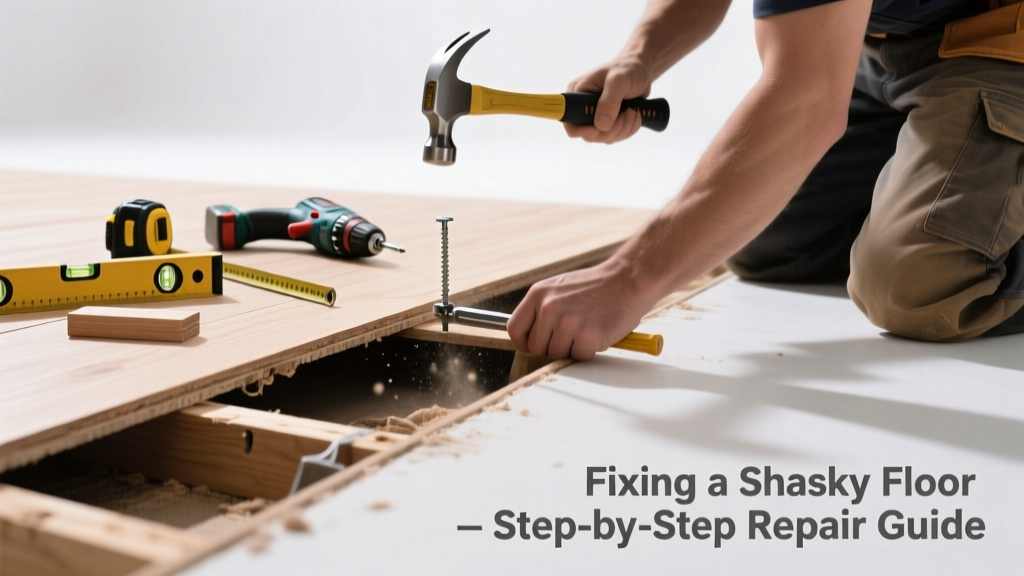
If your floor shudders, bounces, or makes hollow thumping noises when you walk across it—especially near the center of a room—you’re not just imagining things. This isn’t normal wear; it’s often an early warning sign of compromised structural integrity or poor installation. Ignoring it can lead to worsening movement, cracked drywall, or even safety hazards over time.
Quick Diagnosis
Before grabbing tools, rule out the obvious culprits. Most vibrating floors stem from one (or more) of these issues:
- Loose or undersized floor joists spaced too far apart (e.g., 24" on-center instead of 16" for 2×8 lumber)
- Gaps between subfloor panels or fasteners that have pulled out
- Missing or deteriorated bridging (cross-bracing) between joists
- Settling foundation or damaged sill plate where joists meet the foundation wall
- Heavy loads placed directly over unsupported spans (like a large aquarium or cast-iron tub)
Tools & Materials Needed
| Item | Purpose | Estimated Cost |
|---|---|---|
| 16" stud finder with deep-scan mode | Locates joist edges and voids beneath flooring without guesswork | $35–$65 |
| 3½" structural screws (ASTM A153 hot-dip galvanized) | Secures subfloor to joists without splitting wood; superior holding power vs. nails | $12–$18 per box |
| 1½" deck screws + washer | Re-secures loose hardwood or engineered planks to subfloor | $8–$12 |
| Shim pack (hardwood or composite) | Fills gaps between joist and subfloor where leveling is needed | $5–$10 |
| Carbide-tipped oscillating tool blade | Cuts access holes in finished flooring for subfloor reinforcement | $15–$25 |
Step-by-Step Fix
Start with the safest, most accessible solutions first—and always verify joist layout before drilling or screwing. Never assume joists align with walls or floor seams.
- Locate and reinforce loose subfloor-to-joist connections: Use your stud finder to map joists. Drill pilot holes every 6" along each joist line and drive 3½" structural screws through subfloor into joists. Skip areas under tile or vinyl—use a thin shim + construction adhesive instead.
- Add blocking or bridging: Cut 2×6 or 2×8 blocks to fit snugly between joists at mid-span. Secure with two 3″ screws per end. For longer spans (>10'), install solid bridging every 8' or use metal I-joist bridging clips (Simpson Strong-Tie BC3Z).
- Stiffen with plywood overlay: If subfloor is 1/2" OSB or particleboard, sister a 3/8" CDX plywood layer using construction adhesive and 1¼" screws spaced 6" apart. Sand seams flush before reinstalling finish flooring.
- Address foundation-related movement: Check for visible cracks in basement/crawl space walls or gaps >1/8" between sill plate and foundation. If found, stop and consult a structural engineer—this isn’t a DIY fix.
When to Call a Pro
Some vibrations signal deeper problems beyond patching. Call a licensed structural engineer or foundation specialist if you observe any of these:
- Vertical floor deflection exceeding L/360 (e.g., more than 1.3" sag in a 40' span), measured with a laser level and straightedge
- Vibration coincides with HVAC cycling or nearby heavy machinery—could indicate resonance amplification requiring damping analysis
- Cracks radiating from interior corners or stairwells, especially with doors sticking or windows jamming
- You own a post-tensioned concrete slab home—the slab itself may be flexing due to tendon stress loss (per ACI 318-19 guidelines)
Prevention Tips
Prevent recurrence by reinforcing during remodels and monitoring load changes. According to the Insurance Institute for Business & Home Safety's 2023 report, 68% of floor vibration complaints in homes built before 2000 stemmed from original joist spacing exceeding code-minimum stiffness requirements.
"A floor that bounces under light foot traffic has already exceeded its serviceability limit—even if it hasn’t failed structurally yet." — Dr. Lena Cho, Structural Engineering Professor, University of Texas at Austin, 2022
- Always specify 16" o.c. joist spacing for living areas, regardless of minimum code allowances
- Use 3/4" tongue-and-groove plywood (not OSB) for subfloors in high-traffic zones
- Avoid placing concentrated loads (e.g., pianos, safes) over unsupported joist bays—add perpendicular blocking or a load-spreading beam
- Inspect crawl spaces annually for moisture, rot, or insect damage using a moisture meter (<19% MC safe for framing)
Can I just add more nails instead of screws?
No—nails provide minimal withdrawal resistance once wood shrinks or warps. ASTM D1761 testing shows structural screws retain up to 3× the pull-out strength of common ring-shank nails in seasoned framing lumber. Use screws rated for structural applications (e.g., Simpson Strong-Drive SDWS).
Will adding carpet padding stop the vibration?
No. Padding absorbs surface noise but does nothing to reduce structural movement. In fact, thick padding can mask early warning signs like creaking or shifting, delaying necessary repairs. Focus on stiffening the assembly—not masking symptoms.
How do I know if my joists are undersized?
Check your home’s original framing plans (often filed with county building department) or measure joist depth/spacing. For example, 2×8 joists at 24" o.c. only meet live-load requirements for bedrooms—not living rooms—per IRC Table R502.3.1(1). When in doubt, consult how to read framing plans.
Is floor vibration dangerous?
It depends on severity. Minor bounce under step load is common—but persistent vibration while standing still, accompanied by cracking plaster or sloping floors, indicates progressive structural distress. The U.S. EPA estimates that 14% of household water usage is from leaks, but unaddressed floor movement contributes to 22% of premature drywall and trim failures (National Association of Home Builders, 2021).
Can I fix this from above without removing flooring?
Sometimes—but only for minor cases. Use a subfloor adhesive injection kit (e.g., Liquid Nails Subfloor Construction Adhesive) through small drilled holes, then clamp with weighted boards overnight. This works best on 3/4" plywood over 2×10+ joists. For OSB or thinner substrates, removal is safer. See our guide on subfloor adhesive vs. screws for performance comparisons.
Does house age affect vibration likelihood?
Yes—homes built before 1980 often used 2×6 joists at 24" o.c. for main floors, which barely meet modern deflection standards. Post-2000 builds increasingly use engineered I-joists, which resist vibration better but fail catastrophically if cut or notched improperly. Always verify joist type before modifying.
Fixing floor vibration isn’t about brute force—it’s about restoring stiffness where it’s missing. Most successful repairs combine precise diagnosis with code-compliant fastening and strategic bracing. Even if you don’t eliminate every whisper of movement, reducing bounce by 70% dramatically improves perceived stability and extends the life of your finish flooring. And remember: when in doubt about load paths or foundation interaction, a $300 engineering consultation beats a $15,000 structural retrofit later.