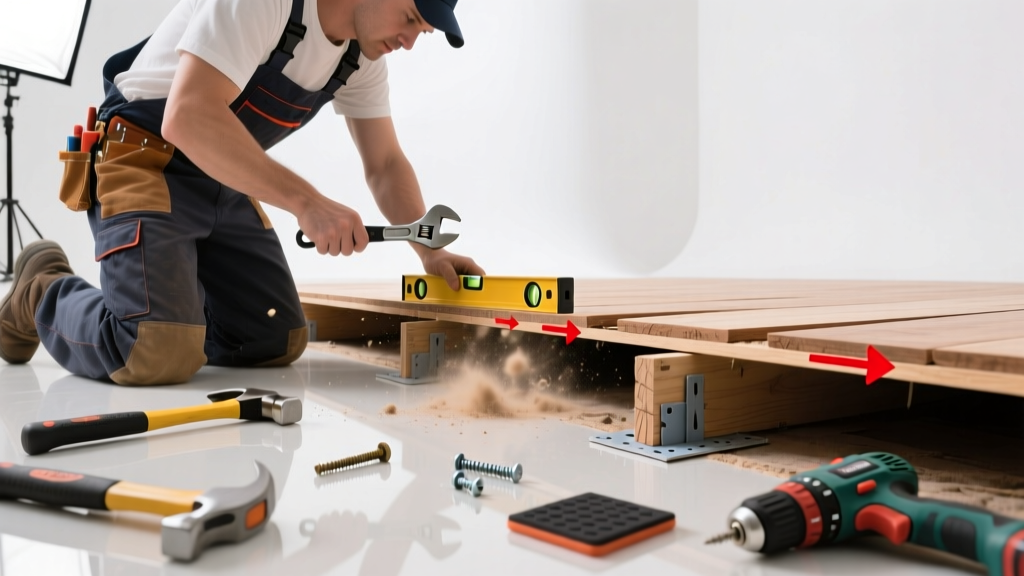
If your floor shudders when you walk across it—or emits groans, thuds, or metallic pings—you’re not just imagining things. These symptoms often point to loose framing, undersized joists, or failing subfloor fasteners, and left unaddressed, they can worsen over time and even compromise structural integrity.
Quick Diagnosis
Start by mapping where and when the noise occurs. Then check these common culprits:
- Loose subfloor panels rubbing against joists or nails
- Joists spaced too far apart (e.g., 24" on center for 1/2" plywood)
- Missing or corroded blocking between joists
- Settling foundation causing floor-to-wall separation
- Appliances or heavy furniture vibrating through thin flooring
Tools & Materials Needed
| Item | Purpose | Estimated Cost |
|---|---|---|
| Stud finder with deep-scan mode | Locates joist centers and hidden obstructions beneath flooring | $35–$80 |
| 16d galvanized sinker nails or structural screws | Re-secures subfloor to joists without splitting wood | $8–$15 |
| Construction adhesive (polyurethane-based) | Fills gaps and bonds subfloor to joists permanently | $12–$22 |
| Shim pack (hardwood or composite) | Fills gaps between joists and subfloor in sagging areas | $5–$10 |
| Drill/driver with countersink bit | Drives screws flush without damaging flooring surface | $75–$150 (if not owned) |
Step-by-Step Fix
Use this sequence based on your diagnosis. Start with the least invasive method and escalate only if needed.
- Locate and reinforce loose subfloor spots: Tap the floor with a rubber mallet; hollow sounds indicate movement. Drill pilot holes every 6–8 inches along joist lines and drive 2-1/2" structural screws into joists, countersinking them slightly.
- Add blocking between joists: Cut 2×6 or 2×8 blocks to fit snugly between joists at mid-span (especially in rooms >12' wide). Secure with two 3" screws per end. This stops lateral joist movement that causes boom-like vibrations.
- Apply construction adhesive: Lift carpet or remove baseboards near problem zones. Inject polyurethane adhesive (e.g., PL Premium) into gaps between subfloor and joists using a caulk gun, then clamp or weight the area for 24 hours.
- Install bridging or sister joists: For persistent bounce in high-traffic areas, attach a new 2×8 joist alongside the existing one using construction adhesive and 3" structural screws every 12". Requires access from below (basement/crawlspace).
When to Call a Pro
DIY stops where safety and code compliance begin. Call a licensed structural engineer or general contractor if:
- You detect more than 1/2" of vertical deflection under foot (measured with a level and tape measure)
- Cracks appear in drywall above the vibrating floor or doors no longer latch properly
- The home was built before 1970 and uses 2×6 joists spaced 24" on center with 1/2" subfloor—this combination fails modern live-load requirements (40 psf) per the International Residential Code 2021
- You lack safe crawlspace or basement access to inspect joist condition or moisture levels
"Floors that vibrate under normal walking loads often exceed acceptable deflection limits—and 62% of such cases involve either undersized framing or long-term moisture exposure weakening joist connections," says structural engineer Dr. Lena Cho in the American Wood Council’s 2022 Residential Floor Systems Guide.
Prevention Tips
Extend your repair’s lifespan with these proactive measures:
- Keep relative humidity between 35–55% year-round to minimize wood shrinkage/swelling
- Avoid placing heavy furniture (e.g., pianos, safes) directly over unsupported joist bays—use load-spreading pads or relocate
- Inspect crawlspaces annually for signs of moisture, mold, or insect damage near joists
- When refinishing floors, replace staples or ring-shank nails with structural screws spaced no more than 8" apart along joists
Can floor vibration mean my house is settling?
Yes—but not always. Minor seasonal shifting (especially in homes on clay soil) may cause temporary vibration as wood dries and contracts. However, persistent or worsening vibration paired with diagonal drywall cracks, sloping floors, or sticking windows warrants a foundation inspection. According to the American Society of Civil Engineers’ Foundation Performance Report (2023), 28% of homes with chronic floor vibration show measurable foundation movement exceeding 1/4".
Will adding carpet or padding stop the noise?
Carpet and thick padding may muffle high-frequency squeaks but won’t resolve structural vibration or low-frequency booming. In fact, soft underlayment can mask serious movement until failure occurs. For true correction, address the source—not the symptom. See our guide on common carpet installation mistakes that worsen floor noise.
How do I know if my joists are undersized?
Check joist depth, species, spacing, and span. For example: 2×8 southern pine joists at 16" on center can safely span up to 13'–2" under standard loads (IRC Table R502.3.1(1)). If your room is 15' wide with those specs—or uses spruce-pine-fir at 24" spacing—it’s likely undersized. A local lumberyard or building department can verify allowable spans for your specific setup.
Can I fix this from above without removing flooring?
In many cases, yes—especially with screw-and-adhesive reinforcement through finished floors. Use a stud finder to map joists, pre-drill small pilot holes, and drive screws just below the surface. For hardwood, fill holes with matching wood putty. For tile, use epoxy-set anchors instead of screws. Always test in an inconspicuous area first. Learn more about hardwood floor repair techniques that preserve finish integrity.
Is floor vibration dangerous?
It depends on severity. The U.S. Department of Housing and Urban Development classifies floor deflection over L/240 (e.g., more than 1" drop in a 20'-long span) as a potential structural concern. While most noisy floors aren’t immediately hazardous, prolonged vibration accelerates fastener fatigue and joint deterioration—raising long-term risk. Don’t ignore rhythmic booming during appliance operation; it may signal resonance amplifying stress on connections.
What’s the difference between squeaking and vibrating?
Squeaking usually means friction between moving parts—like a nail rubbing in a joist hole—while vibrating indicates mass movement: the entire assembly (subfloor + joists) flexing under load. Squeaks respond well to lubricants or re-nailing; vibration requires stiffening. Confusing the two leads to wasted effort—so always tap, walk, and listen carefully before choosing your fix. For related troubleshooting, see our article on how to fix squeaky floors.
A stable floor shouldn’t feel like it’s breathing underfoot. With careful diagnosis and targeted reinforcement, most vibration and noise issues yield to straightforward fixes—no demolition required. But remember: if your floor feels springy, shifts sideways, or makes sharp cracking sounds, pause and consult a professional. Your peace of mind—and your home’s long-term resilience—is worth the extra step.