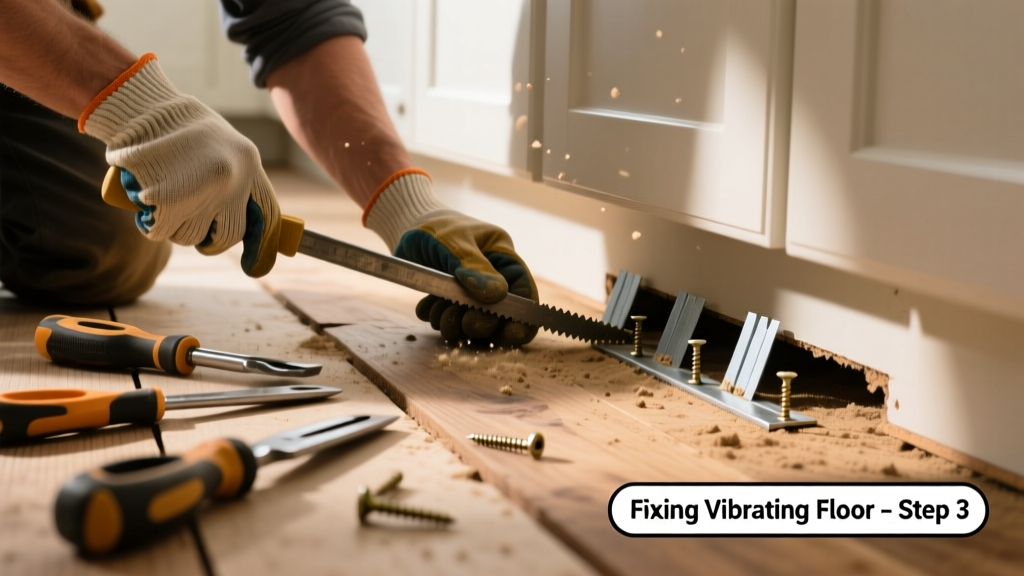
If your kitchen floor shudders when you walk across it—or worse, rattles your coffee mug—it’s not just annoying; it’s a warning sign. Vibrations often point to underlying structural issues like loose joists, undersized subflooring, or compromised support beams. Ignoring it can lead to squeaks, cracks, or even sagging over time.
Quick Diagnosis
Start by identifying the source—not all vibrations are created equal. Here are the most common culprits:
- Loose or undersized floor joists (especially if spaced 24" on center instead of 16")
- Gaps between subfloor panels or between subfloor and joists
- Missing or improperly installed blocking or bridging between joists
- Heavy appliances (like refrigerators or dishwashers) sitting directly over weak spots
- Settling foundation or damaged sill plate anchoring the joists to the foundation
Tools & Materials Needed
| Item | Purpose | Estimated Cost |
|---|---|---|
| 16" stud finder with deep-scan mode | Locates joist centers and voids beneath flooring | $35–$65 |
| 3/4" plywood or OSB (½ sheet) | Reinforces weak subfloor areas | $22–$30 |
| 2" coarse-thread deck screws | Secures subfloor to joists without splitting wood | $8–$12 |
| Shim pack (hardwood or composite) | Fills gaps between subfloor and joists | $5–$9 |
| Cordless impact driver | Drives screws quickly and with high torque | $110–$180 |
Step-by-Step Fix
Most kitchen floor vibrations stem from movement at the subfloor-to-joist interface. Try these methods in order of increasing complexity:
- Locate and screw down loose subfloor sections: Use a stud finder to map joists, then drive 2" deck screws every 6" along joist lines where vibration is strongest. Countersink screws slightly to avoid interfering with finished flooring.
- Add blocking between joists: Cut 2×6 or 2×8 blocks to fit snugly between joists perpendicular to their span, every 4–6 feet in the affected zone. Secure with two 3" screws per end.
- Install a sister joist: If a joist is cracked or undersized (e.g., 2×8 instead of required 2×10), attach a new 2×10 alongside it using construction adhesive and 3" screws every 6".
- Reinforce with plywood overlay: For widespread flex, remove base cabinets (if accessible), screw down a ½" plywood layer over existing subfloor—stagger seams and glue/screw to joists.
When to Call a Pro
Some vibrations signal deeper trouble that demands engineering insight or licensed intervention:
- You hear cracking sounds or see visible sagging (>¼" dip over 10 feet)
- Joists show signs of rot, insect damage, or water staining
- Vibration coincides with nearby plumbing or HVAC cycling on/off
- Your home was built before 1970 and lacks engineered joist spacing documentation
According to the American Society of Home Inspectors’ 2022 Structural Assessment Guidelines, “Floors exhibiting rhythmic vibration under normal foot traffic should be evaluated for joist deflection exceeding L/360—a red flag requiring structural recalculations.”
Prevention Tips
Once fixed, keep your kitchen floor steady long-term:
- Avoid concentrating heavy loads (e.g., cast-iron cooktops or double ovens) over unsupported spans—consult span tables before installing
- Inspect crawl space or basement supports annually for moisture, rust, or shifting
- Use rubber isolation pads under appliance feet to dampen transmitted vibration
- Ensure subfloor seams fall over joists—not between them—and are glued and screwed (not just nailed)
Can I fix this without removing the tile or hardwood?
Yes—in many cases. Screws can be driven through grout lines or expansion gaps in tile, and through tongue-and-groove seams in hardwood. For vinyl plank, use a drill bit slightly smaller than the screw shank to minimize surface damage. Patch any visible holes afterward with matching caulk or filler.
Will adding more screws make the problem worse?
No—if done correctly. Over-torquing or driving screws into warped or split joists can worsen instability. Always pre-drill pilot holes in older joists and use screws rated for structural subfloor attachment (e.g., Simpson Strong-Tie SDWS).
Is this related to my dishwasher or garbage disposal vibrating?
Sometimes—but usually not the root cause. Those appliances transmit vibration only if the floor itself is already flexible. If turning off the appliance stops the shaking, check mounting brackets and feet first; if vibration persists with appliances off, the issue is structural.
How do I know if my joists are spaced too far apart?
Standard residential joist spacing is 16" on center for 3/4" subflooring. If yours are 24" apart, they likely require blocking or an overlay unless engineered for higher spans. Confirm spacing by measuring between fasteners in the basement or crawl space—or use a deep-scan stud finder calibrated for joists.
Can I use construction adhesive alone instead of screws?
No. Adhesive helps but doesn’t replace mechanical fastening. The U.S. Department of Housing and Urban Development’s 2021 Residential Construction Standards requires both glue *and* screws for subfloor-to-joist connections where live loads exceed 40 psf—standard for kitchens.
Does floor vibration mean my foundation is failing?
Not necessarily—but it can be an early symptom. Foundation settlement typically causes diagonal drywall cracks, sticking doors, or uneven floors across multiple rooms. Isolated kitchen vibration points more strongly to framing or subfloor issues. Still, rule out foundation movement with a level check across door thresholds and floor-to-wall junctions.
A vibrating kitchen floor isn’t just a nuisance—it’s feedback from your home’s structure asking for attention. Addressing it early preserves your finish flooring, prevents costly callbacks if you’re remodeling, and keeps daily tasks like chopping vegetables or loading the dishwasher safe and stable. Whether you tighten a few screws or add strategic blocking, the right fix restores confidence underfoot—and peace of mind above it. For ongoing guidance, see our guides on how to repair a squeaky floor and subfloor repair in kitchens.