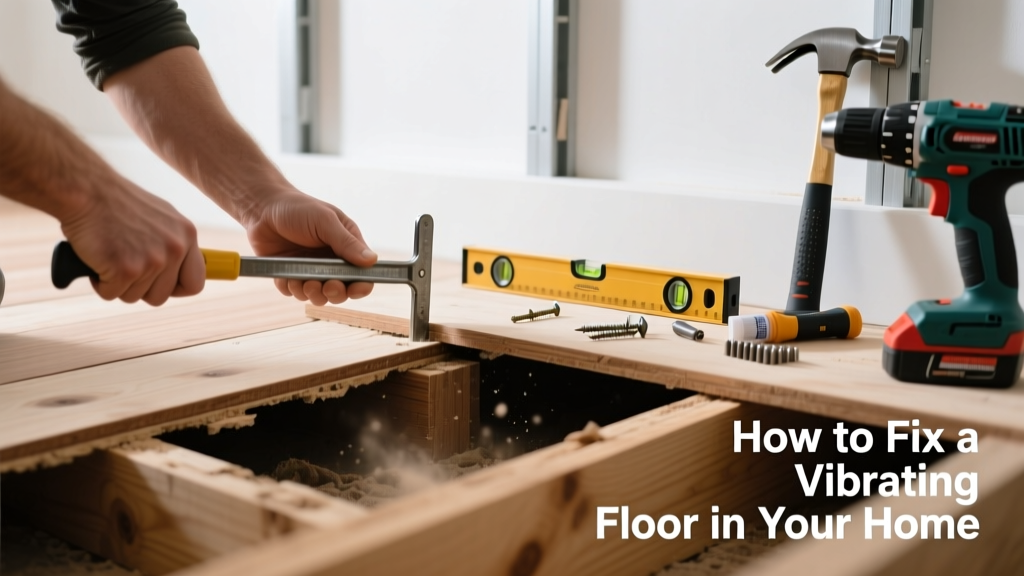
If your floor shudders when you walk across it—or worse, rattles dishes in the cabinet—you’re not just imagining things. A vibrating floor signals underlying structural or installation issues that can worsen over time, especially in older homes or those with long-span joists. Ignoring it risks accelerated wear on flooring, fasteners, and even drywall cracks.
Quick Diagnosis
Floors vibrate due to energy transfer—usually from foot traffic or appliances—amplified by insufficient stiffness or support. Here are the most common culprits:
- Joists spaced too far apart (e.g., 24" on center instead of 16" for 2x10s)
- Undersized joists (especially in additions or remodels using 2x8s where 2x10s or 2x12s are needed)
- Missing or loose bridging (cross-bracing between joists)
- Settled or damaged support beams or posts in crawlspaces or basements
- Loose subfloor panels or missing subfloor screws/nails
Tools & Materials Needed
| Item | Purpose | Estimated Cost |
|---|---|---|
| Stud finder with deep-scan mode | Locates joist edges and centerlines through finished flooring | $35–$65 |
| 1/4" lag screws & washers | Secures blocking or bridging without splitting wood | $8–$12 |
| 2x4 or 2x6 pressure-treated blocking | Provides lateral support between joists; cut to fit snugly | $2.50–$4.00 per 8' board |
| Cordless impact driver | Drives lag screws quickly and with high torque into dense framing | $120–$220 |
| Laser level (optional but helpful) | Verifies beam or post alignment before adding support | $75–$140 |
Step-by-Step Fix
Most vibration fixes target rigidity—not just strength. Stiffness matters more than raw load capacity for footfall response. Try these methods in order of accessibility and impact:
- Add solid blocking between joists: Cut 2x4s to fit tightly between adjacent joists every 4–6 feet along spans longer than 10'. Secure with two 3" lag screws per end. Start near the area of worst vibration.
- Install metal bridging ("I-joist bridging" or "twist-in"): For tighter access or deeper joists, use pre-bent steel bridging clipped between joists at midspan. Space every 8' and stagger rows.
- Reinforce the subfloor-to-joist connection: If you have access from below (crawl space), drive 2.5" construction screws every 6" along each joist edge into the subfloor. Skip nails—they loosen over time.
- Add a sister joist: For severely undersized or cracked joists, attach a new 2x10 or 2x12 alongside using construction adhesive and 3" screws every 6". Clamp while gluing.
When to Call a Pro
Some vibration stems from foundational movement or compromised bearing points—not just flex. Call a licensed structural engineer or foundation contractor if you observe any of these:
- Visible sagging (>1/2" over 10') or cupping in the floor plane
- Cracks wider than 1/8" in drywall corners or ceiling plaster above the vibrating zone
- Misaligned doors or windows on the same level
- Vibration accompanied by audible creaking, groaning, or snapping sounds
- Support posts resting directly on dirt or crumbling concrete piers
According to the American Society of Civil Engineers’ Guidelines for Residential Floor Vibration Assessment (2021), floors exceeding 0.02 inches of deflection under a 200-lb point load require professional evaluation—most DIYers lack the dial indicator tools to measure this accurately.
Prevention Tips
Vibration often begins during remodeling or when heavy appliances are added without recalculating live loads. Prevent recurrence with these habits:
- Always specify joist size and spacing per span tables in the International Residential Code (IRC Table R502.3.1) before installing new flooring
- Use tongue-and-groove subflooring with construction adhesive and screws—not staples—on all new builds or replacements
- Install engineered hardwood or LVP over a 1/2" plywood underlayment screwed to joists—not just glued to OSB
- Anchor large appliances (washer/dryer, refrigerator) to wall studs using seismic straps
Can floor vibration mean my house is settling?
Not necessarily—but it can be an early warning sign. Settlement usually causes diagonal drywall cracks, sticking windows, or uneven door gaps first. Vibration alone points more to framing flexibility than foundation failure. Still, if vibration appears suddenly alongside other symptoms, get a foundation inspection within two weeks.
Will adding carpet and padding fix the vibration?
No—it masks it temporarily. Carpet padding absorbs high-frequency noise but does nothing to increase floor stiffness. In fact, thick padding can make low-frequency resonance feel more pronounced underfoot. Focus on structural reinforcement first, then upgrade finishes.
Is it safe to add blocking from above by drilling through the subfloor?
Not recommended. Drilling upward risks hitting electrical wires or plumbing in joist cavities—and creates weak points in the subfloor. Always access joists from below via crawl space or basement. If no access exists, consider hiring a contractor to cut small inspection ports in inconspicuous areas (e.g., inside a closet).
How much does it cost to fix a vibrating floor professionally?
Minor blocking or bridging runs $350–$900. Sistering 2–3 joists averages $1,200–$2,400. Full structural retrofit—including beam replacement or pier repair—starts around $4,800 and climbs past $15,000 depending on access and soil conditions. Get at least three itemized bids before proceeding.
Can I use construction adhesive alone to stop floor bounce?
Adhesive helps—but only when combined with mechanical fasteners. The U.S. Department of Housing and Urban Development’s 2022 Residential Construction Handbook states that subfloor adhesive must be paired with screws spaced no more than 6" on edges and 12" in the field to prevent creep and delamination over time.
Does floor vibration affect home resale value?
Yes—especially if noted in inspection reports. Buyers perceive it as a red flag for deferred maintenance or hidden structural issues. One 2023 National Association of Realtors survey found 68% of buyers lowered offers or walked away after observing noticeable floor movement during walkthroughs—even with no other defects.
A stable floor isn’t just about comfort—it’s about confidence in your home’s skeleton. Address vibration early, methodically, and with the right tools, and you’ll extend the life of your flooring, reduce noise transmission, and protect your investment. For deeper issues like beam deflection or soil movement, don’t guess: bring in someone with a structural license and a load calculator. And remember—subfloor repair and joist reinforcement go hand-in-hand when tackling persistent bounce.