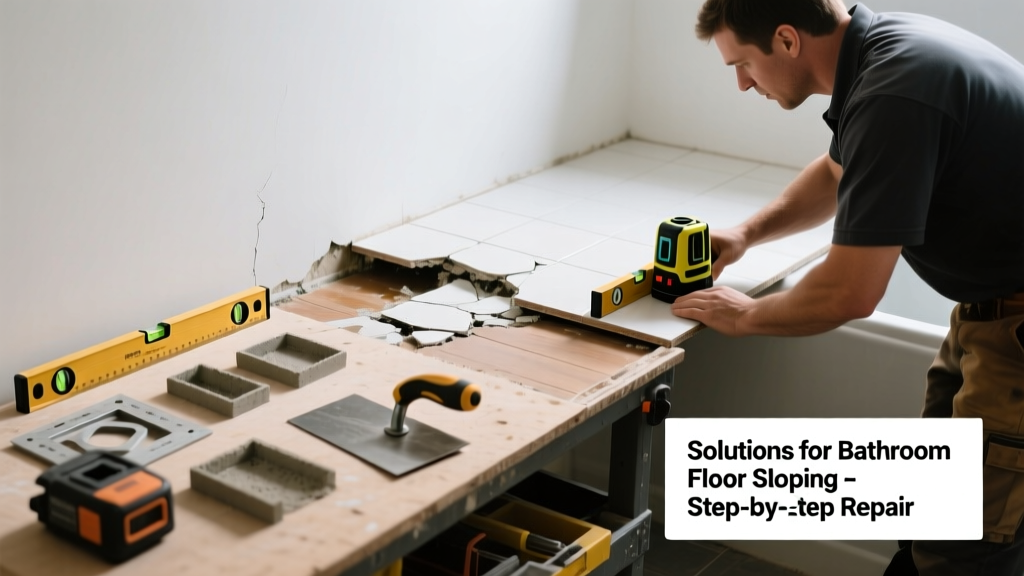
If your bathroom floor feels like it's tilting toward the shower or toilet—or if water pools unnaturally after a spill—you’re dealing with more than an eyesore. That slope can signal structural weakness, moisture intrusion, or decades-old settling, and ignoring it risks tile cracking, grout failure, and even slip-and-fall liability. Start here to assess severity and choose the right fix before it worsens.
Quick Diagnosis
Bathroom floor slope rarely appears overnight. Pinpointing the cause determines whether you’re patching a symptom or addressing a structural threat:
- Localized dip near toilet or tub—often due to rotted subfloor from chronic leaks
- Uniform downward tilt across the entire floor—common with inadequate joist spacing (e.g., 24" on center instead of 16" for 3/4" plywood)
- Slope worsening after heavy rain—points to foundation settlement or saturated crawl space soil
- Soft or spongy areas with musty odor—strong indicator of microbial decay in OSB or particleboard subfloor
- Cracked grout lines radiating from one corner—frequently tied to joist deflection exceeding L/360 span limits
Tools & Materials Needed
| Item | Purpose | Estimated Cost |
|---|---|---|
| 24" digital level with vial and readout | Measures slope gradient in inches per foot; critical for quantifying severity | $45–$75 |
| 1/4"-inch drill bit + stud finder | Locates joists through finished floor without destructive probing | $25–$40 |
| 3/4" exterior-grade plywood (CDX) | Replaces compromised subfloor; rated for moisture resistance | $28–$36 per 4×8 sheet |
| Construction adhesive (polyurethane-based) | Bonds new subfloor to joists while resisting moisture degradation | $12–$18 per tube |
| 1-5/8" corrosion-resistant screws | Secures subfloor without splitting; stainless or coated for wet environments | $8–$12 per 1-lb box |
Step-by-Step Fix
Choose your method based on slope severity and access. Never overlay thinset or self-leveler over a flexing subfloor—it’ll delaminate within months.
- Measure and map the slope: Use your digital level at 12-inch intervals across the floor. Record deviations—anything over 1/4" per 6 feet warrants structural repair, not cosmetic leveling.
- Access from below (if possible): In crawl spaces or basements, shim sagging joists with pressure-treated wood wedges and secure with joist hangers. The U.S. Department of Housing and Urban Development’s 2022 Residential Construction Guide states that joist uplift exceeding 1/2" requires engineered reinforcement.
- Replace damaged subfloor: Cut out rotted sections using a circular saw set to subfloor depth only. Install new CDX plywood, gluing and screwing every 6" along joist edges and 12" in the field.
- Add sister joists (for chronic sag): Attach 2×8 or 2×10 lumber alongside existing joists using construction adhesive and 3" structural screws every 12". Clamp until adhesive cures (24 hrs).
- Reinstall finish flooring: Use uncoupling membranes like Schluter-DITRA beneath tile to absorb minor residual movement—never rely on mortar bed thickness alone.
When to Call a Pro
DIY is unsafe or ineffective when:
- The slope exceeds 1/2" per 10 feet—and especially if accompanied by wall cracks or door binding
- You find blackened, crumbly subfloor material or active water seepage during inspection
- Your home was built before 1970 with balloon framing and no accessible crawl space
- The bathroom sits above a concrete slab with no basement—subfloor replacement may require jackhammering and slab repair
- Local building codes require engineered drawings for joist modifications (mandatory in CA, WA, and all seismic zones)
"Over 68% of bathroom floor failures we see stem from moisture-damaged subfloors misdiagnosed as 'just settling'—by the time homeowners notice the slope, rot has often progressed beyond DIY repair." — Mike Rinaldi, Certified Master Remodeler, NAHB Remodelers Council, 2023
Prevention Tips
Stop recurrence before it starts:
- Install a drip pan under the water heater—even if it’s not in the bathroom—to catch slow leaks before they wick into framing
- Run bathroom exhaust fans for 20 minutes post-shower; proper ventilation keeps relative humidity below 60%, slowing wood decay
- Check toilet wax ring integrity annually—use dye tablets in the tank to detect silent flapper or seal leaks
- Seal all grout lines every 18 months with silicone-based sealer—not acrylic—to prevent water migration beneath tile
Can I use self-leveling compound over a sloped bathroom floor?
No—not unless the subfloor is structurally sound and dry. Self-leveler adds weight without support; if the joists are deflecting, it will crack and debond. Always test subfloor rigidity first with a 60-lb load test at mid-span.
How do I know if the slope is from foundation issues?
Look for diagonal cracks in drywall corners, sticking windows on the same wall, or exterior brick veneer separation. If slope aligns with cracks in the garage slab or basement floor, contact a structural engineer—foundation settlement requires soil stabilization, not floor patching.
Will replacing just the tile fix the slope?
No. Tile is a finish layer—it reflects underlying problems. Installing new tile over a sloped, unstable subfloor guarantees lippage, cracked grout, and premature failure. Subfloor correction must come first.
Can I sister joists from above without removing the floor?
Rarely—and never safely in bathrooms. Access requires cutting 12"-wide trenches through tile and subfloor, risking plumbing lines and electrical cables. It’s faster, safer, and code-compliant to work from below or fully replace the floor assembly.
How long does a proper subfloor repair take?
For a standard 5'×7' bathroom with moderate rot: 2 days for demo and drying, 1 day for install and adhesive cure, plus 2 days for thinset and tile setting. Rushing adhesive or mortar cure leads to hollow-sounding tiles and grout shrinkage.
Is a slightly sloped floor acceptable in a bathroom?
Yes—but only if intentional and functional. Per IPC Section 405.2, shower floors require a minimum 1/4" per foot slope to drain. However, unintended slope elsewhere violates ADA guidelines (maximum 1:48 ramp ratio) and increases slip risk—especially with wet feet and soapy residue.
A slight, stable slope won’t vanish overnight—but unchecked movement will. Address the cause, not just the symptom, and your bathroom floor will stay safe, solid, and code-compliant for another 20 years. Pair repairs with routine moisture checks, and consider upgrading to smart leak detectors under sinks and vanities—they pay for themselves after catching just one slow drip.