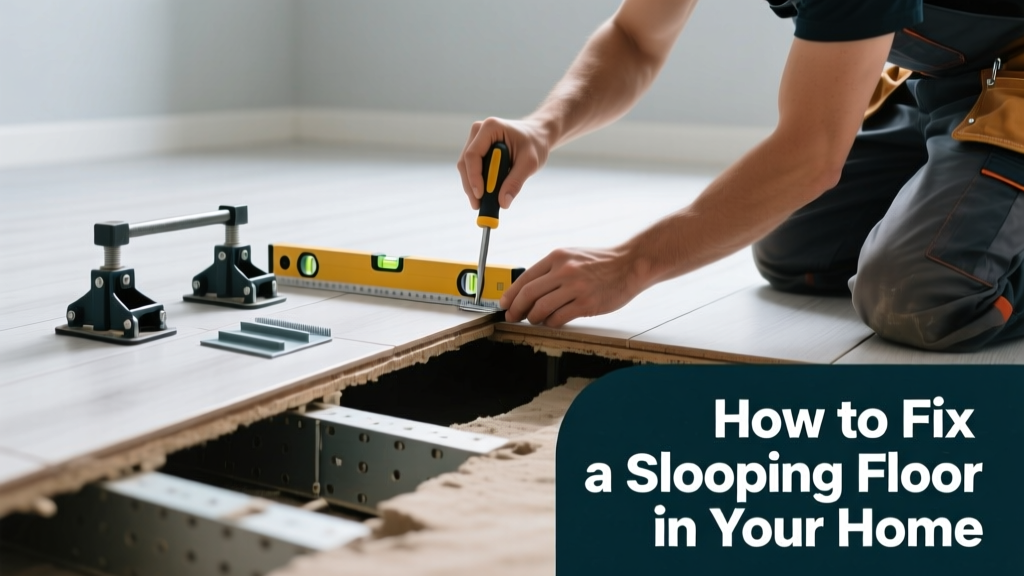
A slightly sloping floor isn’t just an eyesore—it’s often the first visible sign of deeper structural trouble. You might notice doors sticking, water pooling near baseboards, or furniture sliding toward one wall. Ignoring it risks worsening foundation movement, joist decay, or even safety hazards.
Quick Diagnosis
Before grabbing tools, identify the root cause. Most sloping floors stem from one (or more) of these issues:
- Settling or shifting foundation—especially common in homes built on clay soil or with poor drainage
- Rotted or undersized floor joists, often due to chronic moisture or termite damage
- Failed or inadequate support posts or beams in crawlspaces or basements
- Poorly compacted fill dirt beneath a slab-on-grade foundation
- Heavy point loads (e.g., a large aquarium or masonry fireplace) causing localized deflection
Tools & Materials Needed
| Item | Purpose | Estimated Cost |
|---|---|---|
| Laser level or long straightedge + bubble level | Accurately measure slope direction and degree over 10+ feet | $45–$120 |
| Moisture meter | Detect hidden rot or high subfloor humidity before cutting into flooring | $60–$180 |
| Jack post (adjustable steel column) | Temporarily lift sagging beams or joists during repair | $85–$220 |
| Pressure-treated 4×4 or 6×6 lumber | Replace failed support posts or build new beam supports | $12–$35 per piece |
| Construction adhesive & structural screws | Secure sistered joists and prevent squeaks or slippage | $18–$42 |
Step-by-Step Fix
Choose the method based on your diagnosis and access. Always start by shutting off power if working near wiring and wearing safety glasses and gloves.
- Map the slope: Use a laser level across multiple rooms to confirm whether the slope is uniform (foundation issue) or isolated (joist/post failure).
- Access the underside: Enter crawlspace or basement. Look for cracked concrete, rust stains, damp insulation, or visibly bent joists. Tap joists with a hammer—if they sound hollow or flex easily, rot is likely.
- Stabilize and lift: Place a jack post under the sagging beam. Raise slowly—no more than 1/8" per day—to avoid cracking drywall or breaking plumbing. Hold position with temporary blocking, then install permanent pressure-treated post and concrete pier.
- Sister damaged joists: Attach a new 2×10 or 2×12 alongside the rotted joist using construction adhesive and 3" structural screws every 6". Extend at least 3 feet beyond damaged section.
- Re-level subfloor: For minor slopes (<1/2" over 6 feet), use self-leveling compound over plywood subfloor—never over OSB or particleboard.
When to Call a Pro
Some floor slope problems go beyond DIY scope—and attempting them can compromise your home’s integrity. Call a licensed structural engineer or foundation contractor if:
- The slope exceeds 1/2" per 10 feet anywhere in the house
- You see horizontal cracks >1/4" wide in foundation walls or stair-step cracks in brick veneer
- Multiple rooms show progressive sloping over 6–12 months
- There’s active water intrusion, mold growth, or confirmed termite damage in structural wood
- Your home sits on expansive clay soil and you’ve had prior foundation repairs
"Over 70% of foundation-related insurance claims involve unaddressed floor slope that worsened over 2+ years." — National Association of Home Builders Foundation Report, 2022
Prevention Tips
Long-term stability starts with moisture control and routine inspection:
- Install gutters and downspout extensions to keep roof runoff at least 5 feet from foundations
- Maintain consistent soil moisture around perimeter—avoid prolonged drought or saturation
- Inspect crawlspaces annually for standing water, mold, or insect activity
- Use dehumidifiers in basements with relative humidity above 60%
- Never cut or notch floor joists without engineering approval—even for plumbing or electrical
Can floor sloping be fixed without removing flooring?
Yes—if the problem is structural (e.g., sagging beam or rotted joist), repairs happen from below. But if the subfloor itself is warped or delaminated, you’ll need to replace sections—and that usually means pulling up finished flooring. Solid hardwood or tile makes this especially labor-intensive; vinyl plank or carpet is easier to reinstall after subfloor work.
Is floor sloping always a sign of foundation failure?
No. While foundation settlement causes many cases, localized sloping often points to isolated framing issues: a single failed support post, water-damaged joist, or improperly sized header over a large opening. That’s why mapping the slope pattern matters more than assuming the worst.
How much does professional floor leveling cost?
Minor joist sistering or post replacement runs $1,200–$3,500. Full foundation stabilization (piering, mudjacking, or slab jacking) averages $4,500–$12,000, depending on home size and soil conditions. Get at least three itemized bids—and verify each contractor carries structural repair liability insurance.
Will fixing floor slope increase my home’s value?
Yes—when properly documented. A repaired slope with engineering sign-off removes a major red flag during inspections. Realtors report homes with resolved structural issues sell 5–8% faster and closer to asking price, per the 2023 National Association of Realtors Remodeling Impact Report.
Can I use shims to level a sloping floor?
Shims are only appropriate for minor, localized adjustments—like lifting one corner of a cabinet or door threshold. Never shim entire rooms or rely on them to compensate for structural movement. Over time, shims compress, shift, or rot, worsening the problem. They’re a bandage, not a fix.
Does homeowners insurance cover floor sloping repairs?
Rarely. Most policies exclude gradual deterioration, earth movement, or maintenance-related issues. If slope results from sudden, covered peril—like a burst pipe flooding and rotting joists—you may recover part of the cost. File a claim only after getting a written cause assessment from a licensed inspector.
Fixing floor slope isn’t about perfection—it’s about stopping progression and restoring safety and function. Start with careful observation, move deliberately through repairs, and don’t hesitate to bring in expertise when the stakes involve load-bearing systems. A stable floor supports everything else in your home—literally and figuratively. For related issues, see our guides on sagging floor joists and foundation crack repair.