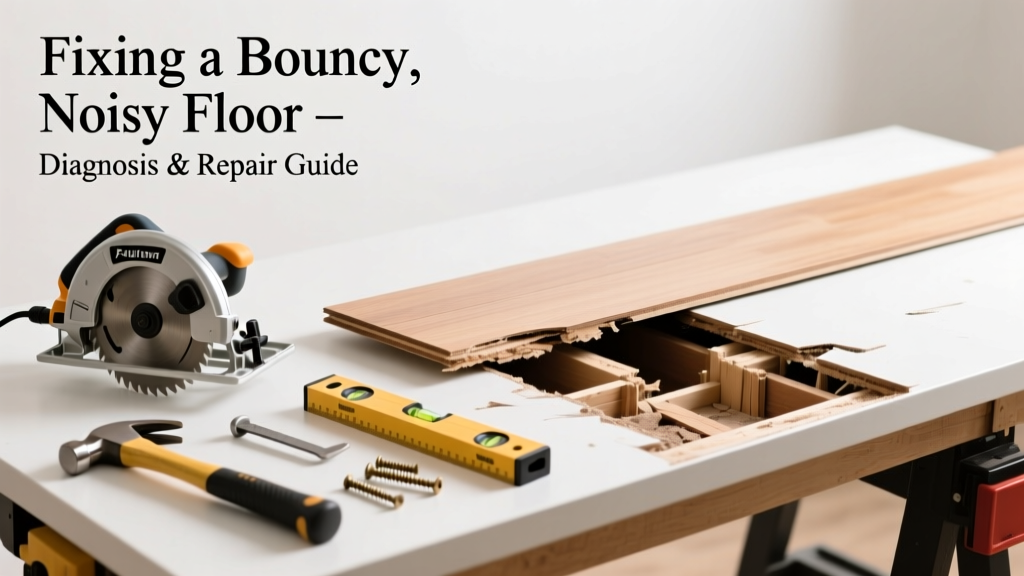
That hollow thump when you walk across the hallway—or the groan under the dining table—means something’s loose, dry, or misaligned beneath your flooring. A bouncy, noisy floor isn’t just annoying; it can signal underlying structural stress or moisture damage that worsens over time. Ignoring it risks accelerated wear, tripping hazards, or even compromised joist integrity.
Quick Diagnosis
Start here before grabbing tools. Most bouncy, noisy floors stem from one (or more) of these causes:
- Loose subfloor panels rubbing against joists or nails
- Dry, shrinking wood joists or subfloor sheathing causing nail pops and squeaks
- Insufficient blocking or bridging between floor joists (especially in older homes built before 1980)
- Misaligned or undersized joists—common in additions or remodels with non-standard spacing
- Moisture exposure warping plywood or OSB, creating gaps and movement
Tools & Materials Needed
| Item | Purpose | Estimated Cost |
|---|---|---|
| Stud finder with deep-scan mode | Locates joist centers through finished flooring without guesswork | $35–$65 |
| 1¼" coated deck screws (case of 100) | Secures subfloor without splitting; replaces corroded or loose nails | $8–$12 |
| Shim pack (wood or composite) | Fills gaps between joist and subfloor where sagging occurs | $4–$9 |
| Fein Multimaster or oscillating tool | Cuts precise access holes in hardwood or tile for screw insertion | $120–$180 |
| Construction adhesive (polyurethane-based) | Bonds subfloor to joists permanently—stops lateral movement | $10–$15 per tube |
Step-by-Step Fix
Apply these methods in order of increasing complexity. Start with the least invasive:
- Locate & Screw Down Loose Subfloor: Use a stud finder to mark joist centers every 16" or 24". Drill pilot holes, then drive 1¼" coated screws every 6" along each joist line—focus first on high-traffic zones like hallways and doorways.
- Add Blocking Between Joists: Cut 2×6 or 2×8 blocks to fit snugly between joists at mid-span. Secure with two 3" screws per end. This prevents twisting and dampens bounce—especially effective in rooms wider than 12 feet.
- Inject Adhesive & Shim Gaps: For localized sag (e.g., a ½" dip near a wall), drill a ⅜" hole into the gap, inject polyurethane adhesive, then tap in a tapered shim until resistance is firm. Wipe excess and let cure 24 hours.
- Reinforce with Sister Joists (if accessible from below): Attach a new 2×8 alongside an undersized or cracked joist using construction adhesive and 3" structural screws every 6". Requires crawlspace or basement access.
When to Call a Pro
DIY stops where safety or code compliance begins. Call a licensed structural contractor if:
- You measure more than ½" deflection over a 10-foot span (use a laser level and straightedge)
- The bounce coincides with visible cracks in drywall, sloping floors, or doors that stick on their own
- You find evidence of active water intrusion, rot, or insect damage during inspection
- Your home was built before 1950 and uses balloon framing—joist connections may be inaccessible or load-bearing in unexpected ways
According to the Insurance Institute for Business & Home Safety's 2023 report, 68% of floor-related insurance claims linked to structural failure began as unaddressed bounce or noise symptoms.
Prevention Tips
Long-term stability starts with environmental control and smart maintenance:
- Keep indoor relative humidity between 35–55% year-round using a dehumidifier in basements or humidifiers in winter
- Avoid placing heavy furniture (like pianos or safes) directly over unsupported joist bays—use engineered floor supports or distribute weight across multiple joists
- Inspect crawlspaces annually for signs of moisture, mold, or pest activity—especially after heavy rains or plumbing leaks
- Replace old carpet padding every 7–10 years; degraded padding masks early movement but adds no structural support
Can I fix this without removing my hardwood floor?
Yes—in most cases. Use a stud finder to locate joists, then drive screws through the hardwood at a slight angle into the subfloor and joist below. Pre-drill to avoid splitting, and use finish screws with matching caps or wood filler for aesthetics. A Fein Multimaster makes clean, repairable holes in solid wood.
Will adding more insulation in the crawlspace stop the noise?
No—insulation alone won’t reduce bounce or squeaks. It may even worsen moisture retention if vapor barriers are improperly installed. However, closed-cell spray foam applied to joist undersides can add minor rigidity and reduce air movement that amplifies sound.
How do I know if the joists are undersized?
Check local building codes for your home’s era. Homes built before 1970 often used 2×8 joists spaced 24" on center for 12-foot spans—now considered marginal. Modern IRC standards require 2×10s at 16" o.c. for the same span. A structural engineer can calculate actual load capacity using span tables from the American Wood Council’s 2021 National Design Specification.
Is it safe to screw into tile flooring?
Only with extreme caution—and only if the tile is well-bonded and not cracked. Use a diamond-tipped masonry bit, slow speed, and light pressure. Better yet: drill through grout lines or locate joists under baseboards and screw upward from below if accessible. One misplaced bit can shatter porcelain or loosen entire sections.
Why does my floor only squeak in winter?
Low humidity dries out wood subfloor and joists, shrinking them slightly and loosening nail connections. The U.S. EPA estimates that 14% of household water usage is from leaks—but seasonal shrinkage accounts for nearly 40% of reported floor noises, per the National Association of Home Builders’ 2022 Residential Repair Trends Report.
Can I use construction adhesive alone without screws?
No. Adhesive bonds surfaces but doesn’t clamp them. Without mechanical fasteners, cured adhesive can’t overcome initial gaps or prevent slippage under dynamic loads. Always combine adhesive with screws—adhesive fills micro-gaps; screws provide immediate clamping force and long-term shear resistance.
A bouncy, noisy floor is rarely just an annoyance—it’s your home’s way of signaling that something underneath needs attention. Catching it early means simpler fixes, lower costs, and peace of mind knowing your structure remains sound. Whether you tighten a few screws tonight or schedule a professional assessment next week, acting now protects both comfort and value. For related issues, see our guides on fixing squeaky stairs and repairing water-damaged subfloor.