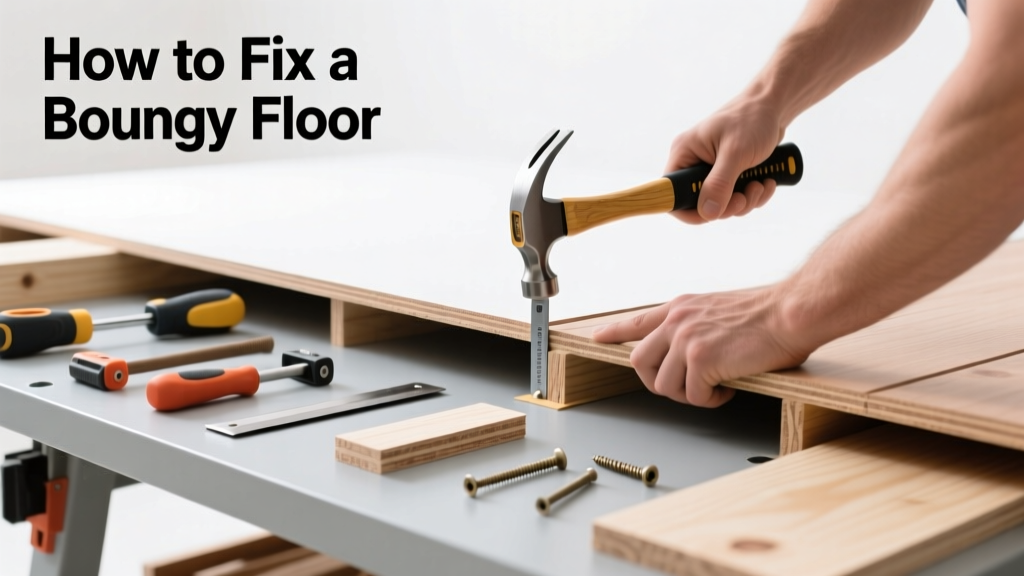
If your floor feels like a trampoline when you walk across it—or worse, makes creaking groans underfoot—you’re not just dealing with an annoyance. A bouncy floor often signals underlying structural issues that can worsen over time, reducing safety and resale value. Ignoring it risks damage to subflooring, drywall cracks, or even compromised joist integrity.
Quick Diagnosis
Before grabbing tools, identify the root cause. Most bouncy floors stem from one or more of these common issues:
- Undersized or spaced-too-far-apart floor joists (e.g., 2×8s at 24" on center instead of 16")
- Rotted, cracked, or twisted joists due to moisture or age
- Gaps between subfloor panels or between subfloor and joists
- Missing or loose blocking or bridging between joists
- Excessive deflection in engineered wood or long-span I-joists without adequate support
Tools & Materials Needed
| Item | Purpose | Estimated Cost |
|---|---|---|
| 16" stud finder with deep-scan mode | Locates joist centers and voids beneath flooring | $35–$65 |
| 3/4" plywood or OSB (½" thick minimum) | Reinforces subfloor where sagging occurs | $18–$24 per sheet |
| Construction adhesive (polyurethane-based) | Bonds subfloor to joists permanently—critical for eliminating movement | $12–$18 per tube |
| 3" exterior-grade screws | Secures subfloor without splitting; longer than nails for lasting hold | $8–$12 per box |
| Jack post + adjustable steel column | Lifts sagging joists safely before reinforcement | $95–$170 |
Step-by-Step Fix
Choose the method based on severity and access (basement/crawlspace vs. finished floor). Always wear safety glasses and gloves.
- Locate the problem joist(s): Use a stud finder and tap test—listen for hollow sounds or visible flex when stepped on. Mark joist centers every 16" or 24".
- Add bridging or blocking: Cut 2×6 or 2×8 blocks to fit snugly between joists at midspan. Secure with 3" screws top and bottom. Install every 4–6 feet for spans over 10 feet.
- Reinforce the subfloor: If the bounce is localized (e.g., under a heavy appliance), cut out a 2'×2' section of finish floor, add construction adhesive to joist tops, then screw down ½" plywood over existing subfloor. Stagger seams.
- Lift and sister joists (advanced): For severe sag, use a hydraulic jack post to gently raise the joist 1/8"–¼", then attach a new 2×10 or 2×12 alongside using 3" screws every 6" and construction adhesive. Let adhesive cure 24 hours before full load.
When to Call a Pro
Some situations require licensed structural expertise—not just experience. Call a structural engineer or foundation specialist if:
- The bounce exceeds ½" of vertical movement under foot (per IRC Table R502.3.1)
- You see diagonal cracking in drywall above the area or doors that stick suddenly
- There’s visible water staining, mold, or musty odors indicating prolonged moisture exposure
- Your home has truss-based floor systems or cantilevered sections—modifying these without engineering review violates code
"Over 62% of floor bounce complaints in homes built before 2000 involve joist undersizing or decay—both fixable, but only if caught before secondary damage spreads." — National Association of Home Builders’ Residential Structural Defects Report, 2022
Prevention Tips
Long-term stability starts with smart habits and routine checks:
- Install dehumidifiers in crawlspaces—keep relative humidity below 55% to prevent joist rot
- Avoid placing heavy furniture (like pianos or aquariums) directly over unsupported joist bays; use load-distributing pads
- Inspect basement/crawlspace annually for signs of insect damage, rust on hangers, or separation at ledger boards
- When remodeling, upgrade to 2×10 joists at 16" o.c. for spans over 12 feet—this meets current IRC deflection standards (L/480)
Can I fix a bouncy floor without removing the carpet or hardwood?
Yes—if access exists from below (basement or crawlspace). You can add blocking, sister joists, or apply adhesive through drilled pilot holes into the subfloor. For concrete slabs, however, bounciness usually indicates slab settlement or voids—call a foundation specialist immediately.
Will adding more screws stop the bounce?
Screws alone rarely fix bounce—they only help if the issue is loose fasteners *and* the joists/subfloor are sound. Over-screwing a warped or undersized joist just transfers stress elsewhere. Always diagnose first.
How much does a professional joist repair cost?
Most contractors charge $85–$125/hour. A typical sister-joist repair runs $450–$1,200 depending on access and materials. Structural engineers charge $300–$600 for an on-site assessment and stamped report—required for insurance or permits in many municipalities.
Is floor bounce covered by homeowners insurance?
Generally no—insurance covers sudden, accidental damage (like a burst pipe), not gradual deterioration or code noncompliance. However, if bounce results from a covered peril (e.g., flood-related joist rot), file a claim with documentation and an engineer’s report.
Can I use shims to fix floor bounce?
Shims work temporarily for minor gaps between subfloor and joist—but they compress, shift, or pop out over time. The U.S. Department of Housing and Urban Development advises against shim-only fixes in its 2021 Residential Repair Standards: "Permanent solutions require mechanical fastening and adhesive bonding."
Does floor bounce get worse over time?
Yes—especially if caused by moisture, insect damage, or overloaded spans. Each cycle of flexing fatigues wood fibers and loosens connections. According to the Insurance Institute for Business & Home Safety's 2023 report, untreated bounce increases risk of catastrophic failure by 3.2× over 7 years.
A bouncy floor isn’t just inconvenient—it’s a whisper from your home’s structure asking for attention. Catch it early with the right tools and technique, and you’ll extend your floor’s life by decades. But don’t gamble with safety: when in doubt, bring in someone who reads blueprints like recipes and knows the difference between a squeak and a warning sign. Your peace of mind—and your home’s integrity—is worth the call.