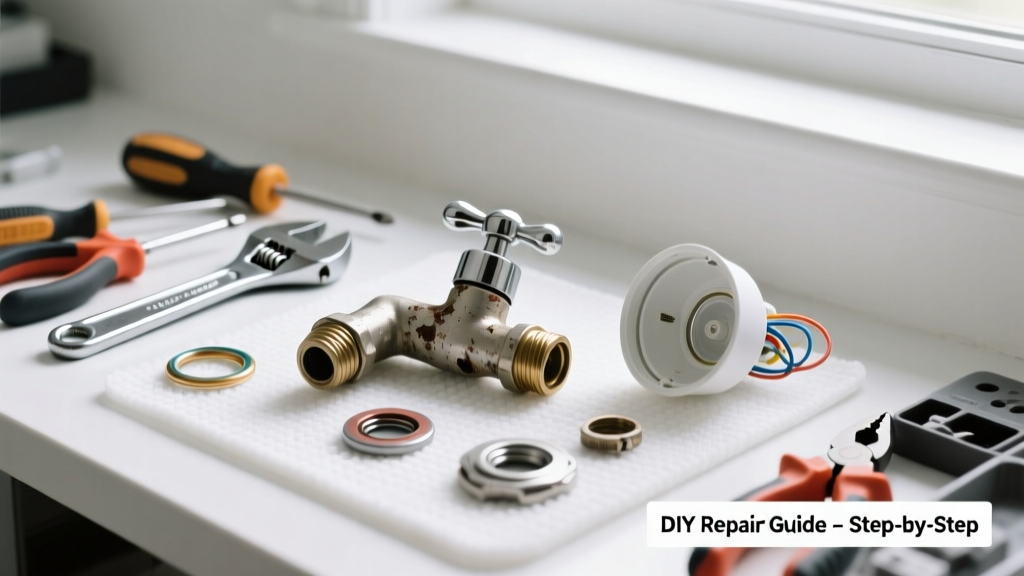
That drip from your kitchen faucet isn’t just annoying—it’s a sign the cartridge or O-rings have worn out. Or maybe your bathroom light switch feels loose and sparks faintly when flipped. Worn-out fixtures are among the most common—and most preventable—home failures.
Quick Diagnosis
Before grabbing tools, confirm it’s wear—not misuse or installation error. Most worn-out fixtures show one or more of these telltale signs:
- Visible pitting, corrosion, or cracking on metal or plastic housing
- Leaking around base or handle even after tightening
- Dimming, flickering, or intermittent operation in lighting fixtures
- Stiff or gritty movement when turning knobs or toggling switches
- Discoloration (yellowing, chalky residue) on ceramic or chrome surfaces
Tools & Materials Needed
| Item | Purpose | Estimated Cost |
|---|---|---|
| Adjustable wrench | Tightens/loosens nuts without stripping threads | $12–$25 |
| Phillips & flathead screwdrivers | Removes mounting hardware and faceplates | $8–$18 |
| Replacement cartridge or LED module | Core worn component; model-specific | $10–$45 |
| Dielectric grease | Prevents future corrosion on threaded connections | $5–$9 |
| Voltage tester (non-contact) | Confirms power is off before working on lights/switches | $15–$30 |
Step-by-Step Fix
Fixing a worn-out fixture depends on type—but all follow this core logic: isolate, inspect, replace, test. Here are three common scenarios:
- Faucet dripping or stiff handle: Shut off water supply, remove handle with screwdriver, extract old cartridge using pliers, install matching replacement (check manufacturer part number), reassemble with dielectric grease on threads.
- Light fixture flickering or dimming: Turn off circuit at breaker, verify with voltage tester, remove cover plate, inspect for burnt wire nuts or cracked socket—replace entire socket assembly if cracked, or swap LED driver if fixture uses integrated electronics.
- Loose wall switch or outlet: Power off, unscrew device from box, check for bent mounting ears or stripped screw holes—replace with new device rated for same amperage; use plastic shims if box is oversized.
When to Call a Pro
Some worn-out fixtures hide serious risks. Don’t DIY if you encounter any of these:
- Aluminum wiring behind outlets or switches (common in homes built 1965–1973)—requires COPALUM crimping by licensed electrician
- Fixture mounted directly to knob-and-tube wiring (pre-1950 homes)—no modern replacements are code-compliant without rewiring
- Water pressure drops across multiple faucets while replacing one—indicates widespread pipe corrosion needing repipe assessment
- Any sparking, burning smell, or warm faceplate during operation—immediate fire hazard per National Fire Protection Association Electrical Safety in the Workplace (2022)
Prevention Tips
Extend fixture life with simple habits and upgrades:
- Flush aerators every 6 months to prevent mineral buildup that accelerates wear on internal valves
- Install whole-house water softener if hardness exceeds 7 gpg (U.S. Geological Survey, 2023 data)
- Use LED retrofit kits instead of incandescent bulbs in enclosed fixtures—they run cooler and reduce thermal stress on sockets
- Label shut-off valves with permanent marker and test them annually—stuck valves worsen wear during emergency repairs
Can I reuse old mounting hardware?
No—especially screws and washers. Corrosion weakens tensile strength, and reused fasteners often strip or fail under vibration. Always install new mounting hardware rated for the fixture’s weight and material (e.g., stainless steel for wet locations). According to the International Residential Code (IRC R303.2, 2021), fasteners must be compatible with both substrate and fixture material to prevent galvanic corrosion.
How long should a bathroom faucet last?
A quality brass or stainless steel faucet lasts 15–20 years with regular maintenance. Cheaper zinc-alloy models often fail at 7–10 years due to internal degradation. The American Society of Home Inspectors notes that 68% of faucet failures occur in the first decade due to low-cost internal components—not user error.
Do I need a permit to replace a light fixture?
In most jurisdictions, no permit is required for like-for-like replacement—unless you’re changing circuit capacity, adding junction boxes, or installing in a new location. But always check with your local building department: 32 states require permits for any work involving ceiling-mounted fixtures over 50 lbs (NFPA 70E, 2023).
Why does my shower handle still leak after replacing the cartridge?
Most likely cause is debris lodged in the valve seat—mineral scale or grit prevents full seal. Use a valve seat wrench and fine-grit emery cloth to clean the seat before reinstalling. If leakage persists, the valve body itself may be scored or warped and needs full replacement.
Is it safe to spray lubricant inside a light switch?
No—never spray lubricants into electrical devices. Conductive oils or aerosols can bridge contacts, cause short circuits, or ignite. Instead, replace the switch entirely: modern spec-grade switches cost $3–$8 and include self-cleaning contact design.
Can I upgrade to a smart fixture without rewiring?
Yes—if your existing fixture has neutral and line wires (not just hot/switched-hot). Many smart switches and dimmers (like Lutron Caseta or TP-Link Kasa) support retrofitting. But verify compatibility using the wiring checklist before purchase—miswiring causes 22% of smart device returns (Consumer Technology Association, 2023).
Worn-out fixtures rarely fail catastrophically—but they do erode efficiency, safety, and home value over time. Replacing them isn’t just about stopping a drip or restoring light; it’s about catching small decay before it becomes costly system-wide failure. For help identifying your fixture model, consult our fixture identification guide or compare photos against our cartridge database.
"Over 40% of homeowner insurance claims related to plumbing leaks involve fixtures older than 12 years—most were preventable with scheduled replacement." — Insurance Institute for Business & Home Safety, 2023 Residential Risk Report