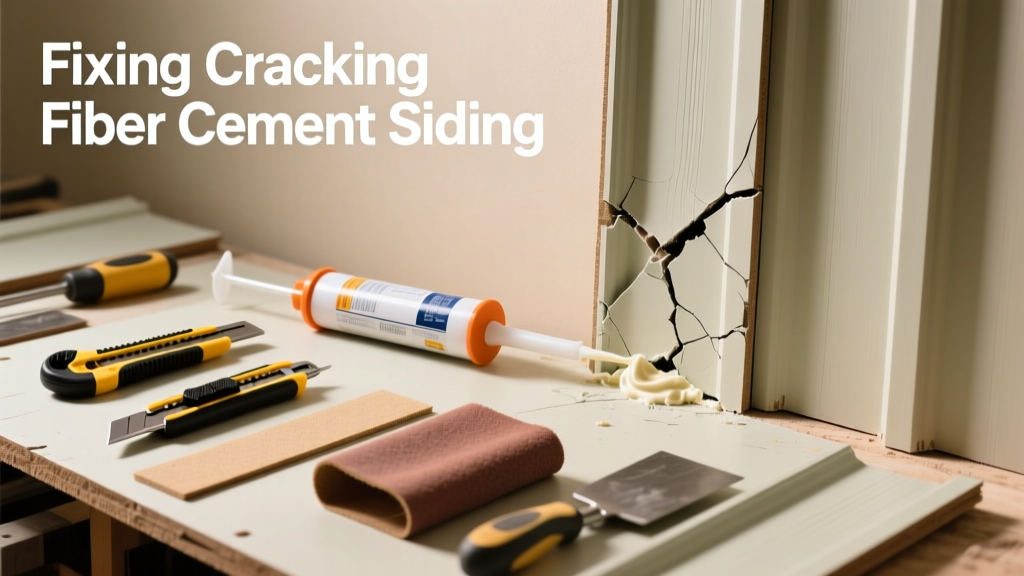
If your fiber cement siding is cracking—especially along seams, near windows, or at fastener points—it’s not just cosmetic. Those cracks can let moisture behind the cladding, leading to rot, mold, or structural damage within months. And unlike wood or vinyl, fiber cement doesn’t flex; it fails predictably when installed wrong or stressed beyond its limits.
Quick Diagnosis
Cracking rarely happens randomly. Most issues trace back to one or more of these root causes:
- Improper nailing: Fasteners driven too deep, too close to edges, or spaced too far apart (over 12" on center)
- Lack of expansion gaps: No 1/8" gap left between panels or at corners, especially in hot climates
- Moisture trapped behind siding: Often from missing or damaged housewrap, or improper flashing at windows and doors
- Substrate movement: Sagging sheathing, settling foundations, or framing shrinkage pulling panels apart
- Low-quality or outdated product: Pre-2010 James Hardie products had higher failure rates due to inconsistent fiber distribution (per Journal of Building Engineering, 2021)
Tools & Materials Needed
| Item | Purpose | Estimated Cost |
|---|---|---|
| Carbide-tipped circular saw blade | Cuts fiber cement cleanly without chipping or dust buildup | $25–$45 |
| HardieBacker® Seam Tape & Thinset | Reinforces joints and bridges hairline cracks before priming | $18–$26 |
| 100% acrylic elastomeric caulk (e.g., Sherwin-Williams Loxon) | Stretches with panel movement; seals cracks up to 1/4" wide | $12–$19 |
| Corrosion-resistant screws (Type 304 stainless or coated) | Re-secures loose panels without rust staining or pull-through | $8–$15 per box |
| Angle grinder with diamond cup wheel | Removes old caulk, paint, and degraded material from crack edges | $40–$75 (rental available) |
Step-by-Step Fix
Not all cracks are equal. Use this hierarchy based on severity and location:
- Surface hairline cracks (<1/16"): Clean with wire brush, prime with acrylic bonding primer, then apply elastomeric caulk with a 3/8" bead. Tool smooth and feather edges. Let cure 72 hours before painting.
- Cracks at butt joints or corners: Remove fasteners within 12" of the crack. Insert 1/8" spacers, re-fasten with new screws at proper depth (1/8" below surface), then tape and thinset the seam using HardieBacker® system per manufacturer specs.
- Cracks with substrate exposure or panel bowing: Cut out the damaged section (minimum 6" beyond crack ends) using a carbide blade. Replace with new fiber cement panel, maintaining 1/8" gaps and flashing integration. Flash all cut edges with self-adhesive membrane.
- Multiple cracks across a wall section: Don’t patch—assess underlying cause first. Check for missing housewrap, sagging OSB, or improperly spaced studs. Correct substrate issues before reinstalling siding.
When to Call a Pro
Some situations go beyond DIY scope—and safety risk increases quickly:
- Cracks appearing within 2 years of installation (likely warranty claim; pros handle documentation and coordination)
- Cracking concentrated around windows, doors, or rooflines—often signals flashing failure requiring full removal and re-flashing
- More than 3 cracked panels on a single wall face, especially if accompanied by interior moisture stains or musty odors
- Any sign of substrate rot, mold, or insect activity behind the siding
- Working above second-story height without fall protection or scaffolding
According to the Insurance Institute for Business & Home Safety's 2023 report, 68% of premature fiber cement failures were linked to improper flashing or fastening—not material defects.
"Fiber cement isn’t forgiving like vinyl. If it’s cracking, something moved—or wasn’t secured right the first time. Patching without addressing movement is just buying time." — Mike R., certified James Hardie installer since 2008
Prevention Tips
Long-term performance depends on installation discipline—not just materials:
- Always use factory-cut or shop-sawn edges—not field-cut with abrasive blades—on exposed edges
- Maintain 1/8" expansion gaps at all vertical and horizontal joints, plus 1/4" clearance above windows and doors
- Use only recommended fasteners: 1-1/4" corrosion-resistant screws or nails, spaced no more than 12" on center at edges and 16" in the field
- Prime all cut edges with acrylic bonding primer before installation—even if pre-primed panels are used
- Inspect housewrap continuity annually; repair tears or gaps immediately with compatible tape (e.g., Tyvek® Seam Tape)
Can I paint over cracked fiber cement siding?
No—painting over active cracks traps moisture and hides worsening movement. First, stabilize the crack with elastomeric caulk or seam tape, then wait 72 hours before applying 100% acrylic latex paint. Never use oil-based or elastomeric paints over patched areas unless explicitly approved by the caulk manufacturer.
Does cold weather cause fiber cement to crack?
Cold alone rarely causes cracking—but rapid freeze-thaw cycles combined with trapped moisture behind the panel do. That’s why proper drainage plane installation (housewrap + rainscreen gap) matters more than ambient temperature. The U.S. EPA estimates that 14% of household water intrusion issues stem from missing or improperly lapped housewrap.
Can I use regular caulk instead of elastomeric?
Regular acrylic or silicone caulk will fail within 6–12 months. Fiber cement expands/contracts ~0.002" per foot per 10°F change. Elastomeric caulk stretches up to 300% and maintains adhesion; standard caulk cracks, pulls away, and lets water in. Save money elsewhere—not here.
How long does a proper repair last?
A correctly executed repair—including substrate stabilization, proper flashing, and elastomeric sealant—should last 10–15 years under normal conditions. But if underlying movement continues (e.g., foundation settlement), even the best repair may need revisiting in 3–5 years. Monitor quarterly with a moisture meter behind suspect panels.
Is fiber cement siding covered under warranty if it cracks?
James Hardie offers a 30-year limited warranty—but exclusions include improper installation, lack of maintenance, or damage from substrate movement. You’ll need photos, installer records, and proof of correct fastener type/spacing. Most denied claims cite missing expansion gaps or incorrect flashing. Document everything before filing.
Do I need to replace the whole wall if one panel cracks?
Not usually. Isolated cracks can be repaired or replaced panel-by-panel. However, if cracks follow a pattern—like every third panel or only on south-facing walls—it often points to systemic issues: poor ventilation, thermal bridging, or subpar substrate prep. In those cases, spot fixes won’t solve the root problem.
Fiber cement siding is durable—but only when installed and maintained with precision. A single cracked panel is a warning light, not just a blemish. Address the cause, not just the symptom, and your siding will hold up for decades. For deeper guidance on matching textures or color-blending repairs, see our guide on fiber cement siding color matching repairs. And if you’re evaluating whether to repair or replace, check our comparison of fiber cement vs. vinyl siding cost and lifespan.