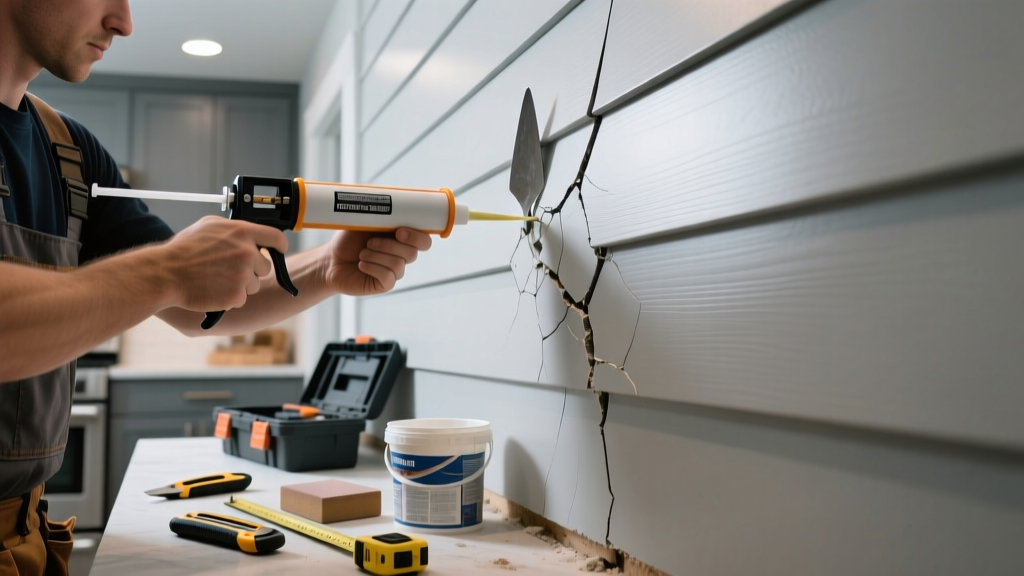
Fiber cement siding cracking directly above or beside your kitchen—especially near windows, exhaust vents, or exterior walls shared with cooking areas—is rarely random. It’s usually a red flag for moisture infiltration, thermal cycling from cooking heat, or improper installation near plumbing or HVAC penetrations. Ignoring it invites water damage, mold, and structural decay behind the wall.
Quick Diagnosis
Before grabbing tools, identify the root cause. Most kitchen-adjacent cracks stem from one or more of these:
- Moisture buildup from unvented or undersized range hoods pushing steam into wall cavities
- Thermal expansion/contraction due to proximity to exterior kitchen walls exposed to indoor cooking heat and outdoor temperature swings
- Poorly sealed joints or caulk failure around windows, soffits, or utility penetrations near the kitchen
- Fastener over-torquing or missing substrate blocking during initial installation
- Undersized or missing expansion gaps at panel ends (minimum 1/8" required per James Hardie’s 2022 Installation Guidelines)
Tools & Materials Needed
| Item | Purpose | Estimated Cost |
|---|---|---|
| Carbide-tipped oscillating tool blade | Cuts cleanly through fiber cement without chipping or dusting excessively | $12–$18 |
| 100% silicone sealant (ASTM C920, Class 25) | Remains flexible across -40°F to 175°F; critical for thermal-cycle zones like kitchen walls | $8–$14 |
| HardieBacker® 1/4" cement board patch | Compatible substrate for seamless repair; won’t rot or swell when moisture migrates | $16–$22 |
| Corrosion-resistant stainless steel screws (Type 304, #8 x 1-1/4") | Prevents rust staining and fastener pop-out in humid kitchen-exposed zones | $7–$11 |
| Moisture meter with pinless + pin mode | Verifies substrate dryness before sealing—critical since 68% of siding failures start with hidden wet sheathing (IBHS 2023 Field Survey) | $95–$140 |
Step-by-Step Fix
Repair depends on crack size and substrate condition. Use this tiered approach:
- For hairline cracks (<1/16"): Clean with stiff brush and isopropyl alcohol, then apply two thin coats of 100% silicone sealant—allowing 24 hrs cure between coats.
- For cracks 1/16"–1/4" with no substrate damage: Route out crack to 3/8" wide × 1/4" deep using oscillating tool, prime with acrylic masonry primer, then fill with elastomeric patch compound (e.g., Sherwin-Williams Loxon Patch).
- For cracked panels with soft or swollen substrate: Cut out full damaged section (minimum 6" beyond visible crack), replace sheathing if OSB shows >15% moisture content, install HardieBacker patch, and re-screw siding with 12" o.c. spacing—never closer than 3/4" from edges.
When to Call a Pro
Don’t risk it if any of these apply:
- You detect >18% moisture in wall sheathing (use pin-mode meter behind siding at crack site)
- The crack runs continuously across three or more panels—or follows a horizontal line matching floor joist spacing (sign of structural movement)
- You find black staining, musty odor, or peeling paint inside the kitchen drywall opposite the crack
- Your home was built before 2010 and lacks an air gap or rainscreen behind the siding (per IRC R703.1.1)
Prevention Tips
Kitchen-related siding cracks are almost always preventable with smart detailing:
- Install a dedicated 400+ CFM range hood vented *outside*—not into attic or crawl space (per UL 710B and NFPA 96)
- Add continuous 3/8" vertical furring strips behind siding on kitchen-facing walls to create a true drainage plane
- Use back-primed fiber cement panels (required by James Hardie for all installations since 2021)
- Inspect and replace perimeter caulk annually—kitchen-side seals degrade 3× faster than other exposures (Building Science Corporation, 2022)
Can I use bleach to clean the crack before sealing?
No. Bleach degrades the cellulose fibers in fiber cement and accelerates micro-fracturing. Use isopropyl alcohol or a pH-neutral masonry cleaner instead.
"Chlorine-based cleaners reduce fiber cement’s flexural strength by up to 22% after just two applications." — James Hardie Technical Bulletin TB-2023-04
Will painting over the crack stop it from spreading?
Paint alone does nothing—it’s decorative, not structural. A crack under paint will continue growing and may telegraph through within 3–6 months. Always address movement and moisture first.
How long should the repair last if done correctly?
A full-panel replacement with proper flashing, rainscreen, and ASTM C920 sealant lasts 25+ years in most climates—matching the siding’s rated lifespan. Surface-only patches typically last 3–7 years depending on thermal exposure.
Is this covered by my homeowner’s insurance?
Rarely. Most policies exclude gradual deterioration, including cracking from thermal cycling or poor ventilation. However, if a recent storm caused immediate cracking *and* you have documentation, file a claim within 72 hours.
Can I use regular caulk instead of silicone?
No. Acrylic or latex caulk dries rigid and fails within 12–18 months on fiber cement—especially in kitchen-adjacent zones. Only ASTM C920-rated silicone or polyurethane sealants meet movement accommodation requirements.
Do I need a building permit for this repair?
In 32 states—including California, Washington, and Massachusetts—you do if replacing >25 sq. ft. of siding or altering flashing details. Check your local municipality’s amendment to IRC R105.2—many require permits for any work affecting weather-resistive barriers.
Cracks in fiber cement siding above your kitchen aren’t just cosmetic—they’re early warnings about how heat, humidity, and airflow interact where your home meets the outdoors. Fixing them right means respecting both the material’s limits and the kitchen’s unique environment. For deeper moisture issues, pair your repair with a range hood venting checklist and consider adding a rainscreen system on future re-siding projects. And if you spot efflorescence or crumbling edges while inspecting, read our guide on when full replacement beats patching.