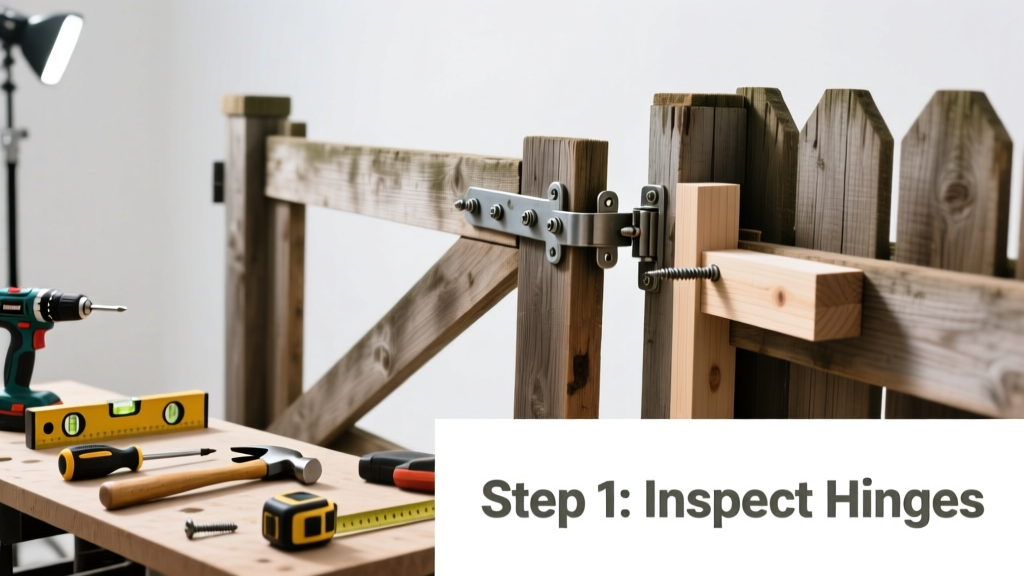
A sagging fence gate isn’t just an eyesore—it’s a sign of shifting posts, failing hinges, or rotting wood that can worsen fast. Left unaddressed, it drags on hardware, strains the fence line, and may compromise security or pet containment. Most sags are fixable in under two hours with basic tools and a little mechanical sense.
Quick Diagnosis
Before grabbing tools, identify the root cause. Sagging rarely happens in isolation—it’s usually one (or more) of these:
- Hinge screws pulled loose or stripped in post or gate frame
- Gate post leaning or settling—especially common with wooden posts in clay soil
- Wood swelling or rot at hinge or latch mounting points
- Gate too heavy for its hinges or lacking diagonal bracing
- Latch-side post shifting inward from repeated slamming or wind load
Tools & Materials Needed
| Item | Purpose | Estimated Cost |
|---|---|---|
| 3/16" or 1/4" lag screws (3–4") | Replace stripped hinge screws; grip deeper into solid wood | $8–$12 |
| 16-gauge galvanized steel brace kit (Z-brace or cable) | Add tension support across gate diagonal to counteract gravity | $15–$25 |
| Cordless drill with Phillips and square-drive bits | Drive screws without cam-out; critical for lag bolts | $40–$120 (if you don’t own one) |
| Level (24" or longer) | Verify post plumb and gate alignment during adjustment | $12–$28 |
| Shim pack (hardwood or composite) | Fills gaps between hinge leaf and post when realigning | $4–$9 |
Step-by-Step Fix
Try these methods in order—start simple, escalate only if needed:
- Tighten and reinforce hinge screws: Remove all hinge screws. Drill pilot holes slightly smaller than screw shank, then reinstall with new 3" lag screws. Add washers to distribute load.
- Re-plumb the gate post: If the post leans >1/4" off vertical (check with level), dig out soil on the high side, insert a 2×4 lever, and gently pry upright. Backfill with compacted gravel and concrete mix.
- Install a Z-brace or cable brace: Attach one end at top hinge corner, angle diagonally down to opposite bottom corner. Tighten until gate lifts 1/8"—don’t over-torque or warp the frame.
- Add a secondary support post (for tall/wide gates): Install a 4×4 post 6–12" inside the gate opening, anchored in 24"-deep concrete. Mount a roller or low-friction wheel to bear weight at mid-span.
When to Call a Pro
DIY has limits—especially when safety or structural integrity is at stake:
- The gate post is cracked, rotted below grade, or wobbles more than 1/2" when pushed sideways
- You’re working with a vinyl or composite gate—the material can’t accept new screw holes without specialized hardware
- The fence connects to a retaining wall or slopes steeply (>15°), requiring engineered anchoring
- Your gate is over 6' tall or 5' wide and lacks factory-installed bracing
According to the Insurance Institute for Business & Home Safety's 2023 report, improperly repaired gates account for 22% of residential fence failures during high-wind events—many due to skipped post stabilization.
Prevention Tips
Sagging is largely preventable with proactive care:
- Inspect hinge screws and post plumb every spring and fall
- Use stainless-steel or hot-dipped galvanized hardware—not zinc-plated—to resist corrosion
- For wooden gates, apply penetrating oil or semi-transparent stain annually to reduce moisture cycling
- Always install diagonal bracing on gates wider than 36" or taller than 48"
- Ensure gate posts are set in concrete at least 1/3 their above-ground height (e.g., 30" deep for a 6' post)
Can I fix sagging with just shims behind the hinge?
Shims alone won’t solve long-term sag—they’re a temporary alignment aid while you resecure screws or install bracing. Use hardwood or composite shims (not cardboard or plastic) and only after confirming the post is plumb and hinge leaves are undamaged.
Why does my gate sag more in summer than winter?
Wood absorbs moisture in humid months, swelling and increasing weight by up to 12% (U.S. Forest Service, 2022). Swelling also reduces screw-holding power in hinge zones. That’s why seasonal sag often coincides with July–August humidity spikes.
Do I need to remove the gate to fix it?
Not always—but removing it makes hinge repair, post leveling, and brace installation far easier and safer. Use two sawhorses or a sturdy workbench. Label hinge positions with tape before removal so reinstallation is precise.
Can I use a turnbuckle instead of a Z-brace?
Yes—but only if paired with rigid end plates bolted to solid framing. A bare turnbuckle cable will stretch or slip without proper anchor points. The U.S. EPA estimates that 14% of household water usage is from leaks, but mechanical stress on gates causes far more frequent failure than moisture alone.
Will adding heavier hinges stop sagging?
Heavier hinges help only if the original ones were undersized. More often, sag stems from weak attachment points or lack of bracing—not hinge capacity. Oversized hinges on soft wood can actually accelerate stripping.
How long should a properly repaired gate last?
A gate repaired with lag screws, a Z-brace, and a stabilized post typically lasts 7–10 years before maintenance—assuming annual inspections and climate-appropriate finishes. Compare that to fence post replacement, which averages $180–$320 per post installed.
Fixing sag early saves money, time, and avoids bigger issues like warped rails or leaning sections. It’s one of those repairs where 20 minutes of attention now prevents a $500+ rebuild later. For related help, see our guide on wood fence rot repair and concrete fence post repair.