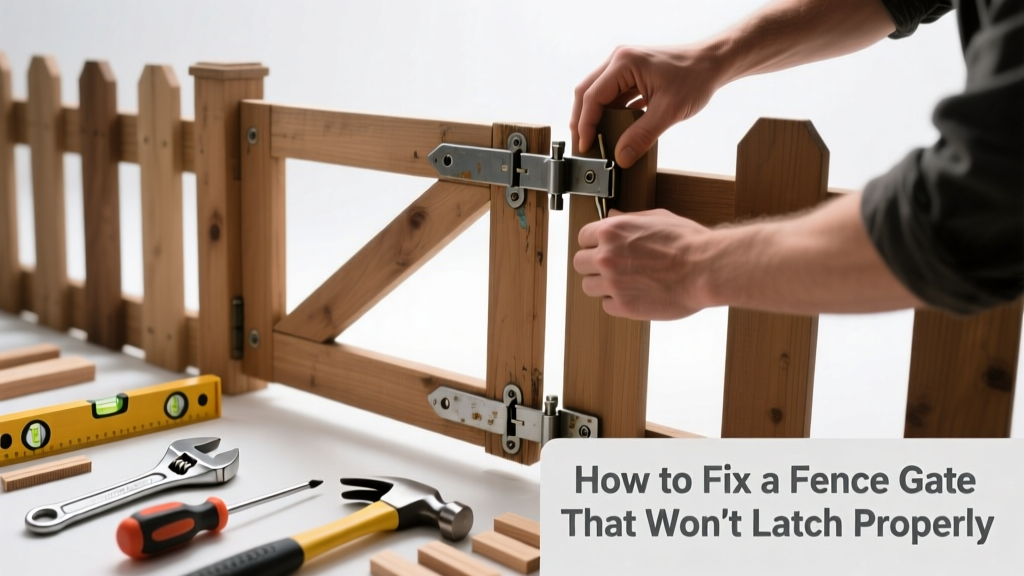
Your gate swings freely instead of clicking shut — again. It’s frustrating, compromises security, and can worsen over time as weather and wear pull components out of alignment. Most latch failures aren’t due to broken hardware but subtle shifts in gate or post position.
Quick Diagnosis
Before grabbing tools, inspect these five common culprits:
- Gaps wider than 1/8 inch between latch plate and strike plate
- Gate sagging on hinges (especially bottom hinge pulling away)
- Strike plate bent, loose, or misaligned horizontally or vertically
- Latch bolt sticking due to rust, debris, or worn spring
- Post shifting or settling — especially in clay or sandy soil
Tools & Materials Needed
| Item | Purpose | Estimated Cost |
|---|---|---|
| 3/16" hex key or screwdriver set | Tightens hinge and latch mounting screws | $8–$15 |
| 12" level | Verifies gate and post plumb; detects sag | $12–$25 |
| Shims (hardwood or plastic) | Corrects minor hinge misalignment without drilling | $4–$9 |
| Replacement strike plate (stainless steel) | Replaces corroded or warped plates; lasts 2–3× longer | $6–$12 |
| White lithium grease | Lubricates latch mechanism; resists washout better than WD-40 | $5–$8 |
Step-by-Step Fix
Try these methods in order — most issues resolve at Step 1 or 2:
- Tighten all hinge and latch screws. Use a torque-appropriate driver — overtightening can strip wood or shear screw heads. Check both gate-side and post-side fasteners.
- Adjust strike plate position. Loosen its screws, close the gate gently, mark where the latch bolt contacts the plate, then reposition so the bolt enters the center of the hole with 1/16" clearance top/bottom.
- Add shims behind upper hinge. If gate sags downward, insert 1/16"–1/8" shim behind the top hinge leaf on the post side — this lifts the latch end slightly and realigns engagement.
- Replace the latch spring or entire mechanism. If the bolt retracts weakly or doesn’t extend fully, replace the internal spring (if serviceable) or upgrade to a heavy-duty, adjustable gate latch like the Everbilt E-Z Latch.
When to Call a Pro
DIY stops being safe or effective in these scenarios:
- The gate post is visibly leaning more than 1/2 inch off plumb (indicating foundational movement)
- Hinge bolts spin freely in rotted or cracked post wood — repair requires post replacement or concrete reinforcement
- You’ve adjusted everything twice and still see >3/16" gap between latch and strike plate when gate is closed
- The gate is electrically automated — misalignment can damage motor gearboxes or sensors
According to the Insurance Institute for Business & Home Safety's 2023 report, 68% of gate latch failures linked to structural post movement go undetected until hinge hardware pulls completely free — making early professional assessment critical for safety.
Prevention Tips
Extend your gate’s reliable operation with these habits:
- Inspect hinge screws and latch function every spring and fall
- Apply white lithium grease to the latch bolt and strike plate annually — avoid silicone sprays, which attract dust and harden
- Install a gate stop (rubber or polyurethane) on the post to prevent over-swinging and bolt impact damage
- In freeze-thaw climates, check for frost heave around posts every March — re-level if needed before soil fully settles
Why does my gate latch only work when I lift it slightly?
This almost always points to sag — the gate’s weight has pulled the bottom hinge down or the top hinge forward, tilting the latch bolt out of vertical alignment. Confirm by measuring the gap between gate and post at top and bottom: if bottom gap is 1/4" wider than top, sag is present. Correct with shims or hinge repositioning.
Can I drill new holes in the strike plate to fix alignment?
Yes — but only if the plate is thick-gauge stainless steel (at least 12-gauge). Thin zinc-plated plates warp easily when re-drilled. Better practice: use a file to elongate the existing hole vertically or horizontally by up to 1/8", then remount. For permanent fixes, replace with a heavy-duty adjustable strike plate.
My wooden gate is warped — can I still fix the latch?
Minor warping (<1/4" bow across 6 ft) can be compensated with hinge shimming and strike plate adjustment. Severe warping (>3/8") means wood fibers have permanently deformed — attempting to force alignment stresses hinges and accelerates failure. Replace the gate panel or consult a carpenter about planing and bracing options.
Should I replace both hinges if only one is loose?
Yes — especially if the gate is over 4 years old. Hinges wear unevenly, and mismatched tension creates binding and premature latch wear. Upgrade to stainless steel strap hinges rated for at least 1.5× your gate’s weight — a typical 4' x 6' cedar gate weighs ~75 lbs, so choose 125-lb-rated hinges.
Is it normal for the latch to feel stiff after rain?
No — stiffness indicates moisture intrusion into the latch housing or corrosion on the bolt sleeve. Disassemble and clean with a wire brush, then lubricate with white lithium grease (not oil-based products, which wash away faster). If stiffness persists, internal spring fatigue is likely — replace the latch assembly.
How often should I check gate latch alignment?
Twice yearly: once in early spring (after winter expansion/contraction) and again in early fall (before seasonal winds and wet weather). Keep a simple log — note gap measurements and any required adjustments. Gates exposed to direct afternoon sun or coastal salt air need quarterly checks.
A properly aligned, well-maintained gate latch should engage smoothly with one firm push — no lifting, shoving, or jiggling. When you address small misalignments early, you avoid costly post repairs and extend gate life by 5–7 years. If your gate still won’t catch after trying these steps, revisit the post stability checklist — because sometimes the problem isn’t the latch at all, but what’s holding it up.