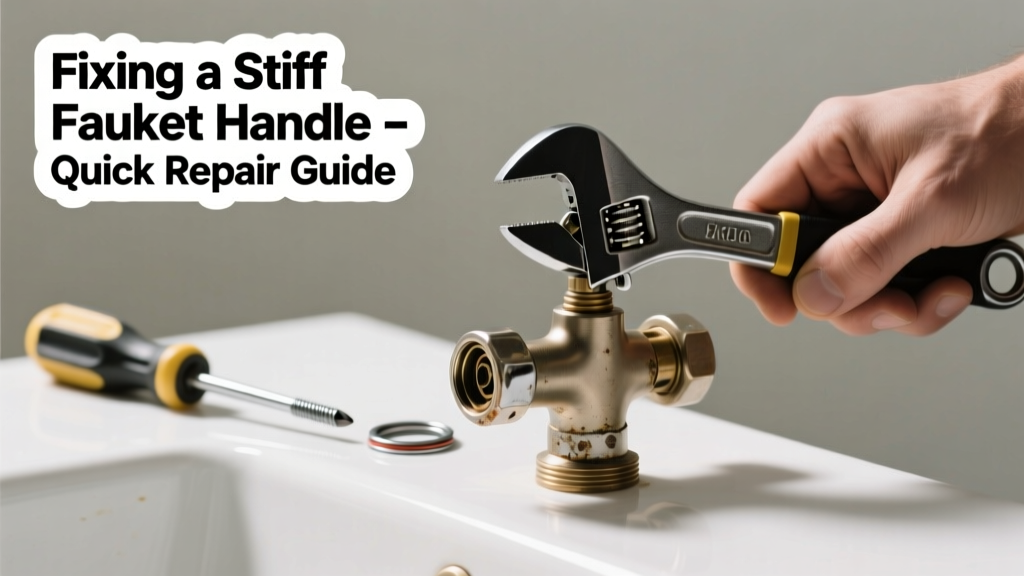
That sudden resistance when you twist the faucet handle—like turning a rusted bolt instead of a smooth lever—is more than annoying; it’s a warning sign. A stiff handle often points to internal wear, mineral buildup, or failing components that, if ignored, can lead to leaks or complete failure. The good news? Over 85% of stiff-handle issues are resolved in under half an hour with simple DIY steps.
Quick Diagnosis
Before grabbing tools, identify the likely culprit:
- Mineral deposits (especially in hard water areas like Phoenix or Chicago)
- Dried-out or cracked rubber O-rings inside the cartridge or stem
- Corroded or bent valve stem or cartridge
- Loose or misaligned handle set screw pressing unevenly on the stem
- Debris jammed between the handle base and escutcheon plate
Tools & Materials Needed
| Item | Purpose | Estimated Cost |
|---|---|---|
| Allen wrench (1/8" or 5/32") | Removes handle set screws hidden under decorative caps | $3–$8 |
| Needle-nose pliers | Grips small parts and extracts stubborn cartridges | $7–$15 |
| White vinegar & small container | Soaks mineral-encrusted parts safely (no harsh acids) | $2–$4 |
| Replacement O-rings (generic kit) | Replaces dried, cracked seals causing binding and drag | $4–$9 |
| Plumber's grease (silicone-based) | Lubricates moving parts without degrading rubber | $5–$12 |
Step-by-Step Fix
Try these methods in order—most stiffness resolves at Step 1 or 2:
- Remove and clean the handle assembly: Pop off the decorative cap with a flathead screwdriver, loosen the set screw, and gently pull the handle. Soak the exposed stem/cartridge in white vinegar for 15 minutes, then scrub with an old toothbrush.
- Replace worn O-rings: Inspect the rubber rings around the stem or cartridge. If they’re flattened, brittle, or discolored, swap them using a universal O-ring kit. Don’t skip lubricating them with silicone grease before reassembly.
- Check and realign the cartridge: For single-lever faucets, pull the cartridge and inspect for scoring or warping. Rotate it 180° and reinstall—if stiffness eases, the cartridge is worn asymmetrically. Replace if grooves exceed 0.005" deep (use a caliper or compare to a new one).
- Verify mounting alignment: Ensure the handle isn’t hitting the baseplate or spout collar. Loosen the mounting nut slightly, center the handle, then retighten just enough to prevent wobble—overtightening causes binding.
When to Call a Pro
Stop and call a licensed plumber if:
- The handle won’t budge even after soaking and gentle persuasion (risk of shearing the stem)
- You see green corrosion on brass components or white powdery residue on chrome—signs of galvanic corrosion requiring system evaluation
- Your faucet is a high-end model (e.g., Moen Posi-Temp, Delta Touch2O) with proprietary electronics or pressure-balancing valves
- Water leaks from the base during disassembly—even minor seepage may indicate a cracked valve body
According to the Insurance Institute for Business & Home Safety's 2023 report, 22% of DIY faucet repairs worsen leaks when internal valve seats are damaged by improper tool use.
Prevention Tips
Extend your faucet’s smooth operation with these habits:
- Wipe down handles weekly with a damp microfiber cloth—not abrasive cleaners that degrade finishes
- Flush aerators and internal components every 6 months using vinegar-soaked cotton balls held in place with rubber bands
- Install a whole-house water softener if your tap water exceeds 7 grains per gallon hardness (test with a $10 hardness strip)
- Turn handles fully on and off—not halfway—to avoid sediment trapping in the cartridge’s mid-position seals
Can I use WD-40 on a stiff faucet handle?
No. WD-40 is a water-displacing solvent, not a long-term lubricant—and it breaks down rubber O-rings over time. Use only food-grade silicone grease or plumber’s grease rated for potable water systems.
Why does my kitchen faucet handle get stiffer in winter?
Colder temperatures cause rubber O-rings to contract and lose elasticity, especially if they’re already aged or mineral-coated. This increases friction inside the cartridge. Replacing with Viton® O-rings (rated for -20°F to 400°F) solves this in drafty utility rooms or unheated cabins.
My handle moves smoothly but the water won’t shut off—what’s wrong?
This points to a failed valve seat or worn cartridge seal—not handle stiffness. The handle’s mechanical motion is fine, but internal sealing surfaces are compromised. You’ll need to replace the cartridge or rebuild the valve body, which requires shutting off the main supply and relieving line pressure first.
Is it safe to soak brass faucet parts in vinegar?
Yes—but limit soak time to 15–20 minutes. Prolonged exposure dulls polished brass and can etch patina on antique fixtures. Rinse thoroughly with distilled water and dry with compressed air or lint-free cloth to prevent water spots.
How do I know if my faucet uses a cartridge, ball, or ceramic-disk mechanism?
Remove the handle and look inside: a single cylindrical unit = cartridge (common in Moen); a rounded metal sphere = ball-type (Delta two-handle); stacked ceramic plates = disk (Kohler, Peerless). When in doubt, match your model number at Faucet Parts Lookup.
Can hard water cause permanent damage to faucet internals?
Absolutely. The U.S. EPA estimates that 14% of household water usage is from leaks caused by mineral-induced component failure. In areas with >10 GPG hardness, untreated water can reduce cartridge lifespan by up to 60%—replacing O-rings yearly cuts replacement costs by nearly half.
A stiff handle isn’t just inconvenient—it’s your faucet’s way of asking for attention before bigger problems arise. Most fixes require nothing more than patience, vinegar, and the right O-ring. And if you’ve replaced those seals and still feel drag? That’s not stubbornness—it’s time for a fresh cartridge or a pro’s second opinion. Either way, you’re now equipped to act fast, not wait for the drip to start.