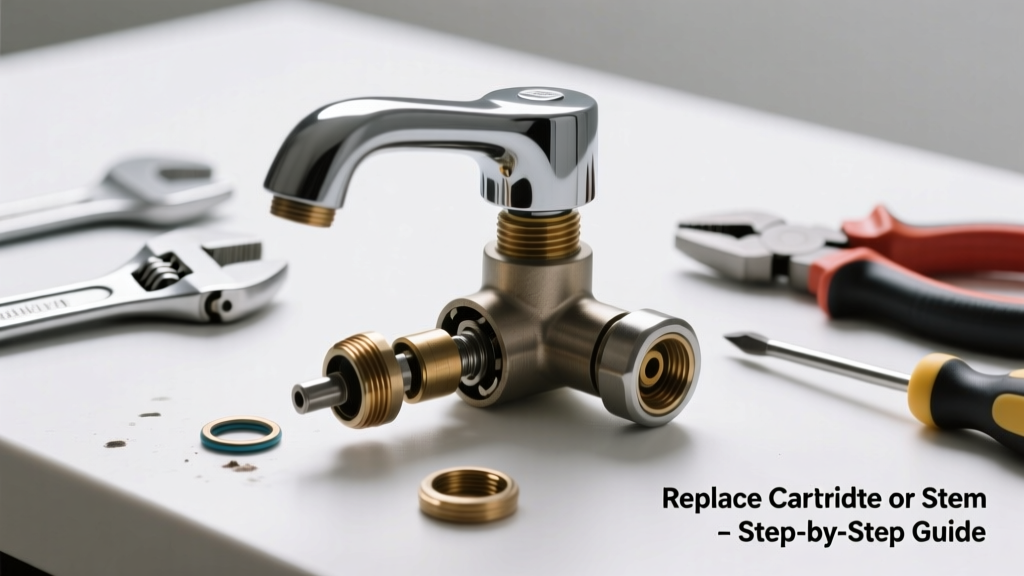
That stiff, gritty, or frozen faucet handle isn’t just annoying—it’s a sign that internal wear is compromising function and possibly water efficiency. Most stiffness comes from one of three replaceable parts: the cartridge, stem, or ceramic disc—and replacing it takes under 45 minutes with basic tools. Ignoring it risks leaks, scalding, or complete handle failure.
Quick Diagnosis
Before grabbing tools, rule out simple causes:
- Mineral buildup on the handle screw or mounting threads
- Corroded or stripped handle set screw (common in single-lever Moen or Delta models)
- Worn-out cartridge (most frequent culprit in widespread brands like Kohler, Delta, and American Standard)
- Cracked or warped plastic stem (typical in older compression faucets)
- Debris jammed inside the valve body—especially after recent plumbing work or water main flushing
Tools & Materials Needed
| Item | Purpose | Estimated Cost |
|---|---|---|
| Adjustable wrench | Grips and loosens stubborn nuts without marring finishes | $12–$28 |
| Hex key set (2–3 mm) | Removes hidden set screws under decorative caps | $5–$15 |
| Cartridge puller (universal) | Extracts stuck cartridges without damaging valve body | $8–$22 |
| Replacement cartridge/stem | Exact OEM match required—check model number stamped on base or handle | $7–$35 |
| White vinegar + soft brush | Dissolves calcium/magnesium deposits on exposed parts | $3–$6 |
Step-by-Step Fix
Follow these methods based on your faucet type. Always shut off both hot and cold supply valves under the sink first—and open the faucet to relieve pressure.
- Identify the faucet brand and model: Look for stamped letters/numbers on the base, underside of the handle, or escutcheon plate. Use our faucet model lookup guide if markings are faded.
- Remove the handle: Pry off the decorative cap with a utility knife tip, then unscrew the set screw. Gently rock the handle side-to-side while pulling—don’t force it. If stuck, apply penetrating oil and wait 10 minutes.
- Extract the old cartridge or stem: For cartridges (Delta, Moen), use a cartridge puller. For stems (older two-handle models), grip the brass stem with channel locks and turn counterclockwise. If seized, heat the valve body briefly with a hair dryer—not a torch—to expand metal slightly.
- Inspect and clean the valve seat: Check for nicks, corrosion, or mineral rings. Use fine-grit sandpaper (400+ grit) to smooth minor scoring—but replace the entire valve body if deeply pitted.
- Install the new part: Lubricate O-rings and cartridge splines with silicone grease (never petroleum-based). Align notches precisely before pushing fully into place. Reassemble in reverse order.
When to Call a Pro
DIY becomes unsafe or impractical when:
- The valve body itself is cracked or leaking at the base—even after new cartridge installation
- You’re working with a commercial-grade or multi-point mixing valve (e.g., thermostatic shower systems)
- Supply lines are corroded copper or galvanized steel showing pinhole leaks
- Your home has polybutylene pipes (installed 1978–1995)—disturbing connections may trigger failures
According to the Insurance Institute for Business & Home Safety's 2023 report, 68% of faucet-related water damage claims involved DIY attempts where damaged supply lines or cross-threaded fittings went unnoticed until flooding occurred.
Prevention Tips
Extend the life of your faucet internals with these habits:
- Flush aerators every 3 months to prevent sediment from cycling back into the valve
- Turn handles all the way on and off weekly—this prevents mineral lock in seldom-used positions
- Install a whole-house water softener if your TDS exceeds 120 ppm (test with a certified hardness test kit)
- Replace rubber O-rings and cartridge lubricant every 3 years—even if no symptoms appear
Can I reuse the old cartridge if I clean it?
No. Once a cartridge shows stiffness, its internal seals and ceramic discs have micro-fractures or dimensional wear. Cleaning removes surface debris but won’t restore sealing integrity. The U.S. EPA estimates that 14% of household water usage is from leaks caused by failed internal parts—many originating from reused cartridges.
What if my handle still feels stiff after replacement?
Double-check alignment: misaligned splines or a partially seated cartridge cause binding. Also inspect the handle adapter—some Moen 1225-style handles require a specific torque-limiting clip. If stiffness persists, the valve body may be warped from overtightening during prior repairs.
Do I need plumber’s tape on the cartridge threads?
No—cartridges aren’t threaded into place. They press-fit into the valve body. Using tape can interfere with proper seating and cause leaks at the cartridge seal. Only use silicone grease on moving surfaces.
Is there a difference between "cold-side" and "hot-side" cartridges?
Yes—some dual-cartridge models (like certain Delta Monitor series) use asymmetric designs with different flow restrictors or temperature stops. Swapping sides can cause erratic temperature control or reduced flow. Always match orientation arrows stamped on the original unit.
How long should a replacement cartridge last?
OEM cartridges typically last 5–7 years in moderate-use kitchens and 3–5 years in high-traffic bathrooms. In hard water areas (>18 gpg), expect 2–3 years unless you maintain a softener. Third-party cartridges often fail within 12–18 months due to inferior ceramic tolerances.
Can I replace just the handle instead of the internal part?
Only if stiffness is purely mechanical—like a bent lever arm or broken plastic hinge. But if resistance occurs *during* turning (not just at start/end), the issue is internal. Replacing only the handle masks the real problem and may worsen stress on worn components.
A stiff handle is rarely about the handle itself—it’s your faucet’s quiet warning that precision internal parts are failing. Addressing it promptly avoids bigger issues like sudden leaks or inconsistent water temperature. Keep spare cartridges for your most-used faucets on hand—they cost less than an emergency plumber’s minimum service call, and you’ll gain confidence tackling similar repairs like replacing a kitchen faucet aerator or fixing a dripping shower faucet.