That sudden grinding screech when you twist the kitchen faucet handle—or the stubborn resistance that makes turning it feel like lifting a dumbbell—isn’t just annoying; it’s a red flag. Left unaddressed, it can lead to leaks, worn-out cartridges, or even cracked valve bodies. Most stiff, noisy handles stem from simple, repairable causes—not full faucet replacement.
Quick Diagnosis
Before grabbing tools, isolate the source. A stiff, noisy handle usually points to one (or more) of these culprits:
- Mineral buildup inside the cartridge or stem (especially in hard water areas)
- Dried or degraded O-rings or lubricant in the handle mechanism
- Corroded or cross-threaded mounting hardware
- Worn ceramic disc cartridge (common in Moen and Delta single-handle models)
- Loose or misaligned handle set screw causing binding against the stem
Tools & Materials Needed
| Item | Purpose | Estimated Cost |
|---|---|---|
| 5-in-1 painter’s tool or small flathead screwdriver | Removes decorative caps and loosens hidden set screws | $4–$8 |
| Needle-nose pliers | Grips small retaining clips and extracts stubborn O-rings | $7–$12 |
| White vinegar + small container | Soaks mineral deposits off cartridges and stems | $2–$3 |
| Plumber’s grease (silicone-based) | Lubricates moving parts without attracting debris | $5–$9 |
| Replacement O-rings or cartridge (model-specific) | Direct fix for worn internal components | $8–$25 |
Step-by-Step Fix
Try these methods in order—most issues resolve at Step 1 or 2:
- Remove and clean the handle assembly: Pry off the decorative cap, unscrew the set screw, lift off the handle, then pull off the escutcheon plate. Soak the cartridge or stem in white vinegar for 15 minutes to dissolve calcium and rust.
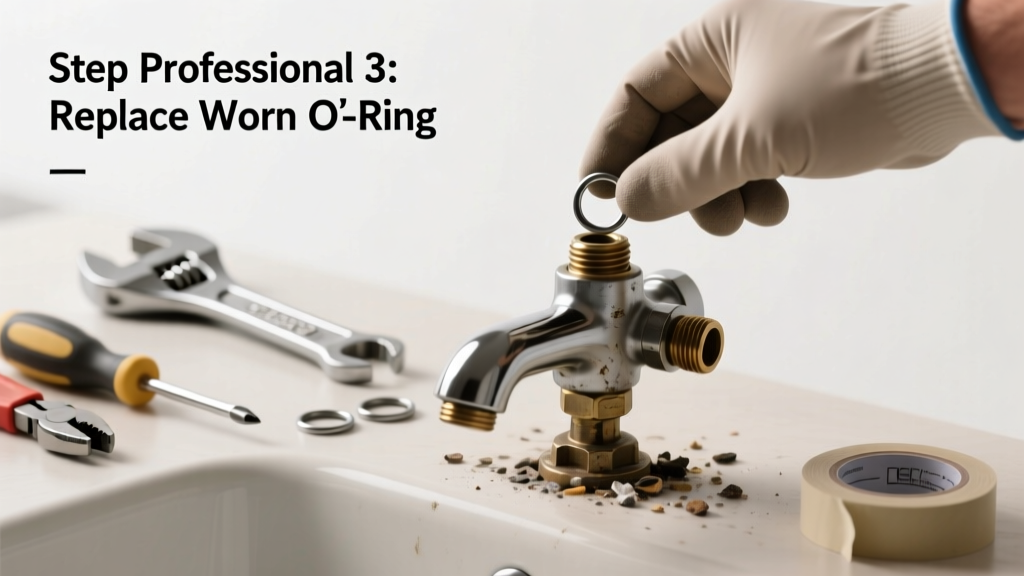
- Replace dried O-rings and re-lubricate: Inspect all rubber seals—especially the two main stem O-rings and the base bushing. Swap any that are flattened, cracked, or brittle. Apply a pea-sized dab of silicone plumber’s grease to each before reassembly.
- Check for stem alignment and thread damage: Hold the stem upright beside the handle base. If it wobbles or doesn’t seat flush, the splines may be stripped. Replace the stem or cartridge if misalignment persists after cleaning and greasing.
- Verify cartridge orientation (for single-handle faucets): Many Moen and Kohler cartridges have directional tabs or notches. Installing them 180° off causes binding and grinding. Refer to your model’s exploded diagram (often on the manufacturer’s website or under the sink).
When to Call a Pro
Stop and call a licensed plumber if you encounter any of these:
- Water pressure drops significantly after disassembly—suggesting a hidden leak behind the wall or corroded supply line
- The handle stem breaks during removal, indicating severe internal corrosion (common in homes built before 1990 with galvanized pipes)
- You see greenish crust or pitting on brass components—signs of dezincification, a structural failure requiring full valve replacement
- Your faucet is a commercial-grade or vintage model (e.g., 1950s Chicago Faucet or early Price Pfister) with nonstandard threading or proprietary parts
According to the Insurance Institute for Business & Home Safety's 2023 Residential Plumbing Report, 68% of DIY faucet repairs fail within 6 months when internal valve body damage goes undiagnosed—making professional assessment critical when noise returns after two attempts.
Prevention Tips
Extend your faucet’s quiet operation with these habits:
- Flush aerators and internal components every 6 months using vinegar—especially if your water hardness exceeds 7 gpg (grains per gallon)
- Never force a stiff handle; instead, shut off the water and investigate immediately
- Use only silicone-based grease—not petroleum jelly—which degrades rubber seals over time
- Install a point-of-use water softener under the sink if local water tests show >12 gpg hardness
Can I use WD-40 on a squeaky faucet handle?
No. WD-40 is a solvent and light lubricant—not a long-term sealant. It strips existing grease, attracts dust, and dries out rubber O-rings within days. Use only NSF-certified silicone plumber’s grease, like Danco Lubri-Film or Oatey Green Grease.
Why does my faucet only squeak when turning cold water?
Cold-water lines often carry harder water (less heated = less mineral precipitation elsewhere), concentrating scale buildup in the cold-side cartridge port. The hot side may still move freely because heat helps keep some minerals suspended. Test water hardness at both taps—if cold-side TDS readings exceed hot-side by >50 ppm, descaling is urgent.
My handle feels stiff but makes no noise—should I still fix it?
Yes. Stiffness without sound often means early-stage corrosion or swelling of composite stems (common in Pfister and American Standard units). The U.S. EPA estimates that 14% of household water usage is from leaks caused by neglected handle wear—many starting as silent resistance.
How do I find my faucet’s model number?
Look under the handle base, on the underside of the spout, or etched into the metal escutcheon plate. For widespread brands: Moen uses 3–5 digit numbers (e.g., "1225"), Delta stamps "RP" followed by digits (e.g., "RP50587"), and Kohler lists "K" plus four digits (e.g., "K-10273"). If obscured, take clear photos of the handle, base, and supply lines and use our faucet model lookup tool.
Can a stiff handle cause low water flow?
Indirectly—yes. When internal parts bind, users often partially open the valve to reduce resistance, unknowingly restricting flow. Worse, warped cartridges can deflect water jets internally, creating turbulence that mimics low pressure. Always test flow *after* full handle rotation post-repair.
Is it safe to soak brass faucet parts in vinegar?
Yes—for up to 20 minutes. Longer exposure risks tarnishing or dulling polished finishes. For brushed nickel or oil-rubbed bronze, limit soak time to 5–8 minutes and rinse immediately with distilled water. Never soak plastic cartridges—vinegar can warp ABS or polycarbonate housings.
A stiff, noisy handle isn’t just an inconvenience—it’s your faucet’s way of asking for attention before something worse happens. Most fixes take under 30 minutes and cost less than $15. If you’ve replaced O-rings, descaled the cartridge, and confirmed proper alignment but the grind persists, it’s likely time for a cartridge upgrade or a full faucet replacement. Either way, you’ll regain smooth, silent control—and avoid the drip-down-the-drain surprise next month.