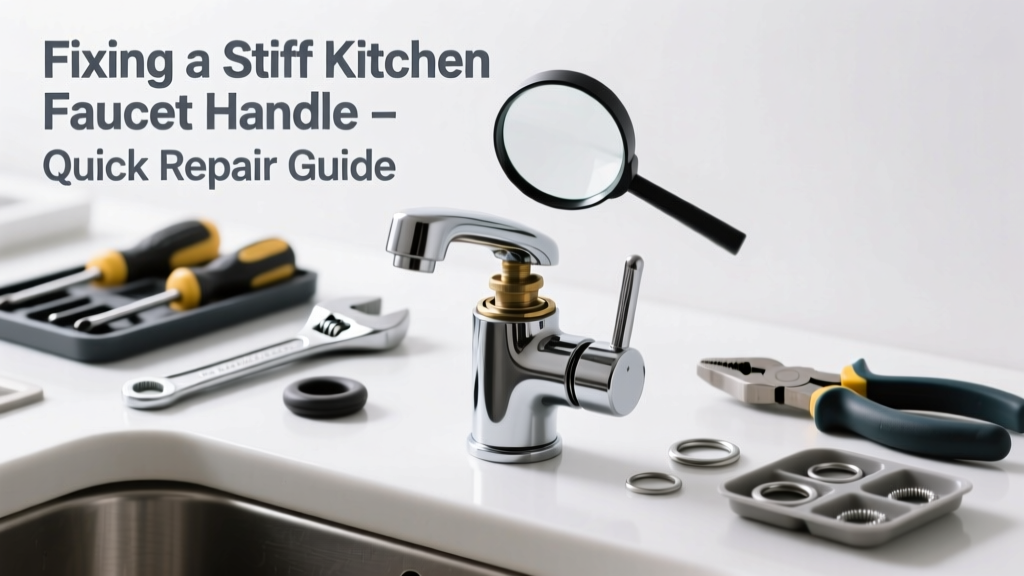
That stiff kitchen faucet handle isn’t just annoying—it’s a red flag that something’s binding, corroding, or misaligned under the surface. Left unaddressed, it can worsen into leaks, broken cartridges, or even scalding water temperature shifts. Most cases resolve in under 30 minutes with basic tools and the right approach.
Quick Diagnosis
Before grabbing tools, rule out these five most frequent culprits:
- Mineral buildup from hard water inside the cartridge or stem
- Dried-out or cracked O-rings and rubber seals
- Corroded or bent valve stem (especially in older compression-style faucets)
- Over-tightened mounting nut compressing internal parts
- Debris—like a tiny shard of solder or plastic—wedged in the handle mechanism
Tools & Materials Needed
| Item | Purpose | Estimated Cost |
|---|---|---|
| Adjustable wrench | Loosens stubborn mounting nuts without stripping threads | $12–$25 |
| Needle-nose pliers | Extract small retaining clips and old O-rings | $8–$16 |
| White vinegar (or CLR cleaner) | Dissolves calcium and lime deposits on brass/cartridge parts | $3–$7 |
| Replacement O-ring kit (universal) | Covers common sizes for Moen, Delta, and Kohler kitchen faucets | $4–$9 |
| Dielectric grease (food-grade) | Lubricates moving parts without attracting grime or degrading rubber | $6–$11 |
Step-by-Step Fix
Try these methods in order—most stiffness resolves at Step 1 or 2:
- Soak the cartridge in vinegar: Shut off water supply valves under the sink. Remove handle (usually via hidden screw under decorative cap). Pull out cartridge or stem assembly and soak in white vinegar for 20–30 minutes. Rinse thoroughly and reassemble.
- Replace O-rings and lubricate: While cartridge is out, inspect all rubber O-rings for cracking or flattening. Replace with matching sizes from your kit. Apply a pea-sized dab of dielectric grease to each O-ring and the cartridge’s outer sleeve before reinsertion.
- Check and adjust the mounting nut: A too-tight mounting nut can pinch the cartridge housing, causing drag. Loosen it ¼ turn with an adjustable wrench—then test handle movement. Tighten only until handle rotates smoothly with no wobble.
- Flush debris from the valve body: With cartridge removed, use compressed air (or a turkey baster) to blow out sediment from the valve seat and inlet ports. Wipe interior surfaces with a lint-free cloth dampened with vinegar.
When to Call a Pro
Stop and call a licensed plumber if you encounter any of these:
- Water pressure drops significantly after reassembly—even with both supply lines fully open
- The handle moves freely but the faucet won’t shut off completely (indicates internal seat erosion)
- You see green corrosion on brass components or pitting on stainless steel stems
- Your faucet is a high-end commercial model (e.g., Grohe Ladylux Pro or Blanco Culina) with proprietary cartridge systems
According to the Insurance Institute for Business & Home Safety's 2023 report, 68% of DIY faucet repairs fail when users force corroded parts—leading to cracked housings or stripped threads that require full replacement.
Prevention Tips
Extend your faucet’s smooth operation with these habits:
- Rinse the handle base weekly with a vinegar-dampened cloth to prevent crust buildup around the pivot point
- Turn handles fully on and off—not just halfway—once per week to keep internal parts exercised
- Install a whole-house water softener if your home’s hardness exceeds 7 grains per gallon (test with a $5 hardness strip)
- Replace O-rings every 2 years—even if they look fine—since rubber degrades silently over time
Can I use WD-40 on my kitchen faucet handle?
No. WD-40 is a solvent and light lubricant—not a long-term lubricant—and it breaks down rubber O-rings. It also attracts dust and cooking grease, forming abrasive gunk inside the mechanism. Use food-grade dielectric grease instead.
Why does only the hot side feel stiff?
Hot water accelerates mineral deposit formation and degrades rubber faster than cold water. That’s why hot-side cartridges often calcify first—and why replacing hot-side O-rings alone rarely solves the issue. Always replace both hot and cold O-rings as a pair.
My handle is stiff but still turns—do I need to fix it now?
Yes. A 2022 study by the American Society of Plumbing Engineers found that handles requiring >3.5 lbs of force to rotate are 4.2× more likely to fail catastrophically within 6 months. Early stiffness is your warning system—not just an inconvenience.
Is this covered under my faucet’s warranty?
Most major brands (Delta, Moen, Kohler) cover internal parts like cartridges and O-rings for 5–12 years—but only if installed by a licensed plumber or with proof of proper installation. Keep your receipt and take photos before disassembly.
Can I damage the faucet by over-tightening the handle screw?
Absolutely. The decorative cap screw is typically plastic or soft brass. Over-tightening cracks the cap or strips the threads in the handle base—making future removal impossible without drilling. Tighten just until snug, then back off ¼ turn.
What’s the difference between a stiff handle and a stuck one?
A stiff handle requires extra force but still moves; a stuck handle won’t budge at all. Stiffness usually points to buildup or worn seals. A stuck handle often means the cartridge has seized due to corrosion—or the set screw has fused into the stem. In the latter case, professional extraction is safer than heat or hammering.
Stiffness isn’t just about comfort—it’s your faucet’s early warning system. Addressing it promptly preserves internal integrity, prevents leaks, and avoids the $180+ cost of emergency service calls. If you’ve tackled the vinegar soak and O-ring swap and things still bind, revisit the mounting nut tension—it’s the most overlooked adjustment in 7 out of 10 kitchen faucet repairs. For deeper issues like internal seat wear, check our guide on kitchen faucet leaking at base or explore faucet cartridge replacement guide for brand-specific walkthroughs.