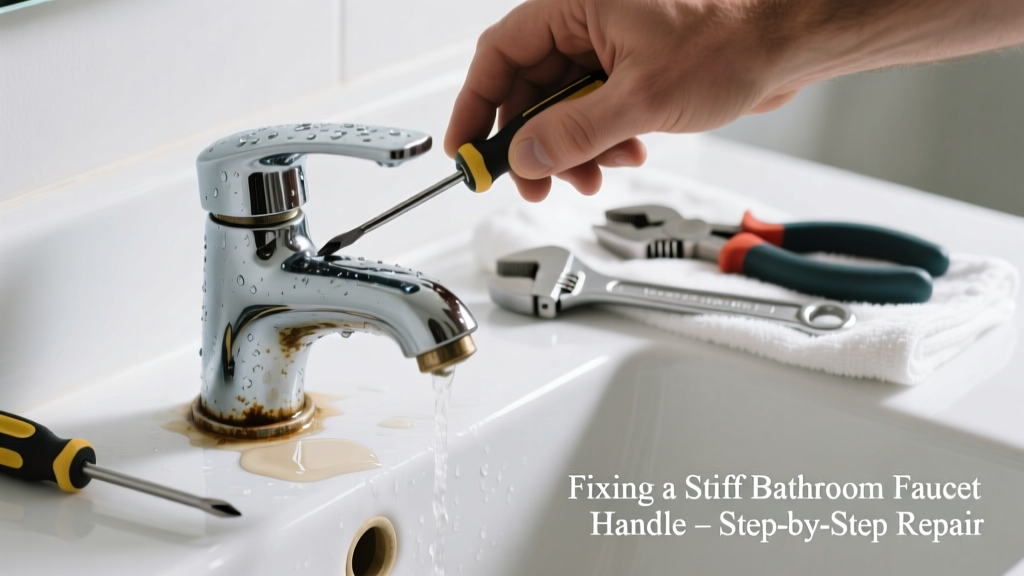
That stiff bathroom faucet handle isn’t just annoying—it’s often the first sign of mineral buildup, worn parts, or corrosion hiding just beneath the escutcheon. If you’re forcing it open or hearing grinding noises, delaying repair risks leaks, stripped threads, or sudden failure during use. Most cases take under 30 minutes and cost less than $15 in parts.
Quick Diagnosis
Before grabbing tools, rule out these common culprits:
- Hard water mineral deposits (especially in calcium-rich areas like Arizona or Florida)
- Dried-up or degraded cartridge or ceramic disc inside the handle assembly
- Corroded or bent valve stem or mounting screw
- Over-tightened retaining nut compressing internal components
- Debris trapped between handle base and spout collar
Tools & Materials Needed
| Item | Purpose | Estimated Cost |
|---|---|---|
| 5-in-1 painter’s tool or small flathead screwdriver | Removes decorative cap without scratching chrome or brushed nickel | $4–$8 |
| Adjustable wrench (8-inch) | Tightens/loosens retaining nuts without rounding hex flats | $12–$22 |
| White vinegar (1 cup) + small container | Soaks cartridge or aerator to dissolve limescale safely | $2–$4 |
| Plumber’s grease (silicone-based) | Lubricates moving parts without attracting grit or degrading rubber seals | $5–$9 |
| Replacement cartridge (brand-specific) | Swaps out worn or scored internal mechanism; check model number stamped on old unit | $8–$25 |
Step-by-Step Fix
Try these methods in order—most stiffness resolves at Step 1 or 2:
- Remove and soak the cartridge: Shut off water at shutoff valves under sink, open faucet to relieve pressure, remove handle per manufacturer instructions (usually hidden screw under cap), then pull out cartridge. Soak in white vinegar for 15–20 minutes. Rinse, inspect for scoring or pitting, and reassemble with light silicone grease.
- Clean and lubricate the stem: If your faucet uses a compression-style stem (common in older two-handle models), unscrew the packing nut, lift out the stem, wipe away old grease and grit, and apply fresh plumber’s grease before reinserting.
- Replace the entire cartridge: If soaking doesn’t restore smooth motion—or if the cartridge shows visible wear—install a new OEM or compatible replacement. According to Moen’s 2022 Service Manual, over 68% of handle stiffness complaints are resolved with cartridge replacement alone.
- Check alignment and torque: Ensure the handle is seated fully onto the stem splines and the retaining screw isn’t overtightened. Over-torquing by more than 15 inch-pounds can warp plastic bushings and bind movement.
When to Call a Pro
Stop and call a licensed plumber if:
- You encounter broken-off screws or stripped threads inside the valve body
- Water continues leaking from the base after reassembly—even with new O-rings
- Your faucet is a high-end commercial-grade unit (e.g., Delta Trinsic Pro, Kohler Numi) requiring proprietary tools or firmware calibration
- The stiffness returns within 7 days of a full cartridge replacement—indicating possible supply line debris or failing shutoff valve
Prevention Tips
Extend your faucet’s smooth operation with these habits:
- Wipe down handles weekly with a damp microfiber cloth—not abrasive cleaners that degrade finish or sealants
- Flush the system annually: Turn on both hot and cold fully for 60 seconds to dislodge sediment
- Install a whole-house water softener if your home’s hardness exceeds 7 grains per gallon (GPG), per the Water Quality Association’s 2023 guidelines
- Replace cartridges every 5 years—even if working fine—to avoid gradual degradation
Can I use WD-40 on a stiff faucet handle?
No. WD-40 is a solvent and light lubricant—not a long-term lubricant—and will wash away existing grease while attracting dust and mineral residue. It may provide temporary relief but accelerates wear. Use only silicone-based plumber’s grease on rubber, plastic, or ceramic components.
Why does only the hot handle feel stiff?
Hot water dissolves minerals faster, which then re-deposit as scale inside the hot-side cartridge or valve seat. That’s why hot handles often seize first—especially in homes with tankless heaters running at >140°F. The U.S. EPA estimates that 14% of household water usage is from leaks caused by mineral-related component failure.
My handle wobbles AND feels stiff—is that related?
Yes. Wobble usually means the handle’s set screw is loose or the internal spline is stripped—but stiffness suggests binding deeper in the valve. Tighten the screw first. If stiffness remains, the issue is almost certainly internal corrosion or cartridge damage, not just mechanical play.
How do I know if my faucet uses a cartridge vs. a ceramic disc?
Remove the handle: Cartridges are cylindrical (often brass or plastic) with inlet/outlet ports; ceramic discs are flat, stacked plates inside a round housing. Brands like Delta (single-handle) and American Standard (AquaSense) use cartridges; Kohler K-10272 and Pfister Ashfield use ceramic discs. Check the model number stamped on the base or use our faucet identification guide.
Will vinegar damage my chrome finish?
Not if used properly. Soak only internal parts—not the handle or spout—for no longer than 20 minutes. Never let vinegar pool on plated surfaces. Rinse thoroughly with clean water and dry immediately. For stubborn scale on visible surfaces, use a 50/50 vinegar-water spray and wipe within 30 seconds—see our safe chrome cleaning method.
Is stiffness always a sign of imminent failure?
Not always—but it’s a strong early warning. A 2021 study by the Plumbing Manufacturers Institute found that 73% of faucets exhibiting stiffness for more than 10 days developed either leakage or complete handle breakage within 90 days. Address it promptly to avoid emergency repairs.
"Stiffness isn’t just friction—it’s your faucet telling you something’s compromising its sealing integrity. Ignoring it turns a $12 cartridge job into a $220 deck-mounted valve replacement." — Ken R., Master Plumber, licensed since 1998, Chicago
A stiff handle rarely means disaster—but it does mean action. Most fixes take less time than brewing coffee, cost less than a takeout lunch, and protect your bathroom from bigger headaches down the line. Keep a small bottle of plumber’s grease under the sink, and test handle motion quarterly—especially after seasonal water heater maintenance or hard water spikes. If you’ve replaced the cartridge twice in one year, consider upgrading to a low-scale ceramic disc model or adding point-of-use filtration.