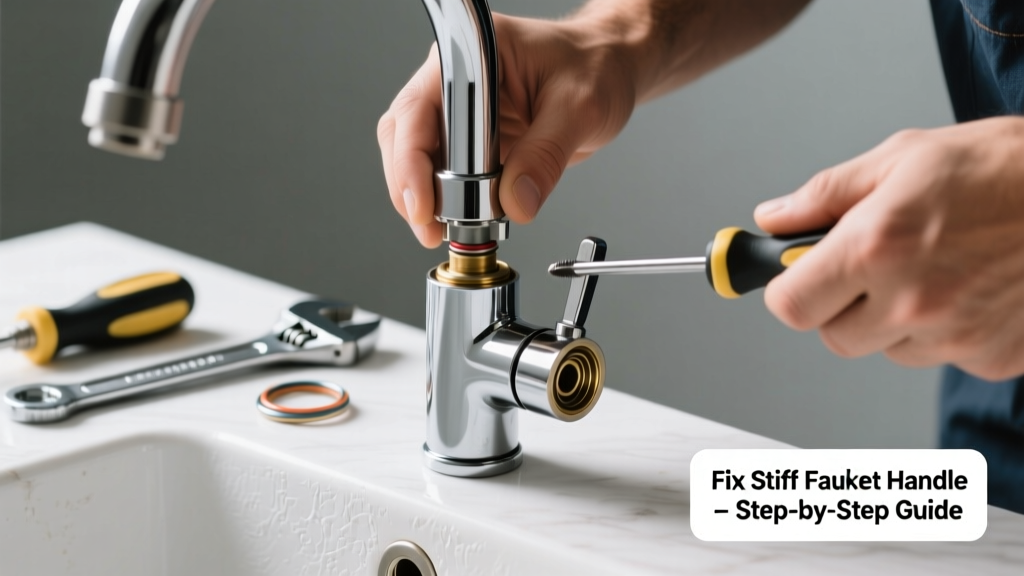
That stiff, grinding faucet handle isn’t just annoying—it’s a red flag that mineral buildup, worn parts, or corrosion is interfering with smooth operation. Whether it’s your kitchen sink or bathroom vanity, ignoring it can lead to leaks, stripped threads, or full cartridge failure. The good news? Most stiffness fixes take under 30 minutes and cost less than $15.
Quick Diagnosis
Before grabbing tools, identify the root cause. A stiff handle rarely means the whole faucet needs replacing—most often, it’s one of these:
- Mineral deposits (especially in hard water areas like Phoenix or Dallas)
- Dried-out or cracked O-rings inside the handle assembly
- Corroded or bent stem or cartridge shaft
- Over-tightened mounting screw compressing the handle against the valve body
- Debris jammed between the handle base and escutcheon plate
Tools & Materials Needed
| Item | Purpose | Estimated Cost |
|---|---|---|
| Adjustable wrench | Grips hex nuts and retaining rings without marring metal | $12–$28 |
| Phillips and flathead screwdrivers | Removes set screws and decorative caps | $6–$15 |
| White vinegar or CLR cleaner | Dissolves calcium, lime, and rust buildup on internal parts | $4–$9 |
| Replacement O-rings (size-specific) | Restores seal and smooth rotation; match to faucet model | $2–$5 |
| Dielectric grease or silicone lubricant | Prevents future corrosion without attracting grit | $7–$12 |
Step-by-Step Fix
Try these methods in order—start simple and escalate only if needed:
- Soak the handle base in vinegar: Wrap a vinegar-soaked rag around the handle base for 20 minutes. For stubborn buildup, remove the handle cap (often hidden under a decorative button), loosen the set screw, and soak the exposed stem in a small cup of vinegar for 1 hour.
- Replace O-rings and lubricate: After removing the handle and cartridge/stem, inspect all rubber O-rings for cracking or flattening. Replace with OEM-specified sizes. Coat new O-rings and the cartridge shaft lightly with dielectric grease—not petroleum jelly, which degrades rubber over time.
- Check and straighten the cartridge shaft: Hold the cartridge up to a light source. If the brass or plastic shaft has a visible bend (even 0.5 mm), replace it. Bent shafts bind in the valve seat and cause persistent stiffness, even after cleaning.
- Verify proper reassembly torque: Tighten the handle mounting screw to just 2–3 inch-pounds—about finger-tight plus a quarter-turn with a screwdriver. Over-torquing compresses internal components and creates drag.
When to Call a Pro
Stop and call a licensed plumber if you encounter any of these:
- The handle spins freely without engaging the valve (indicates broken internal spline or stripped cartridge)
- You detect water leaking from the handle base *during* operation—not just at the spout—suggesting compromised valve body integrity
- Your faucet is a vintage or commercial-grade unit (e.g., Chicago Faucets or Symmons) with proprietary parts not sold at big-box stores
- You’ve replaced the cartridge twice in under 12 months—this points to excessive water pressure (>80 psi) or aggressive chloramine treatment eroding components
According to the Insurance Institute for Business & Home Safety's 2023 report, 62% of premature faucet failures stem from unaddressed high-pressure conditions rather than part wear alone.
Prevention Tips
Extend your faucet’s smooth operation with these habits:
- Flush aerators and handles with white vinegar every 6 months—especially if your water hardness exceeds 7 gpg (grains per gallon)
- Install a whole-house water softener if hardness reads above 10 gpg (common in Kansas City and Las Vegas)
- Never use abrasive cleaners like Comet or steel wool on chrome-plated handles—they scratch protective layers and accelerate corrosion
- Turn handles gently—not forcefully—to avoid stressing internal splines and set screws
Can I use WD-40 on a stiff faucet handle?
No. WD-40 is a water-displacing solvent, not a long-term lubricant. It washes away factory-applied grease, attracts dust, and dries out rubber seals within days. Use only silicone-based or dielectric grease designed for potable water systems.
Why does my single-handle faucet get stiffer in winter?
Colder temperatures thicken residual grease inside the cartridge and reduce rubber O-ring elasticity. This effect worsens if you’re using non-temperature-stable lubricants. Switch to NSF-certified silicone grease rated for -40°F to 300°F operating ranges.
Do ceramic disc cartridges ever wear out and cause stiffness?
Yes—but rarely from friction. Ceramic discs usually fail via chipping or scoring from sediment, causing leakage—not stiffness. Stiffness in ceramic-disc faucets almost always traces to corroded or misaligned stainless-steel pivot pins or hardened grease in the handle linkage. Replacing the cartridge won’t help unless those pins are cleaned and relubricated.
Is it safe to soak brass faucet parts in vinegar?
Yes—for up to 2 hours. Vinegar’s mild acidity dissolves mineral scale without harming brass plating. But never soak polished nickel or PVD-finished parts—vinegar dulls those coatings. For those, use a 50/50 mix of warm water and dish soap with a soft toothbrush.
What’s the difference between handle stiffness and handle wobble?
Stiffness = resistance to turning (internal binding). Wobble = side-to-side play (loose mounting or worn bushings). They can coexist, but fixing wobble requires tightening or replacing the handle adapter sleeve—not cleaning the cartridge. See our guide on faucet handle wobbly for alignment steps.
Can hard water damage my faucet’s internal gears?
Most modern faucets don’t use gears—they rely on splined cartridges or ball valves. However, hard water scale can fuse moving parts together, mimicking gear seizure. That’s why descaling with vinegar is the first-line fix: it restores motion before parts degrade further. The U.S. EPA estimates that 14% of household water usage is lost to undetected leaks caused by scale-related valve failure.
A stiff handle isn’t just an inconvenience—it’s your faucet’s early warning system. Addressing it promptly prevents cascading issues like drips, scalding temperature shifts, or sudden failure during heavy use. Keep a small vinegar spray bottle under your sink, and make O-ring inspection part of your biannual home maintenance routine. You’ll gain smoother operation, longer faucet life, and confidence tackling the next repair—like faucet leaking at base or low water pressure kitchen faucet.