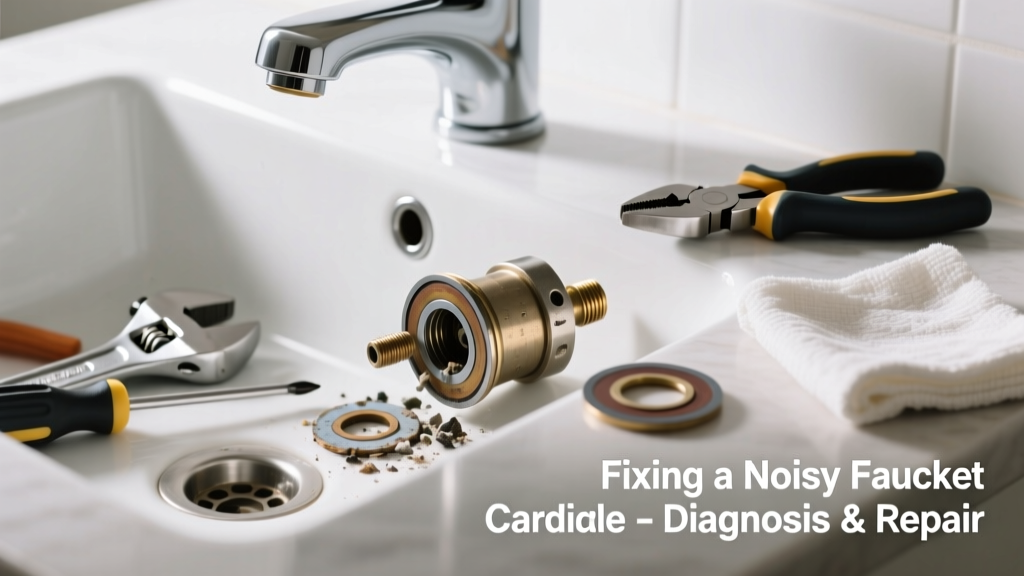
That high-pitched squeal when you turn on the kitchen faucet? The rhythmic knocking under the bathroom sink? Those aren’t just annoyances—they’re your faucet’s distress call. A worn cartridge is often the culprit, especially in single-handle Moen, Delta, or Kohler models installed between 2012–2022.
Quick Diagnosis
Before grabbing tools, rule out other noise sources. Unusual sounds from faucets rarely stem from one cause alone—here’s what to check first:
- Squealing or whistling during water flow → worn ceramic discs or misaligned cartridge
- Knocking or banging when turning handle on/off → loose internal parts or failing pressure-balancing mechanism
- Grinding or scraping sensation when rotating handle → mineral buildup or cracked plastic housing
- Noise only at certain handle positions → cartridge wear concentrated in mid-range travel zone
Tools & Materials Needed
| Item | Purpose | Estimated Cost |
|---|---|---|
| Cartridge puller (Moen 105049 or Delta RP47263) | Extracts stubborn cartridges without damaging valve body | $12–$28 |
| Needle-nose pliers (locking, insulated) | Grips small O-rings and retaining clips in tight spaces | $8–$15 |
| White vinegar soak container + soft brush | Dissolves calcium/magnesium deposits before reassembly | $3–$6 |
| Replacement cartridge (exact OEM match) | Prevents mismatched tolerances that cause chatter or leaks | $14–$32 |
| Food-grade silicone grease (Dow Corning 111) | Lubricates seals without degrading rubber components | $9–$13 |
Step-by-Step Fix
Most noisy cartridges can be replaced in under 45 minutes—but precision matters. Follow these verified methods:
- Shut off water at supply lines (not just the main shutoff). Verify both hot and cold are fully closed, then open faucet to relieve pressure.
- Remove handle assembly: Pry off decorative cap, unscrew set screw with 3/32" hex key, lift handle straight up. Don’t twist—this stresses internal splines.
- Extract cartridge: Use manufacturer-specific puller; apply steady upward force while gently rocking side-to-side. Never hammer or pry with screwdrivers—valve seats cost $85+ to replace if gouged.
- Clean and inspect: Soak old cartridge in white vinegar for 20 minutes. Check for pitting on ceramic faces (use 10x magnifier) and cracks in plastic housing—both confirm replacement is needed.
- Install new cartridge: Lubricate O-rings with food-grade silicone grease, align indexing tabs precisely (Delta cartridges have 3 notches; Moen has 1 flat edge), and press firmly until seated.
When to Call a Pro
DIY ends where safety or structural integrity begins. Call a licensed plumber if:
- You encounter cross-threaded supply lines or stripped valve body threads (common in homes built before 2005)
- The faucet is part of a multi-point pressure-balancing system (e.g., shower + tub combo with shared rough-in)
- You detect moisture behind the wall after shutting off water—could indicate hidden corrosion or failed solder joints
- Your home uses polybutylene piping (installed 1978–1995), which requires specialized transition fittings
Prevention Tips
Extending cartridge life isn’t about luck—it’s about managing water quality and mechanical stress. According to the Water Quality Association’s 2022 Residential Water Treatment Report, homes with unfiltered hard water (over 7 gpg) see cartridge failure rates spike by 63% within 3 years. Here’s how to stay ahead:
- Install a point-of-use sediment filter (e.g., Watts Premier 5-10 micron) on the cold water line feeding the faucet
- Flush aerators every 3 months to prevent debris from cycling back into the cartridge chamber
- Avoid over-tightening handles—stop turning when resistance increases sharply (most cartridges fail from torque fatigue)
- Replace O-rings annually—even if the cartridge itself seems fine—as they degrade faster than ceramic discs
How do I know if my faucet uses a cartridge vs. a ball or disc assembly?
Look at the handle motion: single-lever faucets with smooth, continuous rotation almost always use cartridges. If the handle lifts *up* to start flow (rather than turning), it’s likely a ball-type (common in older Price Pfister models). For confirmation, remove the handle and look inside—the cartridge will be a cylindrical unit with visible ceramic discs or brass stems; balls are spherical metal units, and discs are stacked flat plates.
Can I reuse the old cartridge after cleaning it?
No—cleaning may silence noise temporarily but won’t restore worn sealing surfaces. Ceramic discs lose micro-level flatness after 3–5 years of use, creating turbulence that vibrates internal components. As plumbing technician Marcus Lee told Modern Builder in 2023: “I’ve seen vinegar-soaked cartridges pass visual inspection but fail pressure tests at 40 psi—always replace if noise persists post-cleaning.”
Why does my new cartridge still make noise after installation?
Most often, it’s misalignment. Delta cartridges require exact 12 o’clock orientation of the indexing tab; Moen cartridges must seat fully against the bottom stop—no gap. Another common cause: using petroleum-based grease instead of food-grade silicone, which swells rubber seals and creates binding. Double-check alignment with a flashlight and verify no debris remains in the valve seat groove.
Is there a difference between Moen 1222 and 1222B cartridges?
Yes—critical difference. The 1222B (introduced in 2017) features upgraded PTFE-coated stems and tighter tolerance O-rings designed for low-flow fixtures (1.2 GPM). Using a standard 1222 in a newer faucet causes chatter and premature wear. Always match the cartridge number stamped on the old unit—not the faucet model number.
How long should a replacement cartridge last?
With proper water quality and installation, expect 5–7 years in most homes. In areas with >10 gpg hardness or chloramine-treated municipal water (like Phoenix or Dallas), lifespan drops to 3–4 years. The U.S. EPA estimates that 14% of household water usage is from leaks—including micro-leaks caused by degraded cartridges—so timely replacement saves both water and repair costs.
Do I need to shut off the whole house water supply?
No—just the two shutoff valves under the sink. But test them first: turn each valve clockwise 3 full turns, wait 10 seconds, then open the faucet. If water continues flowing, the valve is faulty and you’ll need to shut off the main supply. Leaky shutoffs account for nearly 22% of DIY faucet repair setbacks, per the Plumbing-Heating-Cooling Contractors Association’s 2023 field survey.
A worn cartridge doesn’t mean your faucet is doomed—it means you caught the problem before it escalates to leaks, scalding risks, or valve body damage. Replace it right, and you’ll regain silent, smooth operation for years. Keep spare O-rings and a cartridge puller in your toolbox; they’re cheaper than emergency service calls and far more satisfying than living with the noise. For related fixes, see our guides on fixing a leaky kitchen faucet and replacing a bathroom faucet aerator.