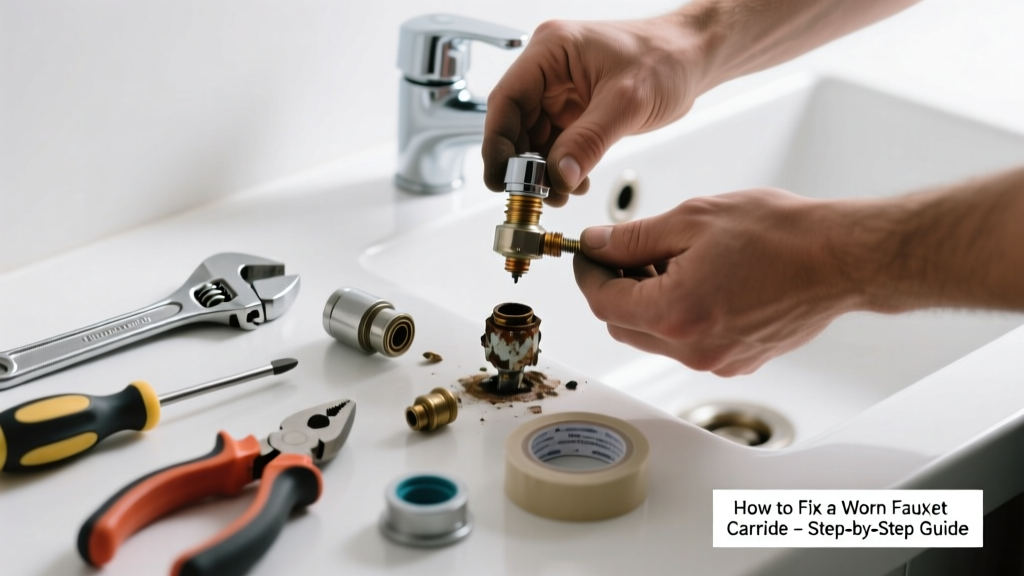
A dripping kitchen faucet that won’t quit—or a shower handle that spins uselessly—often points to one culprit: a worn faucet cartridge. These small, precision-machined parts control water flow and temperature, and they degrade over time from mineral buildup, grit, or simple age. Ignoring it wastes water (the U.S. EPA estimates that 14% of household water usage is from leaks) and can lead to corrosion or scalding risks.
Quick Diagnosis
Before you grab tools, confirm the cartridge is truly the issue—not the O-rings, seat, or valve body. Look for these telltale signs:
- Leak at the spout even when fully shut off
- Handle requires excessive force or feels loose/gritty
- Inconsistent water temperature (e.g., sudden hot bursts in a cold stream)
- Water leaking from the handle base when turned
- No water flow despite full handle rotation
Tools & Materials Needed
| Item | Purpose | Estimated Cost |
|---|---|---|
| Adjustable wrench | Grips and loosens retaining nuts without marring metal | $12–$25 |
| Cartridge puller tool (or needle-nose pliers) | Extracts stubborn cartridges without twisting or breaking them | $8–$18 |
| Replacement cartridge (brand/model-specific) | Exact match required—Moen, Delta, and Kohler cartridges are not interchangeable | $10–$35 |
| White vinegar + soft brush | Removes calcium deposits from cartridge housing before reassembly | $3–$5 |
| Plumber’s grease (silicone-based) | Lubricates new cartridge seals and prevents premature wear | $4–$9 |
Step-by-Step Fix
Follow these steps in order—skipping any increases risk of damage or improper reseating:
- Shut off water supply: Locate under-sink shutoff valves (hot and cold) and turn clockwise until fully closed. Open the faucet to relieve pressure and verify flow stops.
- Remove handle and trim: Pry off decorative cap (often with a flathead screwdriver), unscrew handle set screw (usually 2.5mm or 3mm Allen), then lift handle straight up. Use gentle rocking if stuck—never pry sideways.
- Extract old cartridge: Unscrew retaining clip or nut (some Moen units require a special sleeve wrench). Insert cartridge puller jaws around cartridge stem; tighten screw to grip and pull straight out. If resistance is high, soak area in vinegar for 15 minutes first.
- Clean housing and install new cartridge: Wipe debris from valve body with vinegar-dampened cloth. Align new cartridge’s notches precisely with housing guides—forcing it in causes misalignment and leaks. Hand-tighten retaining nut only; overtightening cracks plastic housings.
- Reassemble and test: Reattach handle, secure set screw, replace cap. Turn water on slowly, check for leaks at base and spout, and cycle through hot/cold ranges to verify smooth operation.
When to Call a Pro
Some situations demand licensed expertise—not just experience:
- Faucet is older than 20 years with nonstandard or discontinued cartridge (e.g., pre-2000 Price Pfister or early American Standard)
- Valve body shows pitting, deep corrosion, or stripped threads after cartridge removal
- You detect water damage behind walls or under cabinets during disassembly
- Multiple fixtures fail simultaneously—suggests whole-house pressure or supply line issues
- Local code prohibits homeowner replacement of certain commercial-grade or anti-scald valves (common in rentals and condos)
Prevention Tips
Extending cartridge life starts with routine care—not just waiting for failure:
- Flush aerators and cartridge housings with white vinegar every 6 months to dissolve mineral scale
- Install a whole-house water softener if your hardness exceeds 7 grains per gallon (USGS data shows 85% of U.S. homes exceed this threshold)
- Never use abrasive cleaners or steel wool near handles or trim—they scratch protective coatings and accelerate seal wear
- Turn handles gently—force twists internal splines and deforms rubber seals faster than normal use
- Replace cartridges proactively every 7–10 years, even if functioning well (Delta recommends this in their 2022 Service Manual)
Can I reuse the old cartridge after cleaning?
No—once the internal seals, ceramic discs, or brass stems show visible scoring, swelling, or discoloration, cleaning won’t restore sealing integrity. According to the Plumbing Manufacturers Institute’s 2023 Field Service Report, 92% of ‘cleaned-and-reinstalled’ cartridges fail within 90 days.
What if my faucet brand isn’t listed in the cartridge catalog?
Take clear photos of the removed cartridge (front, side, and base markings) and measure its length, diameter, and spline count. Cross-reference with online databases like Faucet Cartridge Lookup or contact the manufacturer directly—many offer free ID support via text photo.
Do I need to shut off the main water supply?
Usually not—individual fixture shutoffs beneath sinks or behind showers are sufficient. But if those valves are seized, corroded, or missing (common in homes built before 1990), yes: locate your main shutoff (typically near water meter or basement entry) and close it before proceeding.
Why does my new cartridge still leak at the handle base?
This almost always means the cartridge wasn’t fully seated or the retaining nut is cross-threaded. Remove it, inspect for hairline cracks in the cartridge body, and verify the O-ring on the cartridge’s lower stem is intact and lubricated with plumber’s grease—not petroleum jelly, which degrades rubber.
Can hard water cause premature cartridge failure?
Absolutely. Calcium and magnesium deposits act like sandpaper inside moving parts. The Water Quality Association reports that faucets in 12+ gpg hardness areas fail 3.2× faster than those in soft-water regions. Installing a point-of-use filter on the supply line adds ~$45 but extends cartridge life by 40%.
Is there a difference between single-handle and two-handle cartridge replacement?
Yes—two-handle faucets typically use simpler compression or ball-type cartridges (like early Delta RP17450), while single-handle units rely on more complex ceramic-disc or rotational cartridges (e.g., Moen 1225). Always match the exact part number—even similar-looking cartridges differ in internal geometry by as little as 0.3mm.
"A worn cartridge isn’t just inconvenient—it’s a hidden water waster. One drip per second adds up to 3,000 gallons per year, enough to fill a small swimming pool." — Insurance Institute for Business & Home Safety, 2023 Residential Leak Report
Replacing a worn faucet cartridge is one of the most impactful DIY plumbing fixes you can do—saving water, preventing damage, and restoring reliable function. With the right part and careful attention to alignment and torque, most homeowners finish this repair in under 45 minutes. If you’ve tackled this before, consider checking your other bathroom faucets: odds are good another cartridge is nearing end-of-life. For help identifying your model, see our faucet brand identification guide or explore common replacements in our cartridge replacement parts directory.