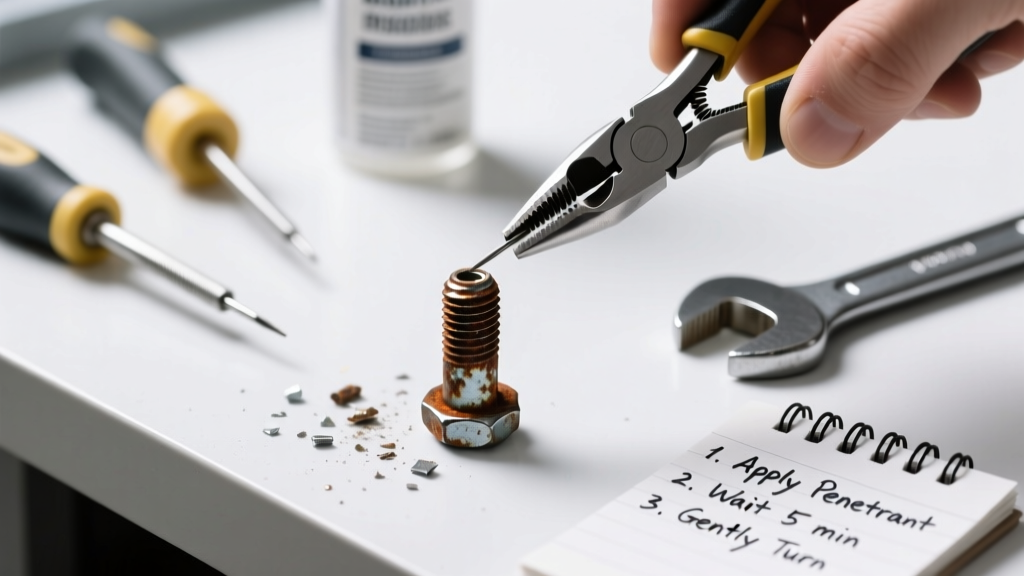
Rusted fasteners are more than an eyesore—they’re silent threats to structural integrity, especially on outdoor decks, garage doors, or HVAC units. Left unaddressed, corrosion weakens grip, invites moisture intrusion, and can lead to sudden failure under load. Most rusted screws, bolts, or lag screws can be salvaged—but only if you act before the threads fuse completely.
Quick Diagnosis
Rust doesn’t appear in isolation. It’s usually a symptom of one or more underlying issues:
- Exposure to rain, snow, or high humidity without protective coating
- Galvanic corrosion from dissimilar metals (e.g., aluminum siding with steel screws)
- Older fasteners made from plain carbon steel instead of stainless or hot-dip galvanized
- Poor installation—overtightening that cracks plating or traps moisture in the joint
- Chemical exposure (de-icing salts, pool chlorine, or fertilizer runoff)
Tools & Materials Needed
| Item | Purpose | Estimated Cost |
|---|---|---|
| Penetrating oil (e.g., PB Blaster or Kroil) | Breaks down oxidation at the thread interface; far more effective than WD-40 for rusted joints | $8–$15 |
| Wire brush (stiff brass or stainless) | Cleans surface rust without damaging base metal or surrounding material | $4–$12 |
| Impact driver (cordless, 12V+) | Delivers rotational torque with hammering action—critical for frozen fasteners | $65–$180 |
| Left-hand drill bit set (1/8"–3/16") | Engages reverse-threaded extraction when drilling into broken bolt shanks | $12–$25 |
| Replacement fasteners (A2-70 stainless or hot-dip galvanized) | Prevents recurrence; matches strength and corrosion resistance of original application | $3–$18 per pack |
Step-by-Step Fix
Choose the method based on rust severity and access. Always wear safety glasses and cut-resistant gloves—snapping fasteners can launch shrapnel.
- Soak and wait: Apply penetrating oil liberally to the fastener head and joint line. Let sit 15–30 minutes (or overnight for severe cases). Reapply once before attempting removal.
- Tap and twist: Lightly tap the fastener head with a ball-peen hammer to break micro-welds caused by rust. Then use a properly sized socket or driver—never an adjustable wrench—to turn counterclockwise with steady, even pressure.
- Heat-and-cool (for steel-only applications): Use a propane torch to heat the surrounding metal (not the fastener itself) for 20–30 seconds. Thermal expansion loosens the bond. Immediately apply cold penetrating oil—steam flash helps drive it deeper. Do not use near wood framing, insulation, or gas lines.
- Drill-and-extract: If the head is stripped or snapped, center-punch the bolt, then drill a pilot hole using a left-hand bit. As you drill, the bit often backs the fastener out. If not, switch to an easy-out extractor—tap it in gently with a hammer, then turn counterclockwise.
When to Call a Pro
Some rusted fasteners aren’t just inconvenient—they’re dangerous to remove without specialized equipment or engineering oversight.
- Fasteners holding load-bearing beams, roof trusses, or stair stringers
- Bolts embedded in concrete anchor systems (e.g., column bases or deck post anchors)
- Rusted fasteners inside HVAC ductwork or gas appliance connections—risk of leaks or ignition
- Any fastener showing pitting deeper than 0.02" (roughly the thickness of a credit card) per the ASTM F1941 standard for structural bolts
"Over 62% of premature deck failures traced by the American Wood Council involved corroded or undersized fasteners—not wood rot." — American Wood Council Deck Construction Guide, 2022
Prevention Tips
Fixing rust is reactive. Prevention saves time, money, and risk long-term.
- Use A4-80 stainless steel or hot-dip galvanized fasteners outdoors—never zinc-plated or plain steel
- Apply a dab of dielectric grease or Tef-Gel to threads before installation to block moisture and prevent galvanic corrosion
- Seal exposed heads with clear silicone or exterior-grade acrylic caulk—especially on deck screws or fascia brackets
- Inspect fasteners annually in high-moisture zones (under sinks, patio furniture, fence posts) and replace at first sign of flaking rust
Can I use vinegar to loosen a rusted bolt?
Yes—but only for light surface rust and non-critical applications. White vinegar soaks (2–6 hours) work via acetic acid dissolution. It’s slower and less reliable than commercial penetrating oils, and prolonged exposure can pit softer metals like aluminum or zinc coatings. Never use on galvanized steel—it removes the protective zinc layer.
Will grinding off the rust fix the problem?
No. Grinding removes visible corrosion but does nothing to restore lost thread depth or tensile strength. A fastener with >15% cross-sectional loss (measured with calipers) is unsafe—even if it looks clean. Replace it. According to the U.S. Department of Transportation’s 2021 Fastener Integrity Bulletin, ground-down fasteners fail 3.2× faster under cyclic loading.
Can I reuse a rusted fastener after cleaning?
Only if it’s lightly stained and fully functional: threads engage smoothly, no pitting under 10× magnification, and head remains intact. Any sign of galling, thread deformation, or brittleness means discard it. Reusing compromised fasteners risks stripping, snapping, or gradual pull-out—especially in shear-loaded applications like railing brackets.
What’s the best replacement for old galvanized screws on a cedar deck?
Use Type 316 stainless steel screws rated for exterior use (e.g., Spax TRX or GRK RSS). They resist chloride-induced corrosion better than Type 304—and cedar’s natural tannins won’t react with them. Avoid aluminum or coated carbon steel; both degrade faster in tannin-rich environments. For more on deck hardware, see our deck screw replacement guide.
Why did my new stainless screws still rust after one season?
Most likely cause: improper grade or counterfeit product. True 316 stainless contains molybdenum for saltwater resistance—but many budget “stainless” screws are actually 410 or 430 grade, which rust easily. Verify markings: genuine 316 shows “A4” or “AISI 316” etched on the head. Also check for mechanical damage during installation—scratched plating exposes vulnerable substrate. Learn how to spot fake stainless here.
Is rust on a hinge screw dangerous?
It depends on location and function. Rust on interior cabinet hinges? Mostly cosmetic—clean and replace. But rust on garage door hinge pins or gate hinges supporting >100 lbs? That’s a red flag. Corrosion reduces shear strength and increases binding friction, leading to misalignment or sudden release. The Door & Access Systems Manufacturers Association recommends replacing all visibly rusted hinge hardware every 5 years in coastal or high-humidity climates.
Rusted fasteners rarely demand emergency action—but they do demand attention before they escalate. Whether it’s a single deck screw or a cluster of HVAC mounting bolts, addressing rust early preserves safety, extends material life, and avoids costlier repairs down the line. Pair each fix with the right prevention strategy, and you’ll spend less time wrestling with seized hardware and more time enjoying your home. For related help, explore our guides on rust on metal roof panels and garage door bolt replacement.