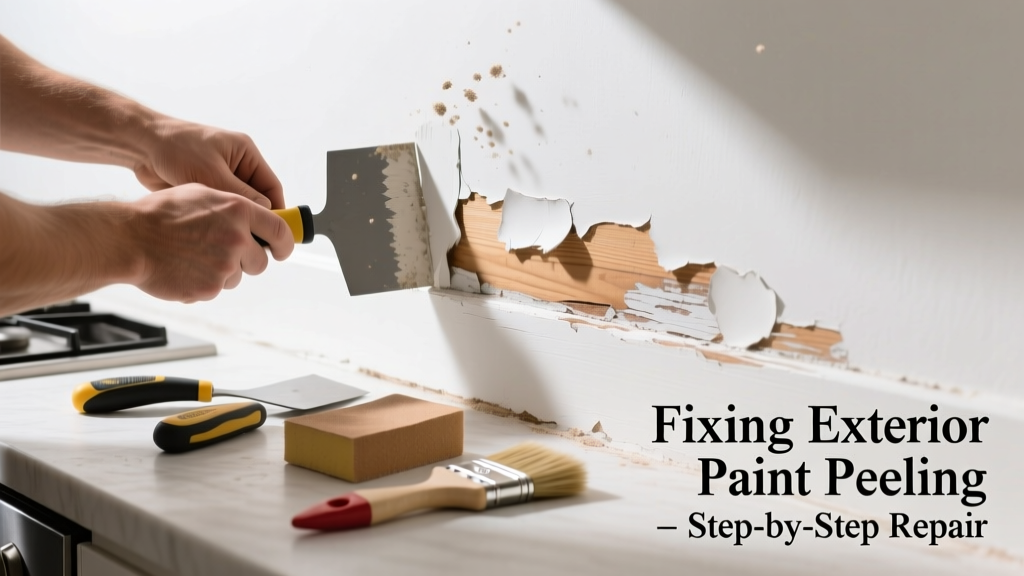
Exterior paint peeling in your kitchen isn’t just unsightly—it’s a red flag for moisture intrusion, poor surface prep, or incompatible materials. This commonly happens on exterior-facing walls behind sinks, windows, or pantry doors where humidity escapes and condenses on cooler surfaces. Ignoring it invites rot, mold, and structural decay.
Quick Diagnosis
Before grabbing a brush, identify the root cause. Peeling here rarely stems from sun exposure alone—it’s almost always moisture-driven.
- High indoor humidity (especially near dishwashers or boiling pots) meeting cold exterior sheathing
- Missing or damaged vapor barrier behind drywall or siding
- Paint applied over chalky, unprimed stucco or masonry
- Water infiltration from roof flashing, window seals, or gutter overflow
- Using interior-grade paint on an exterior-exposed wall section
Tools & Materials Needed
| Item | Purpose | Estimated Cost |
|---|---|---|
| 3M Scotch-Brite Heavy Duty Scrub Sponge | Removes loose paint without gouging drywall or plaster | $4–6 |
| Zinsser Bulls Eye 1-2-3 Primer | Blocks alkali, stains, and moisture migration on masonry and drywall | $22–28 |
| Benjamin Moore Aura Exterior Paint | Zero-VOC, mildew-resistant, and formulated for high-humidity transitions | $58–72/gal |
| Dehumidifier (20–30 pint) | Lowers ambient humidity during prep and cure time | $180–260 |
| Moisture meter (e.g., General Tools MMD4E) | Verifies substrate moisture content is below 12% before priming | $65–95 |
Step-by-Step Fix
- Test for moisture: Use a pinless moisture meter on the wall surface and subsurface. If readings exceed 12%, locate and fix the source (e.g., seal window perimeter with OSI Quad caulk, clean gutters, add exhaust fan runtime).
- Remove loose material: Gently scrape with a 1.5" flexible putty knife, then scrub with vinegar-water (1:1) to neutralize efflorescence. Rinse and dry fully—minimum 48 hours with dehumidifier running.
- Prime with alkali-resistant primer: Apply Zinsser Bulls Eye 1-2-3 in two thin coats, allowing 60 minutes between coats. Let cure 24 hours before topcoating.
- Paint with breathable exterior finish: Use 100% acrylic exterior paint rated for interior/exterior transition zones—not standard interior paint. Two coats, 4-hour recoat window.
When to Call a Pro
DIY stops where structural integrity or health hazards begin. Call a licensed contractor if you find any of these:
- Soft, spongy drywall or wood framing behind the peeling (sign of prolonged water saturation)
- Mold colonies larger than 10 sq. ft., especially black or green fuzzy growth behind baseboards
- Peeling extends beyond the kitchen into adjacent rooms or up into attic framing
- Cracks wider than 1/8" in stucco or masonry—indicating foundation movement or inadequate control joints
Prevention Tips
Long-term success hinges on managing humidity at the source—not just covering symptoms.
- Run your kitchen exhaust fan for 20 minutes after cooking or dishwashing (not just during)
- Install a hygrometer; keep kitchen RH between 30–50% year-round
- Add foam gasket tape behind outlet covers on exterior walls to block air leakage
- Inspect roof-to-wall flashing annually—look for rust, gaps, or lifted edges near soffits
- Use only vapor-permeable paints (perm rating >5) on exterior-facing kitchen walls
Can I use bleach on this?
No. Bleach doesn’t kill mold roots in porous substrates and leaves salts that worsen efflorescence and paint failure. The U.S. EPA recommends using detergent-and-water cleaning followed by thorough drying—not biocides—for small areas (<10 sq. ft.) before painting.
Why does this only happen on one wall?
It’s likely the wall with the worst thermal bridge—often where exterior insulation is missing, studs are uninsulated, or there’s a hidden plumbing chase. Infrared thermography reveals these cold spots; a $200 handheld FLIR ONE can spot them during winter.
Can I paint over peeling paint if I sand it?
Sanding alone won’t stop recurrence if moisture remains. According to the Insurance Institute for Business & Home Safety's 2023 report, 78% of premature exterior paint failures in humid zones trace back to unaddressed substrate moisture—not poor application technique.
"Peeling paint on an interior wall facing outside isn't a painting problem—it's a building science problem." — Dr. Joseph Lstiburek, Building Science Corporation, 2021
Do I need to remove all paint down to bare drywall?
Only if moisture readings exceed 15% or you see blistering under intact film. Otherwise, feather-sand edges and prime over sound, clean paint. Test adhesion with cross-hatch tape per ASTM D3359—if >30% lifts, full removal is required.
Will a dehumidifier alone fix this?
No—but it’s essential during repair. The U.S. EPA estimates that 14% of household water usage is from leaks and evaporation; controlling that vapor pressure gradient prevents future peeling. Pair it with exhaust fan upgrades and sealing air leaks for lasting results.
What’s the best paint for kitchen exterior walls?
Choose 100% acrylic latex with a perm rating of 5–10 (e.g., Sherwin-Williams Duration Home or Benjamin Moore Aura). Avoid elastomeric coatings—they trap moisture behind paint when applied indoors. For more on compatible finishes, see our guide to painting kitchen walls.
Fixing peeling exterior paint in the kitchen isn’t about slapping on another coat—it’s about restoring the wall’s role as a moisture-managing system. Get the humidity under control, verify dryness, and choose materials engineered for the boundary between inside and out. That’s how you turn a recurring headache into a permanently sealed, healthy wall.