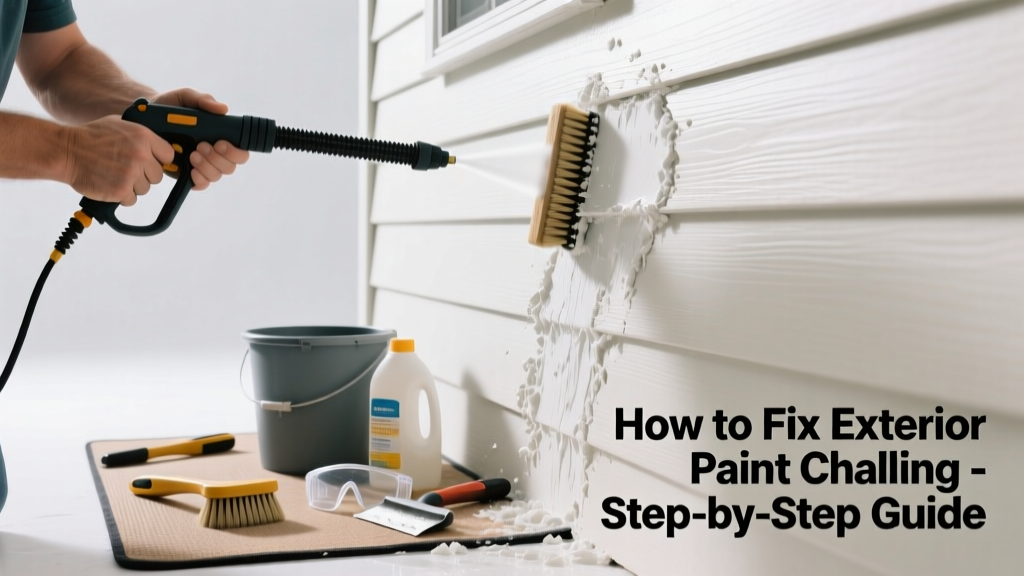
That dusty, white-gray powder coating your siding or trim after a rain? That’s paint chalking — and while some is normal, heavy chalking means your finish is failing. Left unchecked, it exposes wood or stucco to moisture, UV damage, and premature decay. The good news: most cases are fixable in a weekend with the right prep and products.
Quick Diagnosis
Chalking happens when UV exposure and weather break down the paint’s binder, leaving pigment particles loose on the surface. Here’s what’s likely causing yours:
- Using low-quality or interior-grade paint outdoors
- Applying paint over damp, dirty, or poorly prepared surfaces
- Excessive sun exposure on south- or west-facing walls
- Older acrylic or alkyd paints formulated before 2010 (less UV-stable resins)
- Paint applied during high humidity or temperatures below 50°F
Tools & Materials Needed
| Item | Purpose | Estimated Cost |
|---|---|---|
| Stiff-bristle nylon brush (non-metal) | Removes chalk without scratching substrate | $8–$12 |
| Pressure washer (300–1,200 PSI) | Rinses loosened chalk; avoid >1,500 PSI on wood or stucco | $0 (rental) or $180–$400 (buy) |
| Test patch of 100% acrylic primer | Ensures new paint adheres to chalky surface | $14–$22 |
| 100% acrylic exterior topcoat | UV-resistant, flexible, and chalk-resistant finish | $35–$65/gallon |
| Painter’s tape & drop cloths | Protects windows, fixtures, and landscaping | $10–$18 |
Step-by-Step Fix
Fixing chalking isn’t just about slapping on new paint — it’s about removing failure points and rebuilding protection. Use these methods in order of severity:
- Light chalking (powder rubs off easily with finger): Wash with garden hose + mild detergent, scrub gently with nylon brush, rinse thoroughly, let dry 48 hours, then prime and repaint.
- Moderate chalking (white residue coats your hand after rubbing, but substrate isn’t exposed): Pressure wash at 800 PSI using a 40° fan tip, hold nozzle 12–18" from surface, let dry 72 hours, apply one coat of acrylic bonding primer (e.g., Sherwin-Williams Loxon Bonding Primer), then two coats of 100% acrylic topcoat.
- Heavy chalking (chalk layer >1/32", bare substrate visible, or paint feels powdery under fingernail): Sand affected areas lightly with 120-grit paper or orbital sander, vacuum dust, wipe with damp rag, spot-prime with elastomeric primer if stucco or masonry is exposed, then full repaint with system-matched primer/topcoat.
When to Call a Pro
Don’t risk safety or long-term integrity in these scenarios:
- You’re working on second-story siding without secure scaffolding or fall protection
- Chalking coincides with blistering, alligatoring, or peeling — indicating deeper adhesion failure or moisture behind the paint
- More than 30% of your home’s surface shows heavy chalking, especially on fiber-cement or stucco (may require professional moisture testing)
- Your home was painted pre-1978 and you suspect lead-based paint — EPA-certified abatement is legally required before disturbance
Prevention Tips
Chalking isn’t inevitable — it’s often preventable with smart product choices and prep:
- Always use 100% acrylic (not vinyl-acrylic blend) exterior paint — it contains more durable acrylic resins that resist UV degradation
- Apply paint only when air and surface temps stay between 50–90°F for 48 hours post-application
- Prime bare wood, stucco, or repaired areas with a high-build acrylic primer — never skip this step
- Re-coat every 7–10 years on sun-exposed walls, even if they look fine — film integrity degrades before visible failure
- Avoid painting over existing chalky surfaces without thorough removal — new paint will fail within months
Can I use bleach on chalking?
No. Bleach won’t remove chalk and can degrade binders in remaining paint, accelerating failure. It also harms nearby plants and corrodes gutters or flashing. Stick to water, mild detergent, or a dedicated chalk-removal cleaner like Krud Kutter Original.
Will power washing damage my cedar siding?
Yes — if done incorrectly. Cedar is soft and porous. Use ≤900 PSI, keep the nozzle moving, and never hold it in one spot longer than 2 seconds. Better yet: scrub by hand with a stiff nylon brush and low-pressure rinse. For more on cedar care, see our cedar siding repair guide.
Does chalking mean my paint is toxic?
Not necessarily. Modern acrylic paints chalk as part of natural weathering — it’s the pigment separating from degraded binder, not leaching chemicals. However, homes painted before 1978 may contain lead-based paint, and disturbing chalky layers could aerosolize lead dust. Test with an EPA-approved kit or hire a certified inspector if unsure.
Can I paint over chalking with elastomeric paint?
Only after complete chalk removal. Elastomeric coatings are thick and flexible — excellent for bridging hairline cracks — but they’ll delaminate instantly over chalk. The U.S. EPA estimates that 14% of household water usage is from leaks, many caused by failed exterior coatings like this — so proper prep pays off.
How do I know if it’s chalking or efflorescence?
Efflorescence appears only on masonry (brick, concrete, stucco), forms crystalline white deposits, and dissolves in water or vinegar. Chalking occurs on painted surfaces, feels powdery and uniform, and won’t dissolve — it wipes away as dust. If in doubt, test with a damp sponge: efflorescence vanishes; chalk leaves a gray smear.
Do I need to repaint the whole house if only one wall chalks?
Not always — but be cautious. If only one wall (e.g., west-facing) shows heavy chalking, match the existing color with a spectrophotometer at a paint store, use the same brand/formulation, and feather edges into adjacent walls. But if the rest of the house is near its 8–10 year lifespan, partial repainting may create mismatched sheen and weathering rates. See our exterior paint lifespan guide for timing tips.
"Chalking isn't always bad — it's nature's way of shedding worn pigment. But when it exceeds 1/64 inch depth, it's no longer protective. That's when you've lost 40% of your paint's UV resistance." — Dr. Lena Cho, Coatings Research Group, ASTM International, 2022
Chalking isn’t just cosmetic — it’s your paint’s early warning system. Tackle it promptly with proper removal and a quality acrylic system, and you’ll add years to your home’s curb appeal and structural defense. Skip the shortcuts, respect the prep, and your next coat will last longer than the last — guaranteed by the manufacturer, not just hope.