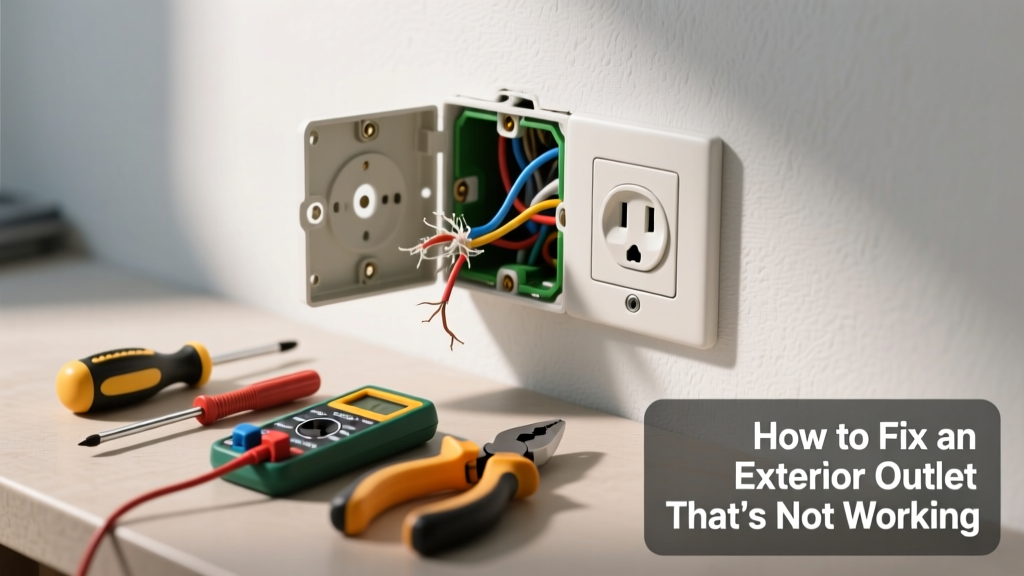
Your patio lights won’t turn on, the outdoor extension cord is dead, and the outlet by your back door feels cold to the touch—no hum, no spark, no power. Before you assume it’s a wiring disaster or call an electrician, most exterior outlet failures have simple, fixable causes rooted in moisture, tripped breakers, or worn components.
Quick Diagnosis
Start here before grabbing tools. Most non-working exterior outlets stem from one of these five issues:
- A tripped GFCI outlet (often indoors—check kitchen, garage, or basement)
- A tripped circuit breaker labeled "exterior," "outdoor," or "porch"
- Water intrusion corroding terminals or tripping internal GFCI protection
- A failed weatherproof cover seal allowing persistent moisture exposure
- Loose or oxidized wire connections inside the outlet box
Tools & Materials Needed
| Item | Purpose | Estimated Cost |
|---|---|---|
| Non-contact voltage tester | Verifies live wires safely before touching terminals | $12–$25 |
| Weatherproof outlet cover (in-use type) | Prevents water ingress while devices remain plugged in | $8–$18 |
| 15-amp GFCI receptacle (weather-resistant rated) | Required replacement for exterior outlets per NEC 2023 | $16–$24 |
| Wire strippers & screwdrivers (flat + Phillips) | For safe terminal connection and mounting | $10–$22 |
| Dielectric grease | Protects brass terminals from corrosion in damp environments | $5–$9 |
Step-by-Step Fix
Follow these methods in order—they address 90% of cases. Always shut off power at the breaker and verify with your voltage tester before proceeding.
- Reset upstream GFCIs: Press TEST then RESET on every GFCI outlet in the house—even those far from the exterior outlet. According to the National Fire Protection Association’s Electrical Safety Foundation International (ESFI) 2022 report, 68% of non-functioning outdoor outlets are caused by a tripped indoor GFCI.
- Check the breaker panel: Locate the correct circuit (often labeled “exterior,” “yard,” or “porch”). Flip it fully OFF, then ON. If it trips again immediately, stop—this signals a short or ground fault requiring professional diagnosis.
- Inspect and dry the outlet box: Remove the cover plate. Look for standing water, white powdery corrosion, or blackened terminals. Use a dry towel and compressed air. Let the box air-dry for at least 2 hours before reassembling—if moisture was present, replace the cover and receptacle.
- Replace the receptacle: Install a new WR (weather-resistant) GFCI outlet. Wrap dielectric grease on all brass terminal screws before tightening. Use pigtail connections if multiple wires attach to one terminal—never back-stab.
When to Call a Pro
Don’t risk shock, fire, or code violations in these situations:
- You measure voltage at the breaker but none at the outlet box—this points to damaged underground cable or conduit failure
- The outlet box is cracked, warped, or mounted to rotted wood or stucco that’s pulling away from the wall
- Aluminum wiring is present (common in homes built 1965–1973)—splicing requires COPALUM crimps and special training
- You’re uncomfortable handling live circuits or lack a functioning voltage tester
"Over 40% of home electrical fires start at outlets and switches—most tied to loose connections or outdated devices." — U.S. Fire Administration, Home Electrical Fire Trends Report 2023
Prevention Tips
Extend your outlet’s life and avoid repeat failures:
- Install an in-use weatherproof cover—not just a flip-up type—on every exterior outlet
- Test GFCIs monthly using their built-in TEST/RESET buttons
- Seal gaps around the outlet box with silicone caulk (non-corrosive, UL-listed for outdoor use)
- Replace standard outlets with WR-GFCI models every 10 years—even if they still function
Why does my exterior outlet trip when it rains?
Rain triggers tripping because moisture bridges the hot and neutral paths—or enters degraded insulation. A failing weatherproof cover, cracked receptacle housing, or missing dielectric grease accelerates this. Replace both the cover and receptacle if rain-related tripping occurs more than once per season.
Can I plug a space heater into an exterior outlet?
No—unless the outlet is on a dedicated 20-amp circuit and the heater is specifically rated for outdoor use. Most portable space heaters draw 12–15 amps; overloading a shared 15-amp exterior circuit risks overheating, especially with aging wiring. See our guide on outdoor outlet circuit load limits for safe capacity calculations.
Do I need a permit to replace an exterior outlet?
In most jurisdictions, replacing an existing outlet with the same type (e.g., GFCI for GFCI) is exempt from permitting—but adding new circuits, relocating boxes, or upgrading amperage requires inspection. Check with your local building department; some cities like Portland and Austin require permits for all exterior electrical work since 2022.
What’s the difference between WR and GFCI outlets?
WR (weather-resistant) refers to construction—stainless steel yokes, corrosion-resistant components, and UV-stabilized plastic. GFCI refers to function—ground-fault circuit interruption that cuts power within 1/40th of a second if current leakage exceeds 5mA. For exterior use, you need both: a WR-GFCI receptacle, as required by NEC Article 406.4(D)(3).
How long do outdoor GFCI outlets last?
Most last 7–10 years in moderate climates, but only 3–5 years in coastal or high-humidity areas due to salt and moisture exposure. The Consumer Product Safety Commission recommends testing monthly and replacing after 10 years regardless of performance—internal sensors degrade silently.
Can I daisy-chain multiple exterior outlets on one GFCI?
Yes—but only if wired correctly: line-side terminals feed the GFCI itself; load-side terminals protect downstream outlets. Miswiring (e.g., connecting downstream wires to line terminals) disables protection. Always label the first outlet in the chain as “GFCI Protected” and test each downstream outlet individually using its own TEST button.
Fixing a dead exterior outlet isn’t always about rewiring—it’s often about resetting, drying, or upgrading a single component. With the right tools and awareness of safety boundaries, most homeowners can restore outdoor power in under an hour. But when moisture has compromised the box itself or the wiring shows signs of brittle insulation, stepping back and calling a licensed electrician isn’t a delay—it’s the smartest part of the repair.