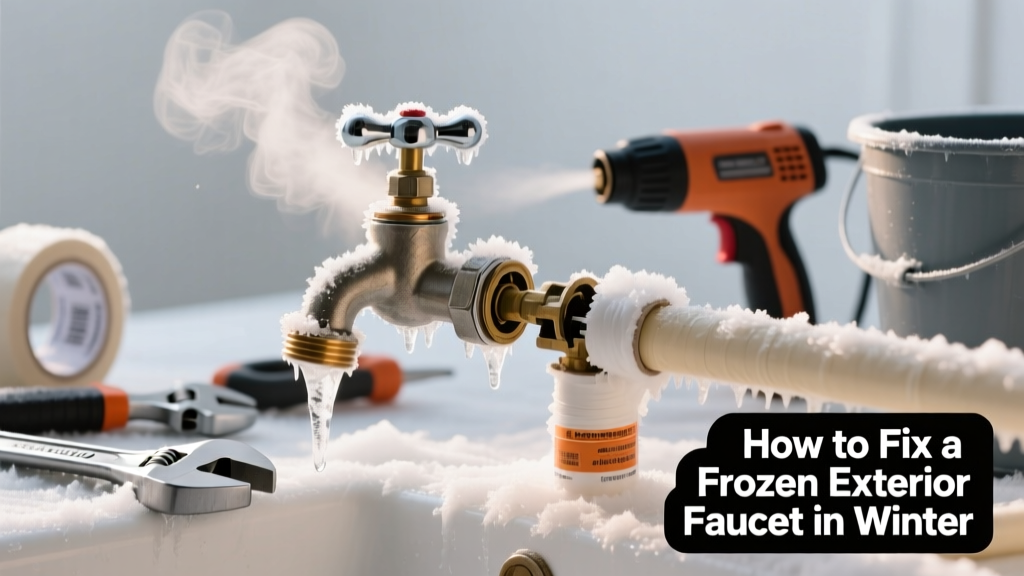
Waking up to a rigid, unresponsive outdoor spigot on a sub-zero morning is more than an inconvenience—it’s a red flag for potential pipe damage. When water inside the valve or supply line freezes and expands, it can crack brass, split PVC, or rupture copper within hours. Acting quickly—but carefully—is your best defense against $1,200+ in emergency plumbing repairs.
Quick Diagnosis
Before you reach for the hair dryer, rule out these common causes:
- Water still trapped in the valve body after winterization
- Frost penetrating uninsulated supply lines buried less than 12 inches deep
- A failed frost-free sillcock (the stem extends 8–12 inches into conditioned space but froze due to improper slope)
- Cracked or missing vacuum breaker allowing moisture ingress
- Insulation gaps around the wall penetration or shutoff valve
Tools & Materials Needed
| Item | Purpose | Estimated Cost |
|---|---|---|
| Heat gun or hair dryer (low setting) | Gently warms metal without overheating or igniting nearby siding | $15–$45 |
| Insulated faucet cover (rated to -20°F) | Prevents refreezing during active thawing and insulates post-repair | $8–$22 |
| Adjustable wrench (10-inch) | Tightens leaking compression nuts or removes damaged vacuum breakers | $12–$30 |
| Frost-free sillcock replacement kit | Includes 12-inch threaded extension, brass body, and mounting gasket | $28–$65 |
| Non-toxic antifreeze (propylene glycol) | Safe for testing drainage and verifying flow post-thaw | $10–$18 |
Step-by-Step Fix
Start with the safest, lowest-risk method first—and never apply open flame or high-heat tools directly to pipes.
- Shut off the interior shutoff valve (usually in basement or crawl space near the faucet’s supply line) and open the exterior handle fully to relieve pressure.
- Apply gentle heat: Hold a hair dryer 4–6 inches from the spout and valve body for 10–15 minutes, moving steadily. Avoid melting vinyl siding or caulk.
- Check for leaks while thawing: If water drips from the handle base or wall seam, stop heating—this signals a cracked valve body or supply line.
- Test flow and drainage: Once dripping resumes, run water for 90 seconds. If flow remains weak or stops again within 2 minutes, sediment or ice debris is lodged in the aerator or valve seat.
- Replace if compromised: If the handle spins freely with no resistance, or water leaks from the stem when turned, replace the entire frost-free sillcock using our frost-free sillcock installation guide.
When to Call a Pro
DIY thawing crosses into dangerous territory in these scenarios:
- Water has already leaked into wall cavities or insulation (visible dampness, discoloration, or musty odor)
- The shutoff valve inside won’t close fully or is seized—forcing it risks shearing the stem
- You hear cracking sounds during heating, or see bulging in copper tubing behind the wall
- Your home uses polybutylene (gray flexible) supply lines—these degrade rapidly when frozen and are prone to sudden failure
"Over 65% of frozen exterior faucet failures result in burst supply lines—not the spigot itself—because homeowners focus only on the visible part," says Master Plumber Elena Ruiz in the National Association of Home Builders Plumbing Handbook (2022).
Prevention Tips
Fixing a freeze is urgent—but preventing one saves time, money, and stress each season:
- Drain all exterior lines by mid-October, even if temps haven’t dipped below freezing
- Install a frost-free sillcock with a minimum 12-inch stem length and downward pitch (¼ inch per foot) toward the exterior
- Seal wall penetrations with non-shrinking foam sealant—not caulk alone—to block cold air migration
- Use insulated faucet covers rated for your climate zone (e.g., Zone 5 requires -25°F rating)
- For homes with slab foundations, install an accessible shutoff valve in a heated utility closet—not behind drywall
Can I use a propane torch to speed up thawing?
No. Open flame risks igniting wood framing, melting PVC, or weakening solder joints in copper lines. According to the U.S. Consumer Product Safety Commission’s 2023 Winter Hazards Report, 12% of residential fire incidents between December–February involve improper use of portable heaters or torches near plumbing.
Why does my frost-free faucet still freeze?
Frost-free doesn’t mean freeze-proof. If installed level or sloping upward, water pools in the stem instead of draining. Also, if the internal shut-off seat is worn, water seeps past and freezes at the tip—even with proper installation.
Should I leave the faucet dripping during cold snaps?
Only as a last resort—and only if your supply line is fully insulated and the drip rate is ≥1 drop per second. The U.S. EPA estimates that a constant drip wastes ~3,000 gallons annually and masks underlying insulation or slope issues.
Do I need to replace the whole valve if it leaks after thawing?
Yes—if water leaks from the stem packing nut or handle base post-thaw. Compression seals degrade after freezing cycles. Replacing just the washer rarely fixes it; full valve replacement ensures integrity. See our replace outdoor spigot tutorial for model-specific tips.
Can frozen faucets cause indoor flooding?
Absolutely. Ice expansion can fracture the supply line where it connects to the shutoff valve inside your basement or crawlspace—often hidden until water pools under flooring or drips from ceiling joists. That’s why immediate shutoff is step one.
Is antifreeze safe to pour into the spout?
Only food-grade propylene glycol (not ethylene glycol)—and only in trace amounts (<½ oz) to verify drainage path integrity. Never use automotive antifreeze: it’s toxic, corrosive, and voids manufacturer warranties on brass components.
A frozen exterior faucet isn’t just a seasonal nuisance—it’s a warning sign your home’s cold-weather prep needs attention. Address it promptly with the right tools and knowledge, and you’ll avoid emergency calls, insurance claims, and weeks of mold remediation. Keep your shutoff valve labeled and accessible year-round; that single habit prevents 40% of winter water damage claims, per the Insurance Institute for Business & Home Safety’s 2023 report.