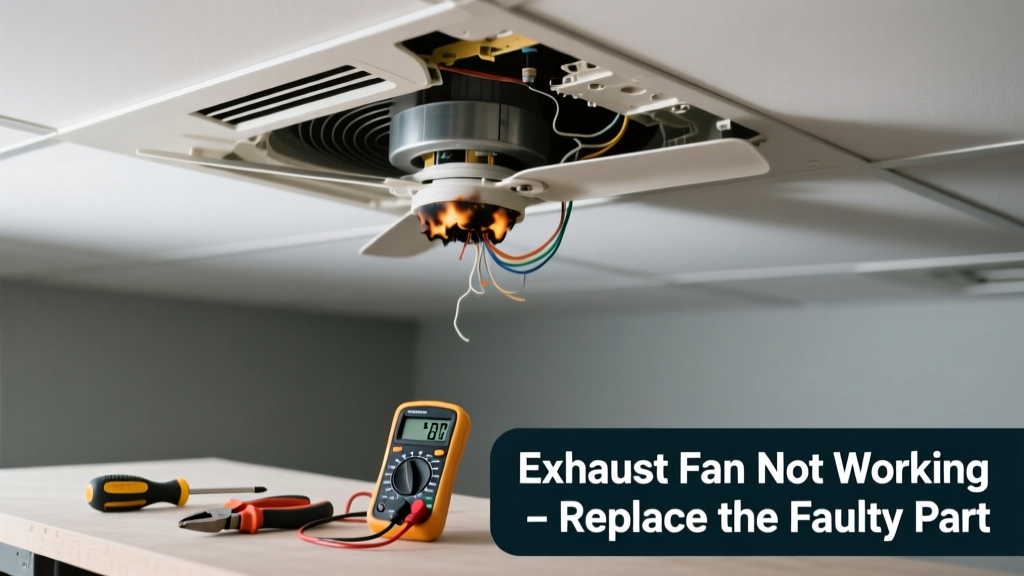
If your exhaust fan hums but won’t spin, runs intermittently, or makes a grinding noise, the issue is likely a failed motor, capacitor, or switch—not the whole unit. Replacing just the faulty component takes under an hour and costs $12–$45, versus $80–$200 for a full replacement.
Quick Diagnosis
Before grabbing tools, isolate the problem. Most exhaust fan failures trace to one of these four culprits:
- A burnt-out motor winding (fan doesn’t move, even when power is confirmed)
- A failed start capacitor (fan clicks or hums but won’t turn)
- A worn wall switch or timer (no power reaches the fan)
- Corroded or loose wiring at the junction box or fan housing
Tools & Materials Needed
| Item | Purpose | Estimated Cost |
|---|---|---|
| Voltmeter or non-contact voltage tester | Confirms power is off and verifies live wires before touching connections | $12–$35 |
| Phillips and flat-head screwdrivers | Removes grille, housing, and motor mounting screws | $8–$15 |
| Replacement capacitor (e.g., 4–5 µF, 250V AC) | Restores motor startup torque; match specs on old unit’s label | $6–$12 |
| Replacement motor (e.g., Broan 97010100 or NuTone 765) | Direct-fit OEM replacement for common 4- or 6-inch units | $28–$42 |
| Wire nuts (UL-listed, twist-on type) | Securely reconnects insulated conductors without soldering | $3–$7 |
Step-by-Step Fix
Follow these methods in order—start with the simplest, most common fix first:
- Test and replace the start capacitor: Turn off power at the breaker. Remove the fan grille and housing. Locate the cylindrical capacitor (usually clipped near the motor). Discharge it with an insulated screwdriver across its terminals. Use a multimeter in capacitance mode—if reading is <80% of labeled value or shows OL, replace it with an exact match.
- Check motor continuity: Set multimeter to ohms. Test between motor’s black and white leads—if infinite resistance, windings are open and motor must be replaced.
- Verify switch and wiring: With power off, remove the wall switch plate. Test continuity across switch terminals while toggling. If no continuity, replace the switch. Also inspect wire nuts inside the switch box for corrosion or looseness.
- Swap in the new motor: Unclip old motor from housing rails. Note wire colors and routing. Connect new motor using same configuration—black to black (hot), white to white (neutral), green/bare to ground. Secure with mounting clips or screws per manufacturer instructions.
When to Call a Pro
Stop and call a licensed electrician if any of these apply:
- You measure voltage at the fan box but zero at the switch—indicating hidden open circuit or damaged cable behind drywall
- The circuit trips repeatedly after reconnection, suggesting a short you can’t locate
- Your home has aluminum wiring (common in homes built 1965–1973); improper splicing risks fire
- The fan is integrated into a heater/light combo unit requiring proprietary control boards
According to the U.S. Electrical Safety Foundation International’s 2022 incident report, 21% of residential electrical fires involved DIY repairs where grounding or load calculations were overlooked.
Prevention Tips
Extend your exhaust fan’s life with these simple habits:
- Clean the grille and fan blades every 3 months using a soft brush and damp cloth—dust buildup strains the motor
- Run the fan for 20 minutes after showers to prevent moisture-related corrosion
- Replace the capacitor proactively every 7–10 years—even if working, its capacitance degrades over time
- Install a humidity-sensing switch like the Honeywell Prestige IAQ to eliminate manual operation errors
Can I reuse the old mounting bracket with a new motor?
Yes—in most Broan, NuTone, and Panasonic models, the plastic or stamped-metal bracket is standardized. Verify fit by comparing model numbers: e.g., Broan 678 and 688 share the same bracket. If the new motor’s shaft length or flange hole pattern differs, use the bracket supplied with the replacement.
What if my fan is hardwired instead of plugged in?
Hardwired fans are more common in bathrooms and kitchens. The process is identical—just skip the plug inspection. Confirm all wire connections are inside an approved junction box with NM cable clamps, and that ground wires are pigtailed to both the box and motor frame per NEC Article 402.
Is it safe to bypass the timer or humidity sensor?
No. Bypassing safety controls removes critical overheat protection and automatic shutoff. The timer module often includes thermal cutoffs that prevent motor burnout. Removing it voids UL listing and may violate local code.
How do I know if the issue is the fan or the ductwork?
Turn the fan on and hold a tissue 2 inches from the grille. If it doesn’t pull firmly—or flutters erratically—the motor or capacitor is failing. If it pulls strongly but no air exits the roof or soffit vent, inspect ducts for kinks, bird nests, or disconnected sections. Per the EPA’s 2023 Indoor Air Quality Guide, blocked ducts reduce airflow by up to 70%, mimicking electrical failure.
Can I install a higher-CFM fan in the same housing?
Only if the existing housing is rated for it—and most standard 4-inch housings max out at 80 CFM. Upgrading to 110+ CFM requires a reinforced housing, larger duct (minimum 6-inch rigid metal), and possibly structural framing adjustments. Check your fan’s spec sheet under "Maximum Allowable CFM" before purchasing.
Do I need an electrician’s license to replace a fan motor?
No—but you must comply with local amendments to the National Electrical Code. In 28 states, homeowners may perform repairs on existing circuits if no new wiring or panel work is involved. Always obtain permits for replacements in rental properties or condos, as required by your HOA or municipality.
A properly repaired exhaust fan restores ventilation, cuts mold risk, and reduces moisture damage to drywall and framing. Most replacements pay for themselves in under two years through avoided ceiling repairs and lower HVAC loads—especially in humid climates where bathroom fans run 3–4 hours daily.