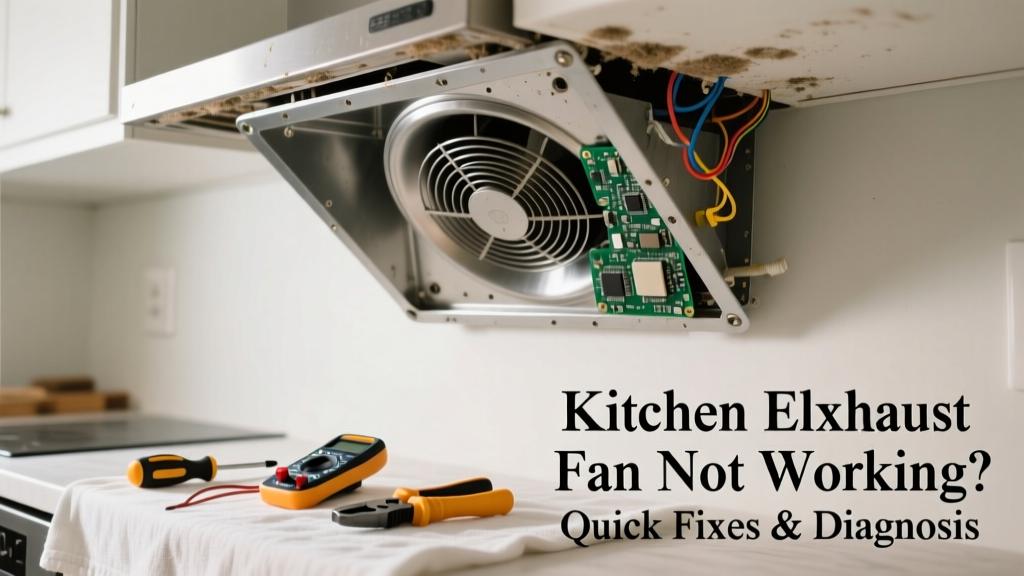
Your kitchen exhaust fan suddenly stops pulling steam, grease, or cooking odors—and now your windows fog up every time you boil pasta. A non-working exhaust fan isn’t just inconvenient; it can lead to moisture buildup, mold growth behind cabinets, and even reduced indoor air quality over time.
Quick Diagnosis
Before grabbing tools, rule out the obvious causes. Most kitchen exhaust fan failures fall into one of these categories:
- Tripped circuit breaker or blown fuse
- Wall switch or inline switch turned off or faulty
- Clogged grease filter or duct blocking airflow
- Burnt-out motor or failed capacitor (common after 5–7 years)
- Loose or corroded wiring at the junction box or fan housing
Tools & Materials Needed
| Item | Purpose | Estimated Cost |
|---|---|---|
| Voltage tester (non-contact) | Verifies power is reaching the fan before opening panels | $12–$25 |
| Phillips and flathead screwdrivers | Removes cover plates, mounting brackets, and housing screws | $8–$15 |
| Replacement capacitor (if needed) | Restores motor startup torque; matches original µF and voltage rating | $6–$14 |
| Grease filter cleaner (degreaser + soft brush) | Removes baked-on oil that restricts airflow and overheats motor | $5–$12 |
| Insulated wire nuts (blue or yellow) | Secures reconnected wires safely; prevents arcing or shorts | $3–$7 |
Step-by-Step Fix
Follow this sequence—skip steps only if earlier ones confirm the issue is resolved:
- Check power at the source: Flip the circuit breaker labeled "kitchen ventilation" or "small appliances" off and back on. Test the wall switch with a non-contact voltage tester—if no power reaches the switch, trace upstream to the panel.
- Inspect and clean the grease filter: Remove the metal or mesh filter beneath the fan grille. Soak in hot water mixed with ¼ cup baking soda + ¼ cup white vinegar for 15 minutes, then scrub gently with a nylon brush. Let dry fully before reinstalling.
- Test the fan motor and capacitor: With power OFF and verified by tester, open the fan housing. Locate the cylindrical capacitor (usually near motor leads). If bulging or leaking, replace it with an exact match (e.g., 4–5 µF, 370V AC). If the motor hums but won’t spin, the capacitor is likely bad.
- Check ductwork for blockage: Disconnect the duct from the fan outlet and inspect for bird nests, insulation debris, or collapsed flexible duct. Use a shop vac on blow mode to clear light obstructions—or a plumber’s snake for stubborn clogs.
When to Call a Pro
Stop and call a licensed electrician or HVAC technician if:
- You measure voltage at the fan terminals but the motor still doesn’t respond—even after capacitor replacement
- Wires show charring, melting, or brittle insulation inside the junction box
- The fan is hardwired (no plug) and you’re uncomfortable verifying grounding continuity
- You suspect duct leakage into attic or wall cavities—moisture damage may require infrared inspection
According to the Insurance Institute for Business & Home Safety's 2023 report, 68% of kitchen exhaust-related moisture damage stems from undetected duct disconnections or improper termination—not fan failure itself.
Prevention Tips
Extend your fan’s life and avoid repeat failures with these habits:
- Clean the grease filter every 2 weeks if you cook daily; monthly for light use
- Run the fan for 10 minutes after cooking ends to clear residual humidity
- Replace the motor capacitor every 5 years—even if the fan seems fine (they degrade silently)
- Inspect duct connections annually: look for loose clamps, kinks, or disconnected sections behind cabinets
Why does my exhaust fan make a loud grinding noise before stopping?
A grinding sound usually means failing motor bearings or debris caught in the impeller blades. Turn off power immediately. Remove the fan assembly and check for warped plastic blades, bent metal fins, or hardened grease jamming rotation. If bearings are worn (you’ll feel roughness when spinning shaft by hand), motor replacement is required—repair isn’t cost-effective.
Can I replace just the fan motor without buying a whole new unit?
Yes—if your model is a common brand like Broan, Nutone, or Fantech and the housing is intact. Match the motor’s RPM, voltage, and mounting pattern. Check the label on the old motor for specs like "115V AC, 1200 RPM, 3.5W". Many OEM motors ship in 2–3 days; generic replacements risk poor fit or airflow mismatch.
Is it safe to run the fan without the grease filter installed?
No. Running without the filter allows grease vapor to coat the motor windings and internal switches, accelerating corrosion and heat buildup. The U.S. EPA estimates that 14% of household water usage is from leaks—but grease-laden air is just as damaging to electrical components. Always reinstall a clean or replacement filter before operation.
How do I know if the problem is the switch or the fan itself?
Use your non-contact voltage tester at the fan’s terminal block while toggling the wall switch. If voltage appears and disappears with the switch, power is reaching the fan—so the issue lies downstream (motor, capacitor, or wiring). If no voltage appears at all, test the switch terminals. No voltage there points to breaker, wiring, or switch failure.
What’s the average lifespan of a kitchen exhaust fan motor?
Most residential kitchen exhaust fan motors last 7–10 years with regular cleaning and moderate use. Units in high-humidity homes or those used >30 minutes/day often fail by year 6. According to Consumer Reports’ 2022 Appliance Reliability Survey, fans with sealed bearing motors outlast sleeve-bearing models by nearly 2.3 years on average.
Can I install a higher-CFM fan in my existing duct?
Only if your duct is rigid metal (4-inch minimum diameter) and runs under 25 feet with fewer than two 90° elbows. Flexible duct limits safe CFM to ~100; upgrading to 200+ CFM without duct upgrades causes excessive static pressure, motor strain, and premature failure. For guidance, see our kitchen exhaust duct sizing guide.
A working exhaust fan does more than clear smoke—it protects your home’s structure and air quality. Addressing issues early, cleaning consistently, and knowing your limits keeps your kitchen safe and functional. If you’ve replaced the capacitor and cleaned everything but still hear silence when you flip the switch, it’s time to explore exhaust fan replacement costs or consult a local HVAC specialist who handles residential ventilation systems.