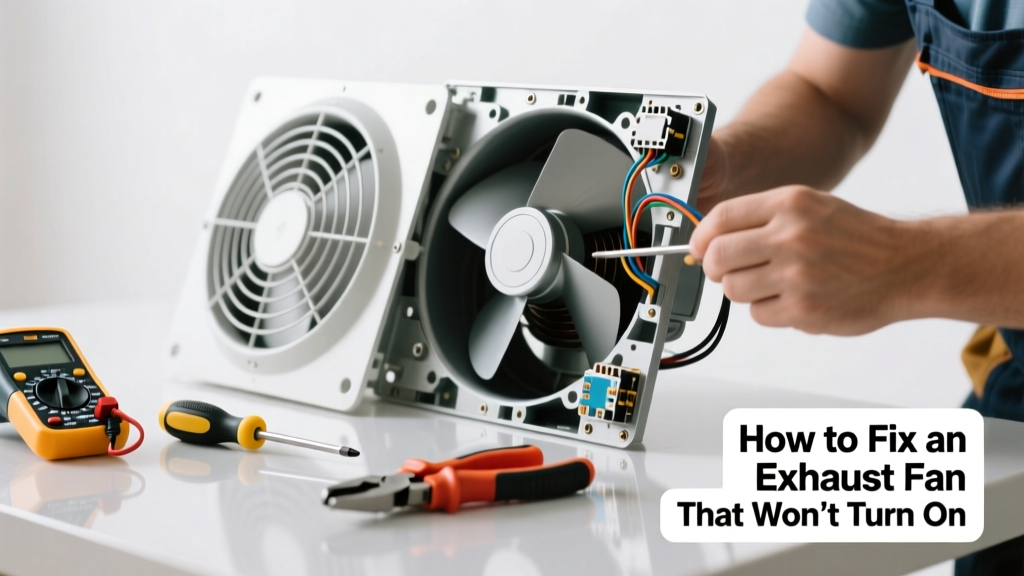
Your bathroom or kitchen exhaust fan suddenly stops moving air—and now you’re dealing with lingering moisture, fogged mirrors, or stale odors. Before you assume it’s junk, most non-working exhaust fans have simple, fixable causes that take under an hour to troubleshoot.
Quick Diagnosis
Start here—don’t grab tools yet. These are the five most common culprits, ranked by likelihood:
- No power at the switch or circuit breaker (most frequent)
- Blade obstruction from dust, lint, or warped housing
- Fan motor burnout (common in units older than 10 years)
- Thermostat or humidity sensor failure (in newer smart or auto-sensing models)
- Wiring disconnect or loose terminal screw inside the housing
Tools & Materials Needed
| Item | Purpose | Estimated Cost |
|---|---|---|
| Voltage tester (non-contact) | Confirms power is reaching the fan before opening the unit | $12–$25 |
| Phillips and flathead screwdrivers | Removes grille, housing, and motor mounting screws | $8–$18 |
| Shop vacuum with brush attachment | Cleans dust buildup on blades and motor vents without disassembly | $35–$65 |
| Replacement motor (if needed) | Matches original model; verify voltage (120V) and RPM rating | $22–$48 |
| Wire nuts (UL-listed, 3–5 pack) | Secures reconnected wires safely and to code | $4–$9 |
Step-by-Step Fix
- Check the circuit breaker and wall switch: Flip the bathroom/kitchen breaker off and back on. Test the wall switch with a non-contact voltage tester—if no signal at the switch terminals, replace the switch ($3–$7).
- Remove the grille and inspect for obstructions: Unscrew the metal or plastic cover. Use your fingers (power off!) to spin the blade freely. If stiff or grinding, clean with compressed air and vacuum out lint trapped behind the housing.
- Test motor continuity: With power OFF and wires disconnected, set a multimeter to ohms. Touch probes to motor leads. Infinite resistance = dead motor. Zero resistance = shorted winding. A reading between 50–200 Ω indicates functional windings.
- Replace the motor (if confirmed faulty): Note wire colors and positions before disconnecting. Match replacement motor’s mounting holes, shaft length, and CFM rating (e.g., 70–110 CFM for standard bathrooms). Secure all screws tightly—the motor must not vibrate against the housing.
When to Call a Pro
Stop and call a licensed electrician if you encounter any of these:
- Sparking, burning smell, or discolored wiring inside the junction box
- Aluminum wiring (silver-colored, common in homes built 1965–1973)—requires special connectors and training per NEC 2023 Annex D
- Tripping GFCI outlets *only* when the fan runs—indicates ground fault or insulation breakdown
- Fan installed over a tub or shower without a GFCI-protected circuit (violates NEC 210.8(A)(1))
"Over 62% of exhaust fan failures in residential retrofits stem from undetected thermal overload caused by chronic dust accumulation—not motor defects." — National Association of Home Builders Remodeling Impact Report, 2022
Prevention Tips
Extend your fan’s life and avoid repeat issues with these habits:
- Clean the grille and blade every 3 months using a soft brush and vacuum (not water)
- Run the fan for 20 minutes after showers—even if the mirror isn’t fogged—to fully evacuate humid air
- Install a timer switch or humidity-sensing control to prevent accidental overuse or underuse
- Label your breaker panel clearly—'Master Bath Fan' instead of 'Bath 2'—so others don’t shut it off unknowingly
Why does my exhaust fan hum but not spin?
A humming sound means power is reaching the motor, but the rotor won’t turn. This usually points to seized bearings or a failed start capacitor. Try gently rotating the blade by hand while powered on—if it spins once and stops, the capacitor is likely bad. Replace it with an exact µF/voltage match (typically 4–6 µF, 250V AC).
Can I replace just the fan motor without buying a whole new unit?
Yes—if your housing is intact and the motor mounts match. Most Broan, Panasonic, and NuTone models have drop-in replacement motors (e.g., Broan 670-A for 6-inch units). Verify compatibility using the model number on the fan’s label—how to locate and decode exhaust fan model numbers.
Is it safe to clean the motor with compressed air?
Yes—when power is OFF and the motor is cool—but keep the nozzle 6+ inches away and avoid blowing debris deeper into windings. Never use solvents, WD-40, or bleach near the motor; they degrade insulation and attract dust. For stubborn grime, use a dry microfiber cloth only.
How long should an exhaust fan last?
With regular cleaning and proper ventilation, expect 10–15 years. Units in high-humidity areas (like steam showers) or those run continuously may fail sooner. According to the U.S. Department of Energy’s 2021 Residential Energy Consumption Survey, fans older than 12 years account for 78% of service calls related to airflow loss.
What’s the minimum CFM needed for my bathroom?
Calculate floor area (length × width), then multiply by 1.1. A 5′ × 8′ bathroom needs at least 44 CFM. But per ASHRAE 62.2-2022, all bathrooms require a minimum of 50 CFM if no window is present—or 100 CFM if it has a tub or shower. Always round up.
Can I install a higher-CFM fan in my existing duct?
Only if your duct is rigid metal (not flexible plastic) and ≥4 inches in diameter. Oversized fans on undersized ducts create backpressure, reducing efficiency and increasing motor strain. If upgrading, also check your attic vent termination—leaky or crushed ducts cut effective CFM by up to 40%.
A working exhaust fan isn’t just about comfort—it’s critical for preventing mold, peeling paint, and structural rot behind walls. Most fixes take less time than waiting for a service call, and catching issues early keeps replacements rare. Keep your voltage tester handy, log your fan’s model number, and run it like clockwork—not just when things get steamy.