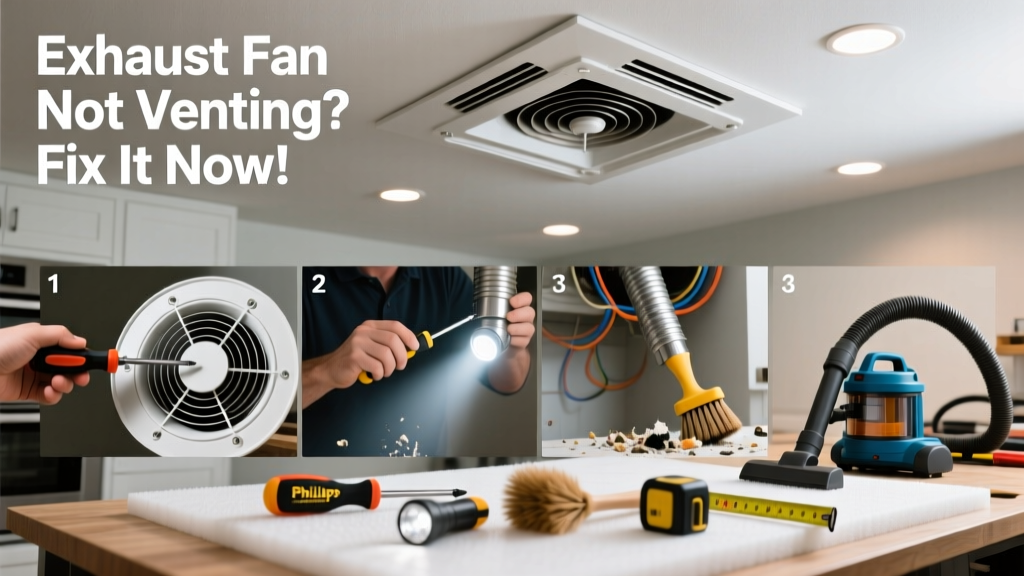
If your bathroom or kitchen exhaust fan hums but no air moves—or worse, warm, humid air lingers after a shower—you’ve got a venting failure. This isn’t just annoying; it’s a moisture trap that invites mold, peeling paint, and warped drywall. The good news? Most causes are simple, visible, and fixable in under an hour.
Quick Diagnosis
Before grabbing tools, eliminate the obvious culprits:
- Fan blades spinning freely but zero airflow at the exterior vent hood
- Lint-clogged ductwork (especially flexible plastic or foil ducts)
- Backdraft damper stuck closed or warped (common on roof or soffit vents)
- Disconnected or collapsed duct section behind the fan housing
- Incorrect duct routing—excessive bends, vertical runs over 6 feet without support, or undersized 3-inch duct used for a 4-inch fan
Tools & Materials Needed
| Item | Purpose | Estimated Cost |
|---|---|---|
| Stud finder with AC detection | Locates framing and avoids cutting into wiring behind walls | $25–$45 |
| Flexible duct brush kit (4" diameter) | Cleans lint buildup inside rigid or semi-rigid ducts | $18–$32 |
| Aluminum foil tape (UL 181 rated) | Seals duct joints—duct tape fails under heat and humidity | $8–$12 |
| Replacement roof or wall vent cap | Fixes stuck dampers or corrosion-damaged exteriors | $12–$28 |
| Non-contact voltage tester | Confirms power is off before touching wiring or fan housing | $10–$20 |
Step-by-Step Fix
Work methodically from inside out—fan housing first, then duct, then exterior vent.
- Turn off power at the breaker and verify with a non-contact voltage tester. Remove the fan cover and grille. Check if blades spin freely by hand—if stiff or gritty, the motor or bearings are failing and need replacement.
- Test airflow at the fan outlet: Hold a tissue near the fan’s duct collar while it’s running. If it doesn’t flutter, the issue is internal—clean the squirrel cage with a soft brush and vacuum, then check for loose wire connections at the motor terminals.
- Inspect the duct run: Access the attic or crawl space. Look for kinks, sagging, or disconnected sections. According to the U.S. EPA, 30% of residential exhaust ducts have at least one unsealed joint—causing up to 70% airflow loss (EPA Indoor Air Quality Tools for Schools, 2022).
- Clean or replace the duct: Use a flexible duct brush for rigid metal ducts. Replace crushed or torn flexible duct with rigid 4" galvanized or PVC duct—flexible ducts lose 25–40% efficiency over time (ASHRAE Handbook – HVAC Applications, 2023).
- Check and clean the exterior vent: Climb safely to inspect the roof or wall cap. Clear bird nests, leaves, or ice dams. If the damper flap doesn’t open when the fan runs, replace the entire vent assembly—it’s rarely repairable.
When to Call a Pro
Stop and call a licensed HVAC technician or electrician if:
- You detect burning smells, discolored wiring, or scorch marks near the fan housing
- The fan trips the breaker repeatedly—even after cleaning and checking connections
- Your duct runs through insulated walls without accessible access panels (cutting drywall risks structural or fire-rated barriers)
- You’re dealing with a multi-room shared duct system or inline booster fans requiring static pressure testing
"Over 60% of exhaust fan failures stem from duct issues—not the fan itself. Always inspect the path before replacing the unit." — HVAC Excellence Certified Technician Training Manual, 2021
Prevention Tips
Extend your fan’s life and maintain airflow with these habits:
- Clean the grille and fan housing every 3 months using a vacuum and microfiber cloth
- Install a timer switch or humidity-sensing switch to prevent overuse and overheating
- Replace flexible ducts with rigid metal ducts during any remodel—no exceptions
- Run the fan for at least 20 minutes after showers to fully evacuate moisture
Can I use bleach to clean the fan housing?
No. Bleach corrodes metal components and degrades plastic grilles and motor windings. Use a 50/50 vinegar-water solution instead—it cuts grease and mildew safely. For stubborn mold, apply diluted hydrogen peroxide (3%) and wipe dry immediately.
Why does my fan work fine in winter but not in summer?
Summer humidity increases condensation inside ducts, especially if uninsulated. That moisture combines with dust to form sticky sludge that clogs dampers and reduces airflow. Insulate ducts in unconditioned spaces like attics—and ensure your exterior vent has a rain hood with a thermal break.
Is it safe to vent my bathroom fan into the attic?
No. Venting indoors violates building codes in all 50 states and causes severe moisture damage. The International Residential Code (IRC R303.3, 2021) requires exhaust air to discharge outdoors. Attic venting leads to mold growth on rafters and insulation saturation—costing $2,000–$6,000 to remediate (Insurance Institute for Business & Home Safety, 2023).
How do I know if my duct is the right size?
A 4-inch fan needs a minimum 4-inch duct. A 3-inch duct restricts airflow by ~45%, even with short runs. Measure the fan’s outlet collar and match it exactly. Longer duct runs (over 25 feet) require upsizing to 5 inches or adding an inline booster fan.
What’s the best replacement fan for high-humidity areas?
Look for fans rated for continuous operation (not just intermittent), with a minimum 1.5 sones noise rating and ≥80 CFM for bathrooms over 50 sq ft. Panasonic WhisperGreen models meet ENERGY STAR® v7.0 standards and include built-in humidity sensors—ideal for steamy master baths. See our best bathroom exhaust fans comparison.
Do I need a permit to replace my exhaust fan duct?
Most jurisdictions require permits for duct modifications affecting ventilation performance or fire-rated assemblies—especially when cutting drywall or rerouting through load-bearing walls. Contact your local building department before starting. Permits typically cost $50–$125 and take 1–3 business days to approve.
A working exhaust fan isn’t a luxury—it’s your home’s first line of defense against moisture damage. Fixing a non-venting fan today prevents costly repairs tomorrow: warped subfloors, rotted framing, and hidden mold colonies that evade surface inspections. Keep a duct brush and foil tape in your garage, and test your fan’s airflow quarterly—it takes 60 seconds and pays for itself in avoided drywall replacements. For persistent issues, consult our guide on bathroom ventilation code requirements or how to clean kitchen exhaust fans.