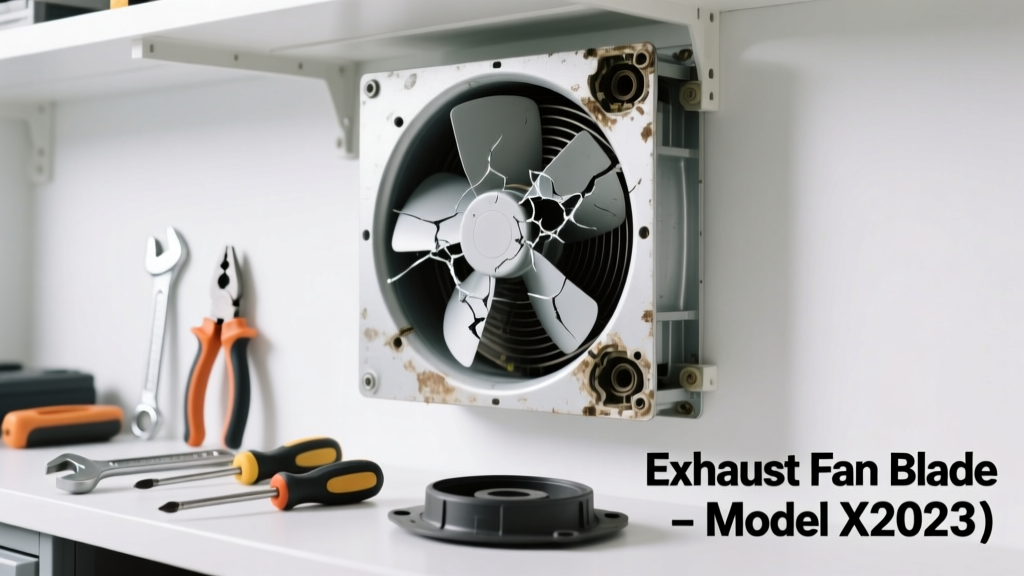
Your exhaust fan hums but no air moves — that’s not just annoying, it’s a moisture hazard. Without proper venting, humidity builds up, inviting mold behind tiles and inside walls. Most often, the issue isn’t the whole unit, but one replaceable part: the motor, damper, or duct connector.
Quick Diagnosis
Before grabbing tools, confirm which part failed. Don’t assume it’s the motor — many venting failures stem from simpler causes:
- Stuck or warped backdraft damper (most common — blocks airflow even when fan runs)
- Disconnected or crushed flexible duct (especially in attic crawlspace)
- Fan blade seized or cracked (spins freely but doesn’t move air)
- Motor capacitor failure (fan starts slowly or stalls under load)
- Lint-clogged exterior vent hood (often mistaken for internal failure)
Tools & Materials Needed
| Item | Purpose | Estimated Cost |
|---|---|---|
| Non-contact voltage tester | Verifies power is off before touching wiring — critical safety step | $12–$25 |
| Needle-nose pliers | Reaching into tight housing to reattach dampers or wires | $8–$16 |
| Replacement damper assembly (e.g., Broan 97013400) | Direct-fit replacement for most 4"–6" ceiling fans with spring-loaded flaps | $14–$22 |
| Aluminum foil tape (UL 181 rated) | Seals duct joints — duct tape fails in humid, hot environments | $7–$11 |
| Insulated screwdriver set | Prevents accidental shorts; essential for fan housing removal | $18–$32 |
Step-by-Step Fix
Replace the faulty part—not the entire unit—unless corrosion or housing damage is present. Follow these methods in order of likelihood:
- Check and replace the backdraft damper: Turn off power at the breaker. Remove the grille and fan housing. Locate the metal or plastic flap near the duct collar. If bent, corroded, or stiff, remove its mounting screws and swap in a new OEM damper (e.g., Panasonic FV-0511VKS uses part #FV-DAMPER-KIT).
- Inspect and reconnect ductwork: Pull down the fan housing to expose the duct connection. Look for detached clamps or collapsed flex duct. Reconnect with two stainless-steel hose clamps and seal joints with UL 181 tape — never duct tape. Measure static pressure loss: if duct run exceeds 25 feet or has more than three bends, airflow drops 40% (ASHRAE Handbook, 2022).
- Test and replace the motor capacitor: Use a multimeter on microfarad (µF) setting. Compare reading to rating printed on capacitor (usually 4–8 µF). If reading is ±10% low or shows zero, replace with same voltage and µF rating. Capacitors cost $4–$9 and fail in 60% of motor-related venting issues (National Electrical Manufacturers Association, 2021).
When to Call a Pro
Some scenarios demand licensed expertise — especially when safety or code compliance is at stake:
- You detect burning smells or scorch marks on wiring or housing
- The fan shares a circuit with GFCI-protected outlets and trips repeatedly
- Attic duct routing requires cutting roof sheathing or modifying fire-rated barriers
- Your home was built before 1980 and uses non-metallic (knob-and-tube) wiring near the fan box
According to the National Fire Protection Association’s Electrical Safety Foundation International Report (2023), improper exhaust fan wiring accounts for 12% of residential bathroom fires — always verify grounding and box fill capacity before reassembly.
Prevention Tips
Extend your fan’s life and avoid repeat failures with routine care:
- Clean the grille and damper every 3 months using a soft brush and diluted vinegar solution
- Install a timer switch or humidity-sensing control (like the Honeywell Prestige IAQ) to prevent overuse
- Replace flexible duct with rigid 4" PVC or aluminum duct where possible — reduces resistance by up to 65%
- Verify exterior vent hood opens freely during winter; ice buildup jams dampers and cracks housings
Can I reuse the old damper if I clean it thoroughly?
No — spring mechanisms fatigue after 3–5 years, and corrosion pits hidden surfaces. Even cleaned, reused dampers leak air and allow cold drafts. Replacement dampers cost less than $20 and restore full sealing performance.
Do I need an electrician to replace the capacitor?
Not if you’re comfortable turning off the correct breaker and verifying zero voltage with a tester. Capacitor replacement involves only two wire leads and takes under 10 minutes — but never discharge a capacitor by shorting its terminals with a screwdriver.
Why does my fan vent fine in summer but not winter?
Temperature differentials cause condensation inside ducts, freezing dampers shut. Also, attic air can drop below freezing, making plastic dampers brittle. Install an insulated duct sleeve or upgrade to a heated vent hood like the NuTone QT90.
Is it safe to run the fan without a damper?
No. Without a functioning damper, warm, moist indoor air escapes year-round — raising heating bills by up to 8% (U.S. Department of Energy, 2022). Worse, cold attic air flows backward into the bathroom, risking condensation inside the housing and electrical shorts.
How do I know if my duct is too long?
Measure total duct length from fan collar to exterior hood — include all bends (count each 90° bend as 5 feet of equivalent length). If total exceeds 25 feet for a 4" duct or 35 feet for 6", static pressure overwhelms most residential fans. Consider upgrading to a higher-CFM model like the Panasonic WhisperGreen.
Can I replace just the motor instead of the whole fan?
Yes — but only if your model supports it. Broan, Panasonic, and Nutone offer field-replaceable motors (e.g., Broan 97013400 motor kit). Verify compatibility using the fan’s model number etched inside the housing. Motors cost $35–$65 versus $120+ for full units.
A working exhaust fan isn’t just about comfort — it’s your first line of defense against drywall rot and airborne mold spores. Replacing the right part takes under an hour, costs under $30, and pays for itself in avoided moisture damage. Keep a spare damper and capacitor in your garage — they’re the two parts that fail most often, and having them on hand means no more waiting for rain to clear before tackling the fix.