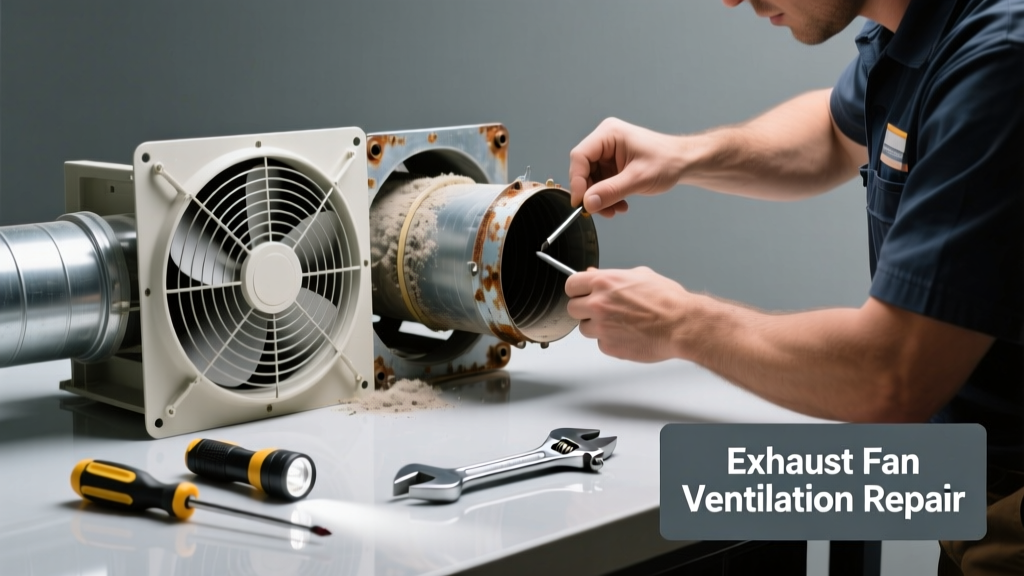
If your bathroom or kitchen exhaust fan is running but no air is moving—or worse, you smell stale air or see moisture buildup—it’s likely not venting outside. That’s not just annoying; it’s a moisture trap that can rot framing, grow mold, and raise indoor humidity by up to 30% in just one shower (U.S. EPA Indoor Air Quality Guide, 2022). Let’s get it fixed right.
Quick Diagnosis
Before grabbing tools, rule out the obvious:
- Fan motor spins but no airflow — suggests duct blockage or disconnected vent
- Fan makes grinding or squealing noise — likely seized bearing or bent blade
- Strong odor or humid air returns into room — indicates backdraft or improperly sealed duct termination
- Lint, dust, or bird nests visible at roof or wall cap — classic sign of outdoor vent obstruction
- Insufficient static pressure test: hold a tissue near the grille while fan runs — if it doesn’t pull firmly, vent resistance exceeds 0.15" w.c. (per ASHRAE 62.2-2022)
Tools & Materials Needed
| Item | Purpose | Estimated Cost |
|---|---|---|
| Flexible aluminum duct cleaner brush (10 ft) | Clears lint and debris from flexible duct runs without disassembly | $12–$18 |
| Roof vent cap wrench (or adjustable pliers) | Removes corroded or stuck roof cap screws safely | $8–$15 |
| Manometer (digital, ±0.01" w.c.) | Measures static pressure to confirm vent restriction (critical for code compliance) | $45–$75 |
| Duct mastic + foil tape (UL 181 listed) | Seals leaks in rigid or flex duct joints—duct tape fails under heat and humidity | $14–$22 |
| 100-micron lint filter (for inline models) | Reduces buildup in long duct runs; replaces disposable filters every 6 months | $9–$16 |
Step-by-Step Fix
- Power off & inspect grille: Turn off circuit breaker, remove cover, and check for dust-caked blades or warped housing. Clean blades with damp microfiber cloth and mild dish soap—never abrasive cleaners.
- Test duct continuity: Use a shop vac on blow mode at the fan outlet while holding a tissue at the roof/wall cap. If tissue flutters weakly or not at all, duct is obstructed or collapsed.
- Clear flexible duct: Insert aluminum brush into duct near fan, rotate clockwise while feeding in. Pull out slowly—repeat until debris stops exiting. Vacuum outlet end thoroughly.
- Inspect and seal duct joints: Look for gaps, kinks, or disconnected sections—especially where flex meets rigid duct or wall cap. Seal with UL 181 mastic, not duct tape. Replace crushed flex duct entirely if diameter reduced >25%.
- Verify outdoor termination: Climb onto roof (with fall protection) or access exterior wall cap. Remove cap, clear bird nests or ice dams, and ensure damper opens freely. Install a bird-proof roof vent cap if repeated nesting occurs.
When to Call a Pro
DIY stops where safety or code compliance begins. Call a licensed HVAC technician or home performance contractor if:
- You detect carbon monoxide near the fan (immediate danger—evacuate and call 911 first)
- Duct runs through unconditioned attic spaces longer than 25 feet with more than two 90° bends (requires engineered static pressure calculation)
- Your home has a balanced ventilation system (e.g., HRV/ERV) — tampering may unbalance whole-house airflow
- You find evidence of condensation inside ductwork or insulation saturation — indicates chronic thermal bridging or missing vapor barrier
Prevention Tips
Exhaust fans fail most often due to neglect—not age. Keep yours working reliably with these habits:
- Clean grille and blades every 3 months (more often in high-humidity homes or homes with pets)
- Replace disposable filters quarterly; clean permanent filters monthly
- Install a timer switch or humidity-sensing switch (like this model) to ensure minimum 20-minute run time after showers
- Inspect roof/wall caps biannually—especially after winter storms or high winds
Can I use bleach to clean the fan housing?
No. Bleach corrodes galvanized metal housings and degrades plastic components over time. Use a 50/50 white vinegar-water solution instead—it dissolves mineral deposits and kills mold spores without damage. Rinse thoroughly and dry before reassembly.
Why does my fan vent fine in summer but not winter?
Ice buildup in roof vents is common in cold climates. Warm, moist air condenses inside cold ducts, then freezes at the termination point. Insulate exposed duct sections in attics with R-8 duct wrap and ensure roof cap has a built-in freeze-resistant damper.
Is it okay to vent my bathroom fan into the attic?
Never. According to the 2021 International Residential Code (IRC M1507.3), exhaust must terminate outdoors. Venting into the attic introduces ~1.5 pints of moisture per shower—enough to saturate insulation and promote wood-destroying fungi within 18 months (IBHS Field Assessment Report, 2023).
How do I know if my duct is too long?
Maximum recommended length is 25 feet for 4-inch rigid duct, or 15 feet for flexible duct—with no more than two 90° bends. Every bend adds ~5 feet of equivalent length. Measure total developed length using duct calculator tools like the Residential Duct Sizing Tool.
What’s the best fan CFM for a standard bathroom?
For bathrooms under 100 sq ft, 50 CFM is minimum per IRC. For larger spaces, use 1 CFM per square foot—or 50 CFM plus 50 CFM per toilet/tub/shower beyond the first. Always verify static pressure stays below 0.20" w.c. at rated CFM.
Can a clogged dryer vent affect my exhaust fan?
Not directly—but if both share a common wall chase or poorly sealed soffit cavity, backpressure from the dryer can reduce fan efficiency by up to 40%. Keep exhaust systems fully isolated and independently terminated.
"Over 60% of exhaust fan failures stem from duct issues—not the fan itself. The motor lasts 12+ years on average; the duct rarely lasts half that without maintenance." — Home Performance Coalition, Duct Maintenance Survey, 2022
A properly venting exhaust fan doesn’t just eliminate foggy mirrors—it protects your home’s structural integrity and indoor air quality. Revisit your fan’s performance every season, treat ducts like plumbing (they move air, not water—but clog just as easily), and remember: if airflow feels weak, don’t wait for mold to show up on the ceiling. A few minutes of inspection now saves hundreds in remediation later.