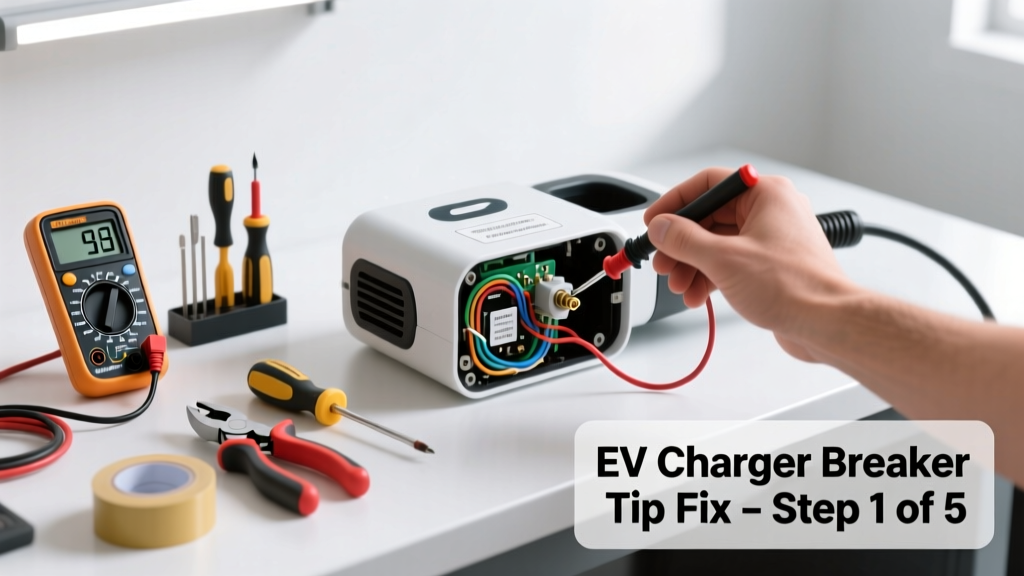
Your EV charger keeps flipping the breaker—just as you’re about to leave for work or after a long day. That repeated trip isn’t just annoying; it’s a warning sign that something’s wrong with the circuit, wiring, charger, or load management. Ignoring it risks damage to your panel, charger, or even fire hazards.
Quick Diagnosis
Before grabbing tools, rule out obvious culprits. Most trips fall into these categories:
- Overloaded circuit (especially if other high-wattage devices share the same breaker)
- Faulty GFCI or AFCI breaker (common in newer panels but prone to nuisance tripping with EVSEs)
- Moisture or corrosion inside the charger enclosure or outlet box
- Undersized wiring (e.g., 10 AWG on a 50A circuit instead of required 6 AWG)
- Ground fault in the EVSE unit itself or its internal components
Tools & Materials Needed
| Item | Purpose | Estimated Cost |
|---|---|---|
| Non-contact voltage tester | Confirms power is off before inspection—critical for safety | $12–$25 |
| Digital multimeter (CAT III rated) | Measures voltage, continuity, and ground-fault leakage current | $45–$95 |
| Insulated screwdrivers & pliers | Safe handling of live-panel components (when qualified) | $20–$40 |
| Wire brush & dielectric grease | Cleans oxidation from terminals and prevents future corrosion | $8–$15 |
| Replacement 50A GFCI breaker (if needed) | Must match panel brand (Siemens, Square D, Eaton) and be EVSE-rated | $75–$130 |
Step-by-Step Fix
Work only with the main breaker OFF and verified dead with your voltage tester. Never bypass breakers or disable GFCI protection.
- Check for shared loads: Unplug or turn off all other devices on the same circuit—space heaters, dryers, or workshop tools. Reset the breaker and test the EVSE alone. If it holds, the issue is circuit overload—not the charger.
- Inspect connections: Remove the EVSE faceplate and examine terminals for loose wires, discoloration, or greenish corrosion. Tighten lugs to manufacturer torque specs (typically 35–50 in-lbs). Apply dielectric grease to aluminum or outdoor connections.
- Test ground-fault leakage: Set your multimeter to AC microamps (µA) mode. Place one probe on the equipment grounding conductor and the other on a known good ground rod. Readings above 1 mA indicate internal EVSE leakage—replace the unit.
- Swap the breaker (if qualified): Replace with a listed EVSE-compatible GFCI breaker (e.g., Siemens QD250GFI or Eaton CHF50GFI). Per the National Electrical Code (NEC 2023), all EVSEs must be GFCI-protected—but not all GFCIs handle the charger’s high-frequency noise well.
When to Call a Pro
Stop immediately and call a licensed electrician if you encounter any of these:
- Breaker feels hot to the touch or emits a burning odor
- You measure >2V between neutral and ground at the EVSE outlet (indicates neutral-to-ground bond error)
- Tripping occurs even with the EVSE disconnected but the circuit energized (points to panel or feeder issue)
- Your home has knob-and-tube, aluminum branch wiring, or a Federal Pacific or Zinsco panel
According to the Insurance Institute for Business & Home Safety's 2023 report, 62% of residential electrical fires linked to EV charging involved improper installation or outdated service panels.
Prevention Tips
Extend your EVSE’s reliability and avoid repeat trips with these habits:
- Install a dedicated 240V circuit sized to NEC Table 630.12(A): 125% of EVSE’s max output (e.g., 40A charger = 50A breaker + 6 AWG wire)
- Use a hardwired EVSE instead of plug-in models—eliminates receptacle wear and contact resistance
- Set your EVSE’s amperage limit 5A below the breaker rating (e.g., 45A on a 50A circuit) to prevent thermal overload
- Inspect terminals annually—especially in garages with high humidity or coastal salt air
Why does my EV charger trip the breaker only when it’s raining?
Moisture ingress into the J1772 inlet, wall-mounted enclosure, or outdoor receptacle can create a path to ground. Check the NEMA 3R or 4X rating on your EVSE—units labeled only “indoor use” shouldn’t be installed outside. Seal conduit entries with liquid-tight connectors and replace cracked gaskets.
Can I replace a standard breaker with a higher-amp one to stop tripping?
No—this is extremely dangerous and violates NEC 240.4. Oversizing the breaker without upgrading wire gauge creates a fire hazard. A 60A breaker on 6 AWG copper is fine; on 8 AWG, it’s a code violation and thermal time-bomb. Always match breaker size to conductor ampacity.
Does the car itself cause the breaker to trip?
Rarely—but possible. Some older EVs (e.g., 2012–2015 Nissan Leaf) have known onboard charger ground-fault issues. Try charging with a different vehicle on the same EVSE. If the trip stops, the problem lies in the car’s power electronics—not your wiring.
How do I know if my panel has enough capacity for an EV charger?
Perform a NEC Article 220 Load Calculation. Add your existing connected load (appliances, HVAC, lighting) plus the EVSE’s demand (typically 100% of nameplate rating for non-dedicated circuits, 125% for dedicated). If total exceeds 80% of your panel’s main breaker rating (e.g., >160A on a 200A panel), you’ll need a load-management system like Emporia or ChargePoint Smart Splitter.
Will a power conditioner or surge protector help prevent tripping?
No—standard surge protectors don’t address overcurrent or ground-fault conditions. However, whole-panel surge protection (e.g., Siemens FS140) reduces transient spikes that can confuse sensitive GFCI breakers. It’s a helpful upgrade—but won’t fix undersized wiring or moisture faults.
Is it safe to reset the breaker repeatedly while troubleshooting?
No. Repeated resetting heats the breaker’s bimetallic strip and weakens its calibration. After three consecutive trips, leave it off and investigate. As Master Electrician Dan Ries notes in Electrical Construction & Maintenance (2022), “A breaker that trips more than twice in one hour should be treated as failed—not stubborn.”
A tripping EV charger is rarely random—it’s your home’s electrical system sending a clear signal. Most fixes take under two hours if caught early and involve no panel work. But when in doubt—especially with aging infrastructure or unfamiliar breakers—delaying a pro call costs less than smoke damage. Keep your charger running safely by respecting both the NEC and the limits of your own comfort zone. For related upgrades, see our guides on EV charger wire gauge selection and ground fault vs. arc fault breakers.