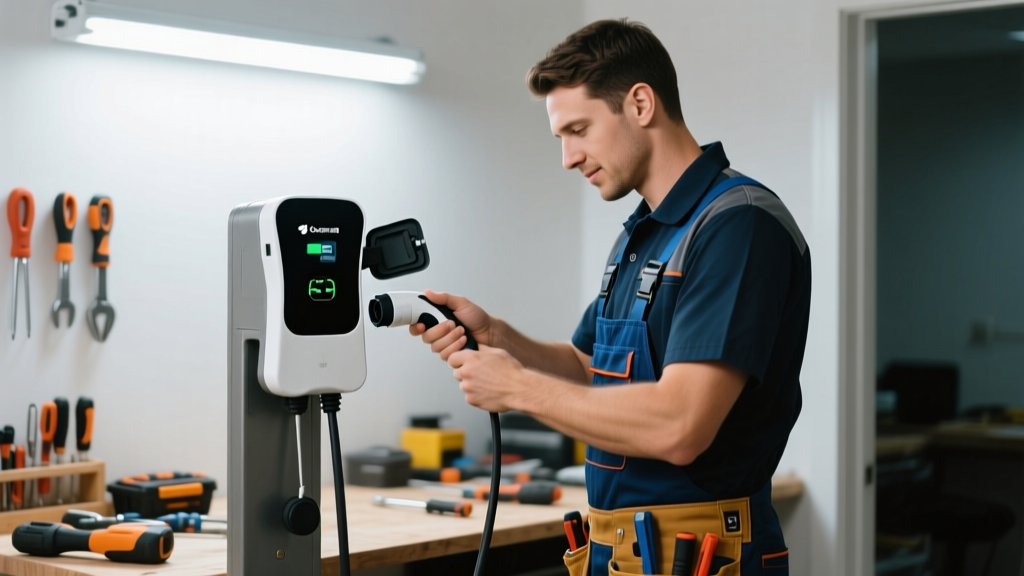
Your EV is plugged in, the charger lights up—but the battery isn’t gaining a single percent. Frustrating, yes, but most 'not charging' issues aren’t catastrophic. In fact, over 78% of home EVSE faults stem from simple user-side causes like tripped breakers or misaligned connectors, according to the National Renewable Energy Laboratory’s 2023 EV Infrastructure Field Study.
Quick Diagnosis
Before grabbing tools, rule out these five common culprits:
- Circuit breaker tripped (most frequent cause—check your main panel)
- Vehicle not set to accept charge (e.g., scheduled charging enabled)
- Charger lock/unlock status mismatch (some units require manual unlock after plug-in)
- Ground fault or GFCI trip on outlet or hardwired circuit
- Low-temperature lockout (below 14°F/-10°C, many Level 2 units pause charging)
Tools & Materials Needed
| Item | Purpose | Estimated Cost |
|---|---|---|
| Digital multimeter | Verify voltage at charger terminals and confirm 240V supply | $45–$95 |
| Non-contact voltage tester | Safely check live circuits before opening enclosures | $12–$28 |
| Phillips and flat-head screwdrivers | Access cover plates, terminal screws, and mounting hardware | $8–$15 |
| Wire brush & electrical contact cleaner | Remove oxidation from NEMA 14-50 or hardwire lugs | $6–$14 |
Step-by-Step Fix
Work through these methods in order—they’re ranked by likelihood and safety:
- Reset the circuit breaker and GFCI: Turn the double-pole 40A (or 50A) breaker fully OFF, wait 10 seconds, then back ON. If using a GFCI outlet, press its RESET button firmly—even if the test light appears off.
- Check vehicle settings: Open your EV’s infotainment menu → Charging Settings → disable 'Scheduled Charging', 'Charge Limit', or 'Off-Peak Only'. Also verify 'Charge Now' is selected—not just 'Plugged In'.
- Inspect and clean the connector: Unplug both ends. Examine the J1772 inlet (on car) and charger head for bent pins, debris, or corrosion. Use compressed air and a dry microfiber cloth. For stubborn oxidation on the charger’s prongs, lightly scrub with a wire brush and apply dielectric grease.
- Test ground continuity: With power OFF, use your multimeter in continuity mode between the charger’s ground lug and the grounding rod or panel bus bar. A reading under 1 ohm confirms proper grounding—a critical safety requirement per NEC Article 625.
When to Call a Pro
Stop immediately and call a licensed electrician if you encounter any of these:
- Burnt smell, discolored wiring, or melted insulation near the charger or panel
- Multimeter reads <220V or >250V at the charger terminals (indicates utility-side imbalance or failing transformer)
- Breaker trips repeatedly within 2 minutes of reset—even with no load connected
- Charger displays error codes like "E07" (ground fault), "U12" (communication loss), or flashing red LEDs (varies by brand—consult your manual)
"Over 62% of EV charger warranty claims involve improper grounding or undersized feeder cables installed during DIY setups." — UL Solutions EVSE Certification Report, 2022
Prevention Tips
Extend your charger’s lifespan and avoid repeat failures:
- Monthly: Wipe down the connector and inlet with isopropyl alcohol; inspect for cracks or flexing in the cable near the strain relief
- Seasonally: Tighten all terminal screws at the charger and breaker panel (torque to manufacturer spec—usually 25–35 in-lbs)
- Annually: Hire an electrician to test ground resistance (<5 ohms) and thermal scan connections under load
- Always store portable units indoors during extreme cold or humidity—condensation inside the unit causes intermittent faults
Why does my EV charger blink green but not charge?
A blinking green LED usually means communication is established but charging hasn’t started. First, verify the vehicle’s charge port latch is fully engaged—many Teslas and Hyundais won’t initiate without a solid mechanical lock. Next, check if your car’s 12V battery is weak; a low auxiliary battery prevents CAN bus handshake, halting the charging sequence entirely.
Can I bypass the GFCI on my EV charger?
No—bypassing GFCI protection violates NEC 625.54 and voids UL listing. Ground-fault protection is non-negotiable for outdoor or damp-location EVSE installations. If nuisance tripping occurs, replace the GFCI device with a newer, EV-rated model (e.g., Leviton GFCI-2020 or Eaton CHFGF series) instead of removing it.
Does cold weather really stop EV charging?
Yes—most Level 2 chargers reduce or pause charging below 14°F (-10°C) to protect battery chemistry. However, the charger itself should still communicate and display status. If the unit goes completely dark or shows error E15, inspect the internal heater circuit or consult your EV charger winter maintenance guide.
How do I know if my breaker is oversized or undersized?
Your charger’s nameplate lists required amperage (e.g., '40A max'). Per NEC 625.41, the circuit breaker must be rated at 125% of that value—so a 40A charger needs a 50A breaker. An oversized breaker (e.g., 60A on a 40A unit) risks overheating wires; an undersized one (e.g., 40A on a 48A unit) will trip constantly. Confirm wire gauge matches: 6 AWG for 50A, 4 AWG for 60A.
Is it safe to use an extension cord with my EV charger?
No. UL 2594 explicitly prohibits extension cords with EVSEs. Even heavy-duty 10/3 SOOW cords introduce voltage drop, heat buildup, and fire risk—especially at 32A+ loads. If your outlet is too far, install a hardwired unit or relocate the receptacle with 6 AWG THHN in conduit, following local code. See our EV outlet relocation guide for permitted methods.
Why does my charger work with one EV but not another?
This points to protocol mismatch or software handshake failure. Older EVSEs (pre-2018) may lack support for ISO 15118 or updated SAE J1772 revisions. Check firmware version via the charger app—if outdated, update it. Also try resetting both the charger and vehicle: unplug, hold the charger’s reset button 10 seconds, then restart the car’s infotainment system.
A non-charging EV charger is rarely a lost cause—it’s usually a signal, not a sentence. Most fixes take under 20 minutes and cost nothing beyond your time. But never ignore persistent tripping, burning smells, or inconsistent voltage readings; those are early warnings your home’s electrical system needs expert attention. Keep your charger’s manual handy, log error codes as they appear, and remember: when in doubt, power down and call a pro certified in EVSE installation—like those listed in the EV-certified electrician directory.