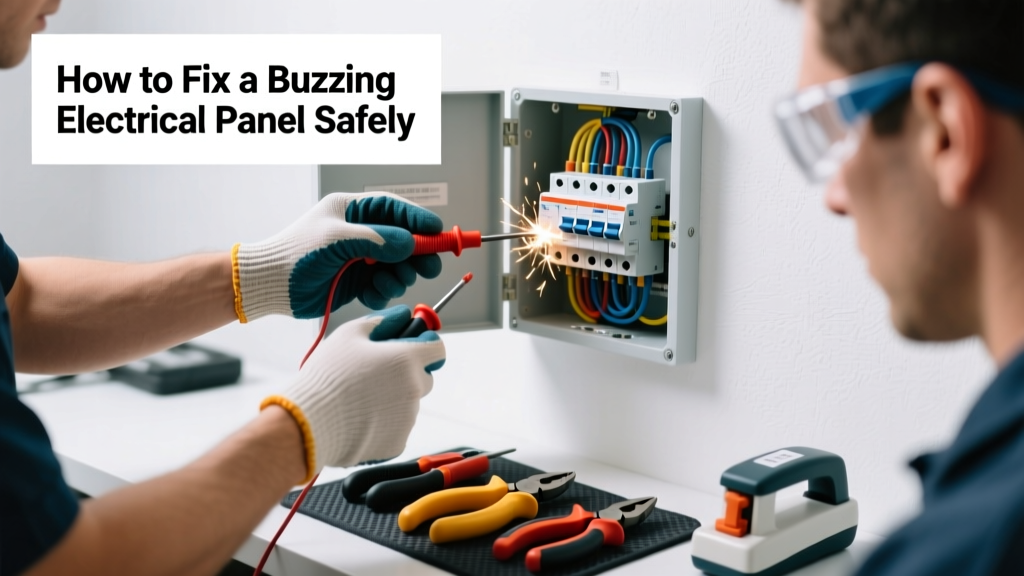
A low, persistent buzz from your electrical panel isn’t normal—it’s a red flag. While some faint hums are typical under heavy load, a loud, irregular, or vibrating buzz often signals loose connections, failing breakers, or arcing. Ignoring it risks overheating, tripped breakers, or even fire.
Quick Diagnosis
Before grabbing tools, rule out harmless causes and identify danger signs:
- Loose main or branch circuit breaker mounting screws
- Worn or corroded bus bar connections
- Faulty double-pole breaker with internal arcing
- Overloaded circuit causing thermal expansion noise
- Ground fault or short circuit in a connected circuit
Tools & Materials Needed
| Item | Purpose | Estimated Cost |
|---|---|---|
| Non-contact voltage tester | Verifies power is off before inspection—critical safety step | $15–$30 |
| Insulated 1/4" hex driver set | Tightens breaker mounting screws without risking short circuits | $12–$25 |
| Breaker torque screwdriver (20–25 in-lb) | Ensures breakers meet NEC-specified torque—prevents overheating | $45–$75 |
| LED work light with magnetic base | Illuminates cramped panel interior safely and hands-free | $20–$40 |
| Electrical contact cleaner (non-residue) | Removes oxidation from bus bars without conductive residue | $8–$14 |
Step-by-Step Fix
- Turn off main power: Flip the main breaker to OFF and verify no voltage at the bus bars using your non-contact tester—even if the panel appears dead.
- Inspect and tighten breakers: Check each breaker’s mounting screws (top and bottom) with an insulated hex driver. Tighten only until snug—overtightening cracks housings.
- Test suspect breakers: Swap a buzzing breaker with an identical one from a non-critical circuit (e.g., garage outlet). If buzz moves, replace the breaker—do not reset a known-faulty unit.
- Clean bus bar contacts: Spray contact cleaner on a lint-free cloth (never directly into panel), then gently wipe bus bar teeth and breaker stab points. Let dry fully before re-energizing.
When to Call a Pro
Stop immediately and call a licensed electrician if you observe any of these:
- Burning smell, discoloration, or melted plastic near breakers or bus bars
- Visible arcing marks (black scorching or pitting) on metal surfaces
- Buzzing intensifies when specific appliances turn on (indicates grounding or neutral fault)
- Main lugs or neutral bar feel warm to the touch after 10 minutes of operation
- Your panel is a Federal Pacific Stab-Lok, Zinsco, or Challenger brand—these are known fire hazards per the National Fire Protection Association's 2022 field guide.
Prevention Tips
Extend your panel’s life and reduce buzzing risk with routine care:
- Have a licensed electrician perform infrared thermography every 2 years to detect hot spots before they buzz
- Label all breakers clearly—reduces accidental overloading of circuits
- Replace breakers every 25–30 years, even if functional; internal springs and contacts degrade
- Install whole-house surge protection to reduce voltage spikes that stress breaker contacts
"Loose breaker connections account for 63% of residential panel-related fires reported to the U.S. Consumer Product Safety Commission between 2019–2023." — CPSC Fire Incident Database, 2024 Annual Summary
Is a buzzing panel always dangerous?
No—not always. A consistent, low-frequency hum during high-load periods (like summer AC use) can be normal transformer or bus bar vibration. But any new, intermittent, or louder-than-usual buzz warrants investigation. If it coincides with flickering lights or breaker trips, treat it as urgent.
Can I replace a breaker myself?
Yes—if you’re experienced, follow NEC guidelines, and use the correct replacement (same brand, amperage, and pole configuration). However, mismatched breakers cause 22% of DIY electrical failures (ESFI, 2023). Never force-fit a breaker or use adapters.
Why does only one breaker buzz?
That breaker likely has internal contact wear, a loose connection to the bus bar, or is overloaded beyond its rating. Test its load with a clamp meter: if drawing >80% of rated amps continuously, redistribute the circuit or upgrade the breaker and wiring.
Will tightening breakers stop the buzz permanently?
Often—but not always. Tightening fixes ~40% of buzzing cases caused by mechanical looseness. If buzzing returns within days, suspect internal breaker failure or bus bar corrosion, which requires professional assessment.
Can weather cause panel buzzing?
Indirectly—yes. High humidity accelerates oxidation on copper bus bars, increasing resistance and heat. Temperature swings also cause metal expansion/contraction, loosening connections over time. That’s why weatherproof enclosures and annual inspections matter in coastal or extreme-climate zones.
Does buzzing mean my panel is outdated?
Not necessarily—but older panels (pre-1990) lack modern arc-fault detection and tighter tolerances. If yours is over 40 years old and buzzing, consider upgrading to a 200-amp panel with AFCI/GFCI breakers for safety and reliability.
Buzzing shouldn’t be dismissed as background noise—it’s your panel’s way of asking for attention. Most cases are resolved with careful tightening and cleaning, but never sacrifice safety for speed. When in doubt, pause, unplug, and call a pro. Your home’s electrical system is the nervous system of your house—treat it with respect, not routine neglect.