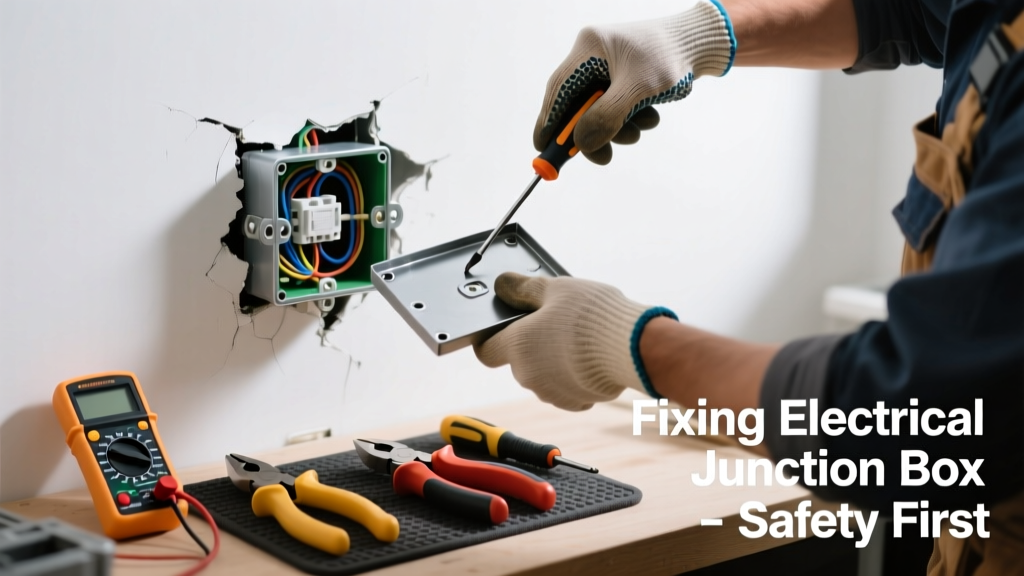
A missing junction box cover isn’t just an eyesore—it’s a serious fire and shock hazard. Exposed wires can arc, overheat, or contact metal framing, and the National Fire Protection Association reports that 12% of home electrical fires originate from uncovered or improperly installed boxes (NFPA Electrical Safety Report, 2022). Don’t ignore it—even if the box looks inactive.
Quick Diagnosis
Before grabbing tools, confirm why the cover is missing:
- The cover was removed during prior work and never reinstalled
- Screws were lost or stripped during maintenance
- The box was installed without a cover—common in DIY remodels or attic/crawlspace rough-ins
- Cover warped, cracked, or corroded and fell off
- Box is oversized or nonstandard, making standard covers incompatible
Tools & Materials Needed
| Item | Purpose | Estimated Cost |
|---|---|---|
| Voltage tester (non-contact) | Verifies power is OFF before handling wires | $12–$25 |
| Phillips screwdriver (#1 or #2) | Tightens mounting screws on metal or plastic covers | $5–$15 |
| Replacement cover (metal or plastic) | Must match box type (e.g., 4-inch square, octagon, round) | $2–$12 |
| Wire nuts (if re-terminating) | Secures loose wire connections before covering | $3–$8 |
| Needle-nose pliers | Adjusts wire bends and grips small screws in tight spaces | $8–$20 |
Step-by-Step Fix
Follow these methods in order—start with the simplest solution first:
- Verify power is off: Turn off the circuit breaker, then test all wires inside the box with a non-contact voltage tester. Double-check at both hot and neutral conductors.
- Identify box type and size: Measure the box opening (e.g., 4" × 4", 3.5" round) and note material (steel, aluminum, PVC). Check for stamped markings like "4S" or "RACO 826" on the box edge.
- Select and install correct cover: Match cover style—blank (no openings), with knockouts, or with built-in clamps. Secure with two or more machine screws (not drywall screws) tightened snugly but not stripped.
- If wires are damaged or loose: Trim frayed insulation, re-strip 3/4" of conductor, and twist on new UL-listed wire nuts. Tuck wires neatly into box before installing cover.
- Test and label: Restore power, verify connected devices operate normally, and label the breaker with the box location (e.g., "Hallway Light Box") using tape or a label maker.
When to Call a Pro
Stop immediately and call a licensed electrician if any of these apply:
- You find more than four current-carrying wires in a standard 4×4 box (exceeds NEC fill capacity)
- The box is recessed deeper than 1/4" from the wall surface (requires mud ring or extension ring)
- Wires show heat damage (discoloration, brittle insulation, melted sheathing)
- The circuit trips repeatedly after cover installation
- The box feeds multiple circuits or serves as a splice point for aluminum wiring (pre-1970s homes)
Prevention Tips
Keep junction boxes safe and compliant long-term:
- Always store spare covers and matching screws in your electrical supply kit
- After any ceiling or wall work, do a full visual sweep of every accessible box—attics, basements, garages
- Use labeled photos in your phone: snap each box pre- and post-repair to track changes
- Install tamper-resistant covers in rental properties or homes with children
- Log box locations and types in your home maintenance binder (or digital app like Home Maintenance Schedule)
Can I use a blank cover on a box with active switches or outlets?
No. Blank covers only work when no devices are mounted. If you see a switch, receptacle, or dimmer attached, you need a device-rated cover—like a single-gang or double-gang faceplate with cutouts. Using a blank cover over live devices violates NEC 314.25 and creates overheating risk.
What if the original cover is lost and I don’t know the brand?
Measure the knockout pattern and box depth. Most standard 4×4 metal boxes accept universal covers like Carlon B210 or Arlington 410. If the box has unusual spacing (e.g., 3.25" between centers), bring the box itself to a supply house—they’ll match it in minutes. Avoid guessing—our electrical box sizing guide shows exact dimension charts.
Is duct tape or wire nuts alone enough to cover exposed wires temporarily?
Never. Tape degrades, melts, and offers zero arc-fault protection. Wire nuts aren’t designed to be exposed—and exposed neutrals can energize grounded surfaces. The U.S. Consumer Product Safety Commission recorded 270 injuries annually from makeshift electrical covers (CPSC Injury Data, 2021). Power off and cover properly—or leave it off until fixed.
Do plastic junction boxes require different covers than metal ones?
Yes. Plastic boxes often use integral tabs or snap-on covers; metal boxes require machine screws. Never force a plastic cover onto a metal box—the threads won’t engage, and vibration loosens it. Also, plastic covers lack grounding continuity, so if the box grounds via the cover (as many metal ones do), you’ll break the ground path.
How often should I inspect junction box covers in my home?
Every 12–18 months—especially after seasonal temperature swings or home renovations. Attic and basement boxes are most vulnerable: thermal expansion cracks plastic, and dust buildup hides loose screws. According to the Electrical Safety Foundation International’s 2023 Home Inspection Survey, 68% of uncovered boxes were found in unfinished spaces overlooked during routine cleaning.
Can I paint a metal junction box cover to match the wall?
Only with non-conductive, UL-listed appliance paint—and only after confirming the cover is clean, dry, and free of rust or grease. Never paint over screw threads or grounding lugs. Paint adds insulation, which may trap heat; if the box serves high-load circuits (e.g., HVAC or EV charger), consult an electrician first. For best results, choose a pre-finished cover in white, almond, or gray—available at most hardware stores.
"A junction box without a cover is like a car without brakes—it might seem fine until the moment it isn't." — Master Electrician Lena Ruiz, NECA Certified Trainer, 2022
Replacing a missing junction box cover takes under 15 minutes—but skipping it risks shock, fire, or failed home inspections. Keep the right cover on hand, verify power every time, and treat every box like it’s live until proven otherwise. If you’re unsure about wire count, box fill, or grounding integrity, knowing when to call an electrician isn’t caution—it’s code compliance.