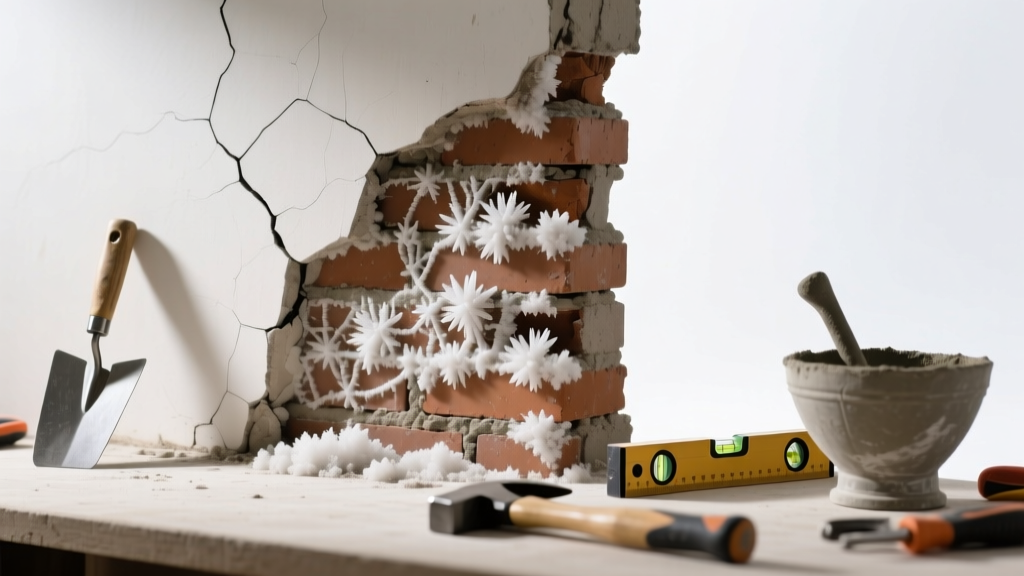
Efflorescence isn’t just a cosmetic issue—it’s your wall’s early warning system. When white, chalky deposits reappear after cleaning or spread beyond surface areas, the underlying masonry (brick, block, or mortar) is likely compromised and needs targeted replacement—not just scrubbing. Ignoring it invites moisture entrapment, freeze-thaw spalling, and eventual structural weakening.
Quick Diagnosis
Efflorescence signals deeper moisture movement. Before replacing anything, confirm the root cause:
- Cracked or deteriorated mortar joints allowing water infiltration
- Missing or failed weep holes in brick veneer systems
- Non-breathable sealants trapping vapor behind masonry
- Failed flashing at roofline, windows, or lintels
- Soil or mulch piled above foundation wall grade
Tools & Materials Needed
| Item | Purpose | Estimated Cost |
|---|---|---|
| Masonry chisel & hammer | Removes damaged mortar and loose brick/block without cracking adjacent units | $12–$28 |
| Pointing trowel & jointer | Ensures consistent, properly compressed mortar joints | $8–$15 |
| Type N mortar mix | Flexible, breathable blend ideal for above-grade masonry repairs | $7–$11 per 80-lb bag |
| Wire brush (stiff-bristled) | Cleans dust and debris from joints before repointing | $5–$9 |
| Hygrometer + moisture meter | Verifies wall moisture content (<12% MC) before sealing or repointing | $45–$120 |
Step-by-Step Fix
Replacement focuses on the failing unit—not the salt deposit. Follow these methods based on severity:
- Repointing cracked mortar joints: Cut out mortar to ¾" depth using chisel; dampen joints; apply Type N mortar in layers; tool joints flush with original profile.
- Replacing a spalled brick: Drill pilot holes around brick perimeter; carefully chip out unit with flat chisel; clean cavity; bed new brick in fresh mortar; match joint depth and color.
- Installing weep tube inserts: Drill 3/16" hole at base of brick veneer cavity; insert stainless steel weep tube angled downward; seal top with breathable caulk.
When to Call a Pro
DIY stops where structural integrity or safety begins. Call a licensed mason or waterproofing contractor if:
- You observe horizontal cracks wider than 1/8" in load-bearing walls
- Efflorescence appears alongside bulging, leaning, or shifting masonry
- The affected area exceeds 10 sq. ft. or involves structural lintels or arches
- Moisture readings exceed 18% MC at multiple depths (per ASTM D4263)
Prevention Tips
Fixing the part is half the job—the other half is stopping recurrence. Implement these long-term controls:
- Redirect downspouts at least 5 ft from foundations (per International Residential Code R401.3)
- Maintain soil grading sloping away from walls at 6" drop over 10 ft
- Avoid applying non-breathable acrylic or silicone sealers—use silane-siloxane hybrids like these tested options
- Inspect and clear weep holes annually with a pipe cleaner or low-pressure air blast
Can I use bleach on this?
No. Bleach reacts with calcium salts to form soluble chlorides that migrate deeper into masonry, worsening future efflorescence and accelerating corrosion of embedded metal ties. Use only dry brushing or diluted white vinegar (1:4) for surface residue—and only after fixing the water source.
Will pressure washing help?
It temporarily removes deposits but forces water deeper into compromised mortar or cracks. The U.S. Department of Housing and Urban Development’s 2022 Rehabilitation Guidelines explicitly warn against high-pressure washing on historic or aged masonry due to increased water intrusion risk.
Is efflorescence always a sign of serious damage?
Not immediately—but it’s never harmless. According to the Brick Industry Association’s Technical Note 11B (2021), persistent efflorescence correlates with a 73% higher probability of mortar bond degradation within 3–5 years if left unaddressed.
Do I need to replace all bricks showing salt?
No—only those exhibiting physical deterioration: surface powdering, edge chipping, or visible cracks. Salt alone doesn’t mean replacement; it means investigate the moisture path. Test adjacent units with a sharp awl—if they crumble or dent easily, they’re compromised.
Can interior humidity cause exterior efflorescence?
Rarely—but possible in tightly sealed homes with unvented dryers or bathrooms. The U.S. EPA estimates that 14% of household water usage is from leaks and condensation, some of which migrates through framing into exterior masonry cavities. Check for missing or blocked soffit vents first.
What mortar type should I avoid?
Avoid Type S or Portland-cement-only mixes. They’re too rigid and impermeable for most above-grade repairs. As noted by the National Concrete Masonry Association’s 2020 Repair Manual: “High-strength, low-permeability mortars trap moisture and accelerate substrate deterioration.” Stick with Type N or lime-rich formulations.
“Efflorescence isn’t the problem—it’s the symptom. Replacing the wrong part, or skipping moisture-path analysis, turns a $40 repair into a $4,000 rebuild.” — James L. Ruff, Senior Masonry Consultant, Building Conservation Associates (2023)
Once the failing section is replaced and the moisture path corrected, monitor the area for 60 days after seasonal rains. If no new deposits appear and the repaired joint remains tight and sound, you’ve addressed both the symptom and the source. For recurring issues, revisit your drainage plan—not your cleaning routine. Consider pairing this fix with a foundation perimeter drain upgrade if your yard slopes toward the house, or add a rain garden to intercept runoff before it reaches the wall.